Introduction
TL;DR Legal professionals spend countless hours reviewing contracts. The traditional manual process drains resources and slows business operations. Modern technology offers a solution through AI contract review software. This technology transforms how legal teams handle contract analysis.
Table of Contents
Understanding AI Contract Review Software
AI contract review software represents a significant shift in legal technology. These platforms use artificial intelligence to analyze legal documents automatically. The software identifies risks, extracts key terms, and flags potential issues.
Legal teams historically relied on manual review processes. Associates would spend days reading through lengthy agreements. Senior attorneys would then verify the work. This approach consumed valuable billable hours.
Modern AI contract review software changes this dynamic. The technology processes documents in minutes rather than days. Accuracy improves because machines don’t suffer from fatigue or oversight. Consistency becomes achievable across all contract reviews.
How AI Contract Review Technology Works
The technology behind AI contract review software uses natural language processing. Machine learning algorithms train on thousands of legal documents. The system learns to recognize standard clauses and unusual provisions.
Pattern recognition forms the foundation of this technology. The software compares new contracts against its trained knowledge base. Deviations from standard language trigger alerts for human review.
Risk scoring provides another valuable feature. The system assigns risk levels to different contract provisions. High-risk clauses receive immediate attention from legal professionals.
The Growing Need for Automation
Law firms handle increasing volumes of contracts annually. Corporate legal departments face similar pressures. Manual review simply cannot scale to meet demand.
Business velocity requires faster turnaround times. Deals move quickly in today’s market environment. Legal review often becomes a bottleneck in transaction processes.
Cost pressures compound the challenge. Clients demand more efficient legal services. Law firms must find ways to deliver quality work at lower prices.
Generic AI Contract Review Tools: Capabilities and Limitations
Generic AI contract review software serves a broad market. These platforms offer out-of-the-box functionality for common contract types. Many vendors provide subscription-based access to their technology.
Standard Features of Generic Solutions
Most generic tools include basic clause extraction capabilities. The software pulls standard terms like payment schedules and termination provisions. Document comparison features highlight changes between different versions.
Pre-built templates cover common contract categories. Non-disclosure agreements receive standard analysis frameworks. Employment contracts get evaluated against typical provisions.
User interfaces prioritize simplicity and ease of adoption. Legal teams can start using these tools with minimal training. Dashboard views present key information at a glance.
Integration capabilities connect with common document management systems. The software often links to Microsoft Office and Google Workspace. Export functions deliver results in familiar formats.
Where Generic Tools Excel
Small law firms benefit significantly from generic AI contract review software. These practices lack resources to develop custom solutions. Off-the-shelf tools provide immediate value at reasonable costs.
Routine contract types work well with generic platforms. Standard vendor agreements receive adequate analysis. Simple employment documents get processed efficiently.
Quick deployment represents another advantage. Firms can implement generic solutions in weeks rather than months. Training requirements remain minimal for basic functionality.
Cost predictability helps with budget planning. Subscription models offer clear monthly or annual expenses. No large upfront investments are required.
Critical Limitations of Generic Solutions
Generic AI contract review software struggles with specialized industries. Healthcare contracts contain unique regulatory requirements. Financial services agreements demand specific compliance checks.
Customization options remain limited in most generic platforms. The software applies the same analysis to every document. Firm-specific preferences cannot shape the review process.
False positive rates can run high with generic tools. The software flags issues that experienced attorneys would dismiss. Review teams waste time investigating non-problems.
Industry-specific terminology confuses generic systems. Technical jargon in technology contracts may get misinterpreted. Specialized financial terms might not receive proper analysis.
Integration depth with existing workflows stays shallow. Generic tools operate as standalone systems. Deep connections to case management platforms rarely exist.
Custom AI Solutions: Tailored for Specific Needs
Custom AI contract review software addresses the limitations of generic tools. These solutions are built specifically for individual organizations. Development focuses on unique requirements and workflows.
Building Blocks of Custom Solutions
Custom development starts with understanding specific contract types. The organization identifies its most common agreements. Developers then train the AI on relevant document samples.
Firm-specific playbooks get encoded into the system. Preferred language for different clause types becomes embedded. Negotiation positions are reflected in the analysis logic.
Integration with existing technology stacks runs deep. The custom solution connects directly to document management systems. Case management platforms receive automated updates from the review process.
Client-specific requirements shape the functionality. Some organizations need enhanced data security measures. Others require specialized reporting formats for compliance purposes.
Advantages of Custom-Built Systems
Accuracy improves dramatically with custom AI contract review software. The system understands context specific to the organization. Industry terminology gets interpreted correctly.
Workflow integration eliminates redundant data entry. Information flows automatically between connected systems. Attorneys spend less time on administrative tasks.
Competitive advantages emerge from customization. Law firms can offer faster turnaround than competitors. Corporate legal teams support business objectives more effectively.
False positive rates drop significantly with trained custom systems. The AI learns what matters to the specific organization. Review teams focus on genuine issues rather than phantom problems.
Scalability becomes achievable for unique document types. The system handles increasing volumes without proportional cost increases. Quality remains consistent as workload grows.
Challenges and Considerations
Development costs for custom solutions run substantially higher. Initial investments can reach six or seven figures. Smaller organizations may struggle to justify the expense.
Implementation timelines extend over months rather than weeks. Requirements gathering takes considerable time. Training the AI requires extensive document samples.
Ongoing maintenance demands dedicated resources. The system needs regular updates as laws and practices evolve. Technical support requires specialized expertise.
Change management presents organizational challenges. Staff must adapt to new workflows and processes. Resistance to change can slow adoption.
Comparing Custom vs. Generic: A Practical Analysis
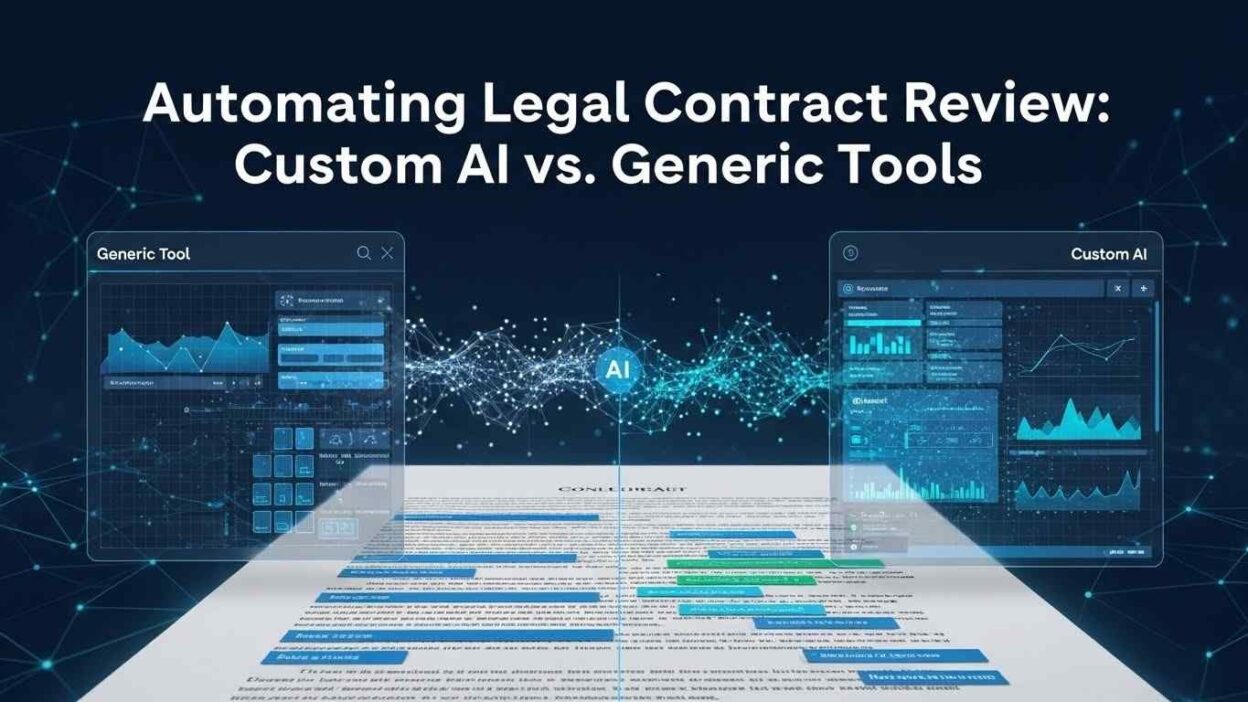
The choice between custom and generic AI contract review software depends on multiple factors. Organization size plays a significant role in the decision. Contract volume and complexity also influence the analysis.
Cost Considerations
Generic solutions offer lower entry costs. Monthly subscriptions typically range from hundreds to low thousands of dollars. Annual commitments often provide discounts.
Custom AI contract review software requires substantial upfront investment. Development costs start in the six-figure range for basic systems. Complex implementations can exceed seven figures.
Total cost of ownership tells a more complete story. Generic tools accumulate subscription costs over years. Custom solutions spread development costs across longer timeframes.
Return on investment calculations must consider efficiency gains. Custom systems deliver greater time savings for high-volume users. Generic tools may suffice for lower contract volumes.
Performance and Accuracy
Accuracy rates vary significantly between solution types. Generic AI contract review software typically achieves 70-80% accuracy on standard contracts. Performance drops on specialized or complex agreements.
Custom solutions achieve 90-95% accuracy within their trained domains. The system understands nuances specific to the organization. False positive rates remain minimal.
Processing speed differs based on system architecture. Generic tools share computing resources across all users. Custom solutions often provide dedicated infrastructure for faster processing.
Learning capabilities show distinct patterns. Generic platforms improve slowly through broad user feedback. Custom systems rapidly incorporate organization-specific corrections.
Flexibility and Adaptability
Generic solutions offer limited customization options. Users typically choose from pre-defined settings and templates. Fundamental analysis logic remains fixed.
Custom AI contract review software provides complete control over functionality. Organizations define exactly how contracts get analyzed. Rules and preferences match specific requirements perfectly.
Update cycles differ between approaches. Generic tools receive periodic updates from vendors. Custom systems update on schedules determined by the organization.
Industry changes require different response approaches. Generic vendors prioritize updates affecting broad user bases. Custom solutions can immediately adapt to organization-specific needs.
Industry-Specific Applications
Different industries face unique contract review challenges. Healthcare organizations navigate complex regulatory frameworks. Technology companies deal with rapidly evolving licensing models.
Legal Services and Law Firms
Large law firms increasingly adopt AI contract review software for commodity work. Due diligence projects involve reviewing hundreds of contracts. Automation dramatically reduces the time required.
Mid-sized firms struggle with the custom versus generic decision. Practice area specialization may justify custom solutions. General practice firms often choose generic tools.
Boutique firms specializing in specific industries benefit from custom systems. The investment pays off through competitive differentiation. Faster turnaround attracts more clients.
Corporate Legal Departments
In-house legal teams face constant pressure to do more with less. Headcount remains flat while contract volumes grow. AI contract review software becomes essential for managing workload.
Multinational corporations often require custom solutions. Multiple jurisdictions create complex requirements. Generic tools cannot handle the necessary sophistication.
Smaller corporate departments may find generic tools sufficient. Standard vendor agreements and employment contracts work well. Cost considerations favor subscription-based solutions.
Financial Services
Banks and investment firms handle extremely complex agreements. Regulatory compliance requirements demand meticulous review. Custom AI contract review software provides necessary precision.
Loan documentation requires specialized analysis capabilities. Generic tools miss industry-specific risk factors. Custom solutions understand financial terminology and structures.
Audit trails and documentation standards drive technology choices. Regulators expect detailed records of contract review processes. Custom systems can provide required documentation automatically.
Healthcare and Life Sciences
Healthcare contracts involve unique regulatory considerations. HIPAA compliance affects vendor agreements. Research contracts contain specialized intellectual property provisions.
Generic AI contract review software often fails in healthcare contexts. Medical terminology and regulatory requirements exceed standard capabilities. False positives overwhelm review teams.
Custom solutions trained on healthcare documents perform significantly better. The system recognizes relevant compliance issues accurately. Risk assessment aligns with industry standards.
Implementation Strategies
Successful deployment of AI contract review software requires careful planning. Organizations must assess current processes before selecting technology. Change management determines whether adoption succeeds or fails.
Assessing Organizational Readiness
Current contract volumes provide a baseline for requirements analysis. Organizations should track how many contracts get reviewed monthly. Document types and complexity levels need identification.
Existing technology infrastructure influences implementation approaches. Document management systems must integrate with the AI platform. Legacy systems may require updates or replacements.
Team capabilities affect training and adoption timelines. Tech-savvy legal teams adapt more quickly to new tools. Traditional practices may need more extensive change management support.
Budget availability shapes the custom versus generic decision. Organizations with limited resources start with generic solutions. Those with larger budgets can consider custom development.
Selecting the Right Approach
Risk tolerance influences the technology choice. Conservative organizations prefer proven generic solutions. Innovative firms embrace custom development for competitive advantage.
Contract complexity drives solution requirements. Standard agreements work fine with generic AI contract review software. Specialized contracts demand custom functionality.
Volume considerations determine return on investment potential. High-volume users justify custom development costs. Lower volumes favor subscription-based generic tools.
Strategic importance of contracts affects decision-making. Mission-critical agreements warrant investment in custom solutions. Routine contracts can use generic platforms.
Deployment Best Practices
Pilot programs test technology before full deployment. Organizations should select representative contract samples. Results inform broader implementation decisions.
Training programs ensure successful adoption. Legal teams need hands-on practice with the system. Technical support must be readily available during rollout.
Integration with existing workflows minimizes disruption. The AI contract review software should fit naturally into current processes. Forced workflow changes create resistance and slow adoption.
Feedback loops drive continuous improvement. Users should report issues and suggest enhancements. Regular updates incorporate lessons learned from actual usage.
Measuring Success and ROI
Organizations must track metrics to evaluate AI contract review software performance. Quantitative measurements provide objective assessment. Qualitative feedback captures user satisfaction.
Key Performance Indicators
Time savings represent the most obvious metric. Organizations should measure hours spent per contract before and after implementation. Reduction percentages demonstrate efficiency gains.
Accuracy rates indicate system reliability. Tracking false positives and missed issues provides insight. Comparison against manual review establishes baseline performance.
Cost per contract reviewed shows financial impact. Total expenses divided by contract volume yields this metric. Trends over time reveal whether efficiency improves.
User adoption rates signal acceptance and effectiveness. Login frequency and feature usage indicate engagement levels. Low adoption suggests problems requiring attention.
Calculating Return on Investment
Generic AI contract review software ROI calculations start with subscription costs. Monthly or annual fees represent the investment side. Time savings multiplied by hourly rates show returns.
Custom solution ROI must account for development expenses. Initial investment gets amortized over expected system lifespan. Ongoing maintenance costs factor into the calculation.
Opportunity costs deserve consideration in ROI analysis. Faster contract review enables more deals to close. Revenue generated from additional transactions represents real value.
Risk reduction provides harder-to-quantify benefits. Improved contract review catches more problematic provisions. Avoided litigation and disputes create substantial value.
Long-Term Value Assessment
Technology improvements compound over time. AI contract review software gets smarter with usage. Initial performance represents minimum capability.
Competitive positioning affects long-term value. Organizations using advanced tools win business from slower competitors. Market share gains create ongoing returns.
Scalability benefits emerge as organizations grow. The same AI contract review software handles 10x volume increases. Headcount requirements grow much more slowly than workload.
Future Trends in Contract Review Automation
Artificial intelligence technology continues advancing rapidly. Contract review capabilities will improve significantly. Organizations must prepare for coming changes.
Emerging Technologies
Natural language generation will create draft responses to contract issues. The AI will suggest alternative language automatically. Negotiation becomes faster and more efficient.
Blockchain integration may provide contract verification capabilities. Smart contracts will require AI analysis of underlying code. New skills and tools become necessary.
Multilingual capabilities will expand global reach. AI contract review software will analyze agreements in dozens of languages. Translation accuracy will improve dramatically.
Real-time collaboration features will connect dispersed teams. Attorneys in different locations will review contracts simultaneously. The AI will coordinate input from multiple reviewers.
Regulatory Developments
Privacy regulations affect AI contract review software development. GDPR and similar laws constrain data usage. Compliance requirements influence system design.
Professional responsibility rules are adapting to AI usage. Bar associations provide guidance on attorney oversight requirements. Standards continue evolving as technology advances.
Industry-specific regulations create compliance obligations. Financial services face different rules than healthcare organizations. AI systems must accommodate varied requirements.
Market Evolution
Vendor consolidation will reshape the AI contract review software landscape. Smaller players will merge or exit the market. Dominant platforms will emerge in different segments.
Pricing models will evolve as competition intensifies. Subscription costs may decrease as technology matures. Usage-based pricing might replace fixed fees.
Custom development will become more accessible. Low-code platforms will enable easier customization. The line between custom and generic solutions will blur.
Making the Decision: Custom or Generic?
Organizations face important choices about AI contract review software. The decision carries long-term consequences. Careful analysis leads to better outcomes.
Decision Framework
Start by assessing contract volume and complexity. High volumes of specialized contracts favor custom solutions. Lower volumes of standard agreements work with generic tools.
Evaluate available budget realistically. Custom development requires substantial investment. Generic subscriptions fit tighter budgets.
Consider organizational technical capabilities. Custom solutions demand ongoing technical support. Generic tools require minimal maintenance.
Assess competitive dynamics in your market. Fast turnaround times may justify custom investment. Stable markets allow generic solutions to suffice.
Hybrid Approaches
Some organizations combine custom and generic solutions. Standard contracts use generic AI contract review software. Specialized agreements get custom analysis.
Phased implementation reduces risk and cost. Organizations start with generic tools to prove value. Success justifies investment in custom development.
Vendor partnerships offer middle-ground options. Some vendors customize their generic platforms for specific clients. This approach balances cost and functionality.
Getting Started
Begin with clear objectives and success criteria. Define what problems need solving. Establish metrics for measuring improvement.
Research available solutions thoroughly. Request demonstrations from multiple vendors. Test systems with representative contract samples.
Consult with experienced users and industry peers. Learn from others’ successes and failures. Avoid repeating known mistakes.
Plan for change management from the start. Technology alone does not guarantee success. People and processes must adapt together.
Frequently Asked Questions
What is AI contract review software?
AI contract review software uses artificial intelligence to analyze legal contracts automatically. The technology identifies key terms, flags risks, and extracts important information. Legal teams use these tools to review agreements faster and more consistently.
How accurate is AI contract review software?
Accuracy varies by solution type and use case. Generic tools typically achieve 70-80% accuracy on standard contracts. Custom solutions reach 90-95% accuracy within trained domains. Human oversight remains necessary for all AI-assisted reviews.
Can AI completely replace lawyers in contract review?
No technology cannot fully replace legal professionals. AI contract review software assists attorneys rather than replacing them. Judgment, strategy, and client counseling still require human expertise. The technology handles routine analysis while lawyers focus on complex issues.
How much does AI contract review software cost?
Generic solutions typically charge monthly subscriptions from $500 to $5,000. Enterprise plans can exceed $10,000 monthly. Custom development starts around $100,000 and can reach several million dollars. Costs depend on features, volume, and complexity requirements.
How long does implementation take?
Generic AI contract review software deploys in 2-4 weeks typically. Setup involves configuration and basic training. Custom solutions require 6-18 months for development and deployment. Timeline depends on scope, complexity, and organizational readiness.
What types of contracts work best with AI review?
Routine agreements like NDAs and vendor contracts work extremely well. Employment agreements and standard service contracts also perform well. Complex, highly negotiated deals require more human involvement. Specialized industry contracts benefit from custom training.
Is my contract data secure with AI review tools?
Reputable vendors implement strong security measures. Data encryption, access controls, and regular audits protect information. Organizations should review vendor security certifications carefully. Custom solutions allow complete control over data security.
Can AI contract review software integrate with existing systems?
Most modern tools offer integration capabilities. Generic solutions connect with common document management platforms. Custom AI contract review software provides deep integration with any system. API availability determines integration depth.
What happens when the AI makes mistakes?
All systems include human review checkpoints. Attorneys verify AI findings before finalizing reviews. Quality control processes catch errors. Systems learn from corrections to improve future performance.
Do I need technical expertise to use AI contract review software?
Generic solutions require minimal technical knowledge. User interfaces prioritize simplicity and ease of use. Custom systems may need technical support for maintenance. Training programs help teams use tools effectively.
Read more:-Intelligent Document Processing with AI: Real Use Cases for Back Office Automation
Conclusion
The choice between custom and generic AI contract review software shapes legal operations significantly. Organizations must carefully evaluate their specific needs and circumstances. Volume, complexity, and budget all influence the optimal decision.
Generic tools provide accessible entry points for automation. Smaller firms and lower-volume users benefit from subscription models. Standard contracts receive adequate analysis at reasonable costs. Quick deployment enables fast value realization.
Custom AI contract review software delivers superior performance for specialized needs. High-volume users justify development investments through efficiency gains. Industry-specific requirements demand tailored solutions. Competitive advantages emerge from customization.
Most organizations should start with a pilot program. Testing proves value before committing significant resources. Success metrics guide expansion decisions. Learning from initial deployment improves broader implementation.
The legal industry continues evolving rapidly. Technology adoption accelerates across all practice areas. AI contract review software becomes essential rather than optional. Organizations that hesitate risk falling behind competitors.
Future developments will expand capabilities further. Natural language generation will automate more tasks. Integration depth will increase across legal technology stacks. Performance improvements will continue as systems learn.
Investment in AI contract review software represents investment in organizational capability. The technology enables legal teams to handle growing workloads. Quality improves while costs decrease. Strategic advantages accrue to early adopters.
Success requires more than just technology selection. Change management determines whether teams actually use new tools. Training programs ensure effective adoption. Continuous improvement processes maximize long-term value.
Organizations should act now to evaluate options. The competitive landscape rewards those who move decisively. Waiting for perfect solutions means missing current opportunities. Starting with available tools beats paralysis through over-analysis.
Whether choosing custom or generic solutions, the goal remains constant. Legal teams need tools that help them work smarter and faster. AI contract review software delivers on that promise when selected and implemented thoughtfully. The future of legal work depends on embracing these capabilities today.