Introduction
TL;DR Every business leader faces this question at some point. The company needs AI capabilities. Leadership wants results. The budget is real but finite. Two paths appear. Build an internal team or hire an AI agency. Neither answer works for every company. The right choice depends on your goals, your timeline, your existing talent, and how central AI is to your core business.
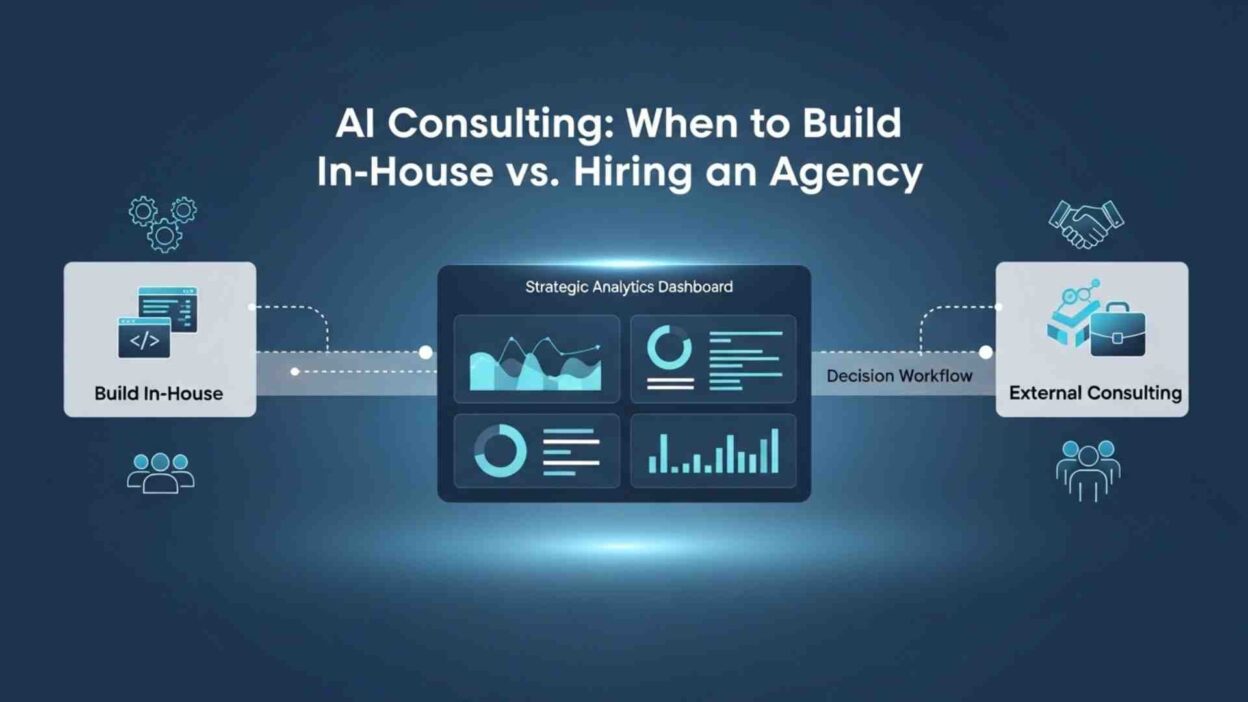
AI consulting build in-house vs agency is one of the most consequential decisions a company makes on its AI journey. Get it right and you accelerate transformation. Get it wrong and you burn budget, lose time, and fall behind competitors who made the smarter call.
This blog breaks down the full picture. You will understand the real costs, the hidden tradeoffs, and the signals that point clearly toward one path or the other. By the end, you will have the framework to make this decision with confidence.
Table of Contents
Understanding the Core Decision: What You Are Really Choosing
More Than a Budget Decision
Most leaders frame AI consulting build in-house vs agency as a cost question. In-house costs more upfront. Agencies cost more per project. This framing misses the deeper factors that determine long-term success.
The real decision is about control, speed, and strategic leverage. Building in-house gives you full control over your AI roadmap. You own the models, the data pipelines, and the institutional knowledge your team develops. This control matters when AI sits at the core of your competitive advantage.
Hiring an agency gives you speed. A skilled AI agency brings proven frameworks, experienced teams, and battle-tested deployment patterns. They deliver results in weeks that an internal team might take months to reach. This speed matters when market conditions demand rapid movement or when AI is a capability you need rather than your primary differentiator.
The AI consulting build in-house vs agency decision also carries talent implications. Building internally means recruiting data scientists, ML engineers, and AI product managers in a brutally competitive market. Hiring an agency means accessing that talent without the recruiting cost, the retention risk, or the long onboarding timeline. Both paths carry distinct risks that leaders must understand before committing.
What Makes This Decision Harder Today
The AI landscape changes faster than any previous technology shift. A tool that was cutting-edge six months ago is commonplace today. This pace creates pressure to move quickly. Companies that take twelve months to build an internal AI team often find the technology has shifted by the time the team is operational.
At the same time, AI has become genuinely strategic for most industries. Healthcare organizations use AI for diagnostic support. Retailers use it for demand forecasting. Financial services firms use it for fraud detection. When AI is strategic, outsourcing it entirely carries its own risks. An agency builds your AI capability today but may not be there to evolve it tomorrow.
The best leaders acknowledge both pressures. They do not romanticize building in-house as the only path for serious companies. They do not dismiss agencies as temporary fixes. They analyze the AI consulting build in-house vs agency question with clear eyes and data-driven judgment.
The Case for Building AI Capabilities In-House
When In-House Makes Strategic Sense
Building an internal AI team makes strong sense under specific conditions. The first condition is strategic centrality. If AI is the core of your product or service, you must own it. A company building an AI-powered product cannot outsource the intelligence that drives the product. Competitors will out-innovate you. Customers will notice the difference.
The second condition is proprietary data advantage. Many companies hold unique datasets that create competitive moats. A logistics company with ten years of delivery route data has an asset no agency can replicate. An internal team can build models on that data. They understand its nuances, its gaps, and its update cycles. They extract value from the data that an external team would take months to even understand.
The third condition is long-term investment horizon. Internal teams become more valuable over time. They accumulate domain knowledge. They understand the company’s systems, culture, and strategic priorities. A senior ML engineer with three years at your company is worth more to you than a fresh hire. The AI consulting build in-house vs agency tradeoff favors in-house when you can afford to wait for this compounding effect.
The fourth condition is regulatory or security requirements. Some industries require tight control over how AI handles sensitive data. Financial services, healthcare, and defense organizations often cannot share proprietary data with external vendors. An internal team operates within your security perimeter. An agency operates within theirs, creating data transfer risks that compliance teams cannot always accept.
Real Costs of Building In-House
In-house AI development carries significant costs that leaders sometimes underestimate. Recruiting alone is expensive. A senior machine learning engineer commands a base salary between one hundred fifty thousand and two hundred fifty thousand dollars annually in most US markets. Add benefits, equity, and recruiting fees and the total cost of hiring one engineer exceeds three hundred thousand dollars in the first year.
Building a functional AI team requires more than one engineer. You need data engineers to build pipelines, ML engineers to train models, ML ops engineers to deploy and monitor systems, and product managers who understand AI capabilities and limitations. A minimum viable internal AI team costs over one million dollars annually in salary alone.
Time is the hidden cost. A team hired in January rarely produces production-ready AI systems before September. Recruiting, onboarding, codebase familiarization, and initial project scoping all consume time before a single model trains. Companies with urgent timelines often cannot absorb this delay. The AI consulting build in-house vs agency comparison must include this time cost explicitly.
Infrastructure costs add another layer. Cloud computing for model training and inference, data storage, MLOps tooling, and experimentation platforms collectively add hundreds of thousands of dollars annually. Internal teams need this infrastructure. Agencies already have it and spread the cost across multiple clients.
Talent Retention and the Risk of Team Attrition
Building an internal team creates a talent retention challenge. AI professionals receive aggressive recruiting outreach constantly. A data scientist you spent six months recruiting and six months onboarding may receive a competing offer with a 30 percent salary increase within eighteen months. When they leave, institutional knowledge walks out the door.
Some companies mitigate attrition with strong equity packages, compelling mission statements, and genuine technical challenges. Companies where AI is the product often retain technical talent well because the work is intellectually engaging. Companies where AI supports the core product, rather than being the product, struggle more with retention.
Plan for attrition in your AI strategy. Document model architectures, training procedures, and deployment configurations thoroughly. Build processes that transfer knowledge across team members. A team that relies entirely on one or two irreplaceable individuals creates existential project risk.
The Case for Hiring an AI Consulting Agency
When an Agency Is the Right Choice
An AI consulting agency accelerates your AI journey in ways internal teams cannot match early on. Agencies bring immediate capability. They arrive with experienced data scientists, ML engineers, and AI strategists who have solved similar problems for other clients. They do not need six months of onboarding. They get to work in week one.
AI consulting build in-house vs agency comparisons often overlook what agencies bring beyond execution. A strong agency brings perspective. They have seen what works and what fails across dozens of industries and use cases. They shortcut the experimentation cycle that internal teams must go through from scratch. This accumulated wisdom has real dollar value.
Companies in their first year of AI adoption almost always benefit from agency partnerships. The learning curve for AI is steep. Internal teams make expensive mistakes learning it. An agency compresses that learning curve dramatically. The investment in agency fees often costs less than the cost of internal team mistakes during the same period.
Agencies also provide flexibility that internal teams cannot match. Need twenty data scientists for a six-month project and two afterward? An agency scales to your need. An internal team cannot scale this way. Hiring twenty people for a six-month project and then laying off eighteen is a legal, reputational, and operational nightmare.
The AI consulting build in-house vs agency calculation also changes when the project scope is well-defined and time-bounded. A company that needs a demand forecasting model for one product line has a discrete problem with a clear endpoint. An agency can scope, build, deploy, and hand off this solution efficiently. Building an internal team for a single well-defined project rarely makes economic sense.
What to Look for in an AI Consulting Agency
Not all AI agencies deliver equal value. The market for AI consulting has exploded. Many firms claim AI expertise without the depth to back it up. Evaluating agencies carefully protects your investment.
Ask for case studies from your specific industry. An agency that has built demand forecasting models for retail clients understands the nuances of seasonal data, promotional spikes, and inventory constraints. Generic AI experience does not transfer cleanly to specialized domains. Specific experience matters enormously.
Evaluate the agency’s model deployment and maintenance practices. Building a model is only half the work. Deploying it into production, monitoring it for drift, and retraining it as data changes requires ongoing engineering commitment. Agencies that focus only on model building and hand off deployment to your team create a dangerous capability gap.
Assess knowledge transfer practices. A strong agency documents everything. They teach your team as they build. They leave the organization with more internal capability than it had when they arrived. An agency that hoards knowledge to maintain dependency is not a strategic partner. The AI consulting build in-house vs agency decision shifts toward agencies that genuinely invest in client capability growth.
Common Mistakes When Hiring an AI Agency
Companies make predictable mistakes when engaging AI agencies. The first is choosing based on price alone. The cheapest agency rarely delivers the best outcomes. Underpriced AI work often means junior staff, minimal documentation, and fragile systems that break six months after delivery.
The second mistake is failing to define success metrics before the engagement starts. An agency without clear success criteria optimizes for the wrong things. Define what good looks like before signing a contract. Write the metrics into the statement of work. Hold the agency accountable to measurable outcomes.
The third mistake is treating the agency as a black box. Leaders who disengage from agency projects during execution lose visibility into the work. They receive deliverables they do not understand. They cannot evaluate quality. They cannot course-correct when the approach drifts from the business need. Assign an internal owner who stays engaged with the agency throughout the project.
A Hybrid Approach: The Best of Both Paths
Starting With an Agency and Building Internal Capability
Many successful companies start their AI journey with an agency and build internal capability in parallel. This hybrid approach captures the speed advantage of agency work while investing in the long-term control advantage of internal expertise.
The agency delivers a working AI system quickly. Internal hires learn from the agency during the engagement. Documentation from the agency becomes the knowledge base for the internal team. When the agency engagement ends, the internal team can operate, maintain, and evolve the system.
AI consulting build in-house vs agency does not have to be an either-or choice. The hybrid model uses agency expertise to accelerate the internal team’s growth. The internal team focuses on the AI problems that are core to the business. The agency handles adjacent problems or provides specialized expertise that the internal team lacks.
Budget the hybrid approach carefully. Running an agency engagement while building an internal team simultaneously is expensive. Companies that try to do both at scale simultaneously often find costs spiral beyond projections. Start with a focused agency engagement on one high-value use case. Hire one or two strong internal AI leads during this engagement. Hand off ownership at the end of the agency project. Repeat for the next use case with more internal capability.
Creating a Long-Term AI Talent Strategy
Whether you start with an agency or build internal from day one, every organization needs a long-term AI talent strategy. The market for AI talent will remain competitive for the foreseeable future. Organizations that create compelling environments for AI professionals retain them.
Compelling environments include genuine technical challenges, access to large and interesting datasets, clear career progression paths, strong management, and competitive compensation. Companies that check all five boxes attract and retain excellent AI talent even against competition from tech giants.
Partner with universities and bootcamps for a talent pipeline. Sponsor research projects at local universities. Hire PhD students for internships. Build relationships with AI bootcamp graduates who bring applied skills and hunger to prove themselves. Diversifying the talent pipeline reduces dependency on the hyper-competitive senior ML engineer market.
How to Make the Final Decision
A Framework for Choosing the Right Path
Use a structured framework to evaluate AI consulting build in-house vs agency for your specific situation. Answer four key questions honestly before deciding.
First, how central is AI to your competitive advantage? If AI is your product or your primary differentiator, build internal. If AI is a capability that supports your core business, agency work is a strong option for early projects.
Second, what is your timeline? If you need results in three to six months, an agency is likely the only viable path. If you can invest twelve to eighteen months before expecting significant output, internal development becomes realistic.
Third, what is your budget for talent? If you can invest over one million dollars annually in AI salaries for three or more years, internal development makes financial sense. If your budget is under five hundred thousand dollars annually, agency partnerships deliver more value per dollar.
Fourth, what is your data situation? If you hold proprietary data that creates genuine competitive advantage, internal teams extract more value from it over time. If your data is similar to what many companies have, agency expertise in building with standard datasets gives you a faster path to value.
The AI consulting build in-house vs agency decision becomes clear when you answer these four questions honestly. Most companies find the answers point strongly in one direction. A few find genuine ambiguity that makes the hybrid approach the right call.
Frequently Asked Questions
How much does it cost to build an in-house AI team?
A minimum viable in-house AI team costs between one million and two million dollars annually in salary and benefits. This covers a data engineer, two ML engineers, an ML ops engineer, and a technical AI lead. Add infrastructure, tooling, and recruiting costs and the total first-year investment often reaches two and a half million dollars. AI consulting build in-house vs agency cost comparisons must account for this full picture, not just base salaries.
How much do AI consulting agencies typically charge?
AI agency fees range widely based on scope, expertise, and geography. Project-based engagements for a focused AI use case typically run between one hundred thousand and five hundred thousand dollars. Retainer relationships for ongoing AI development cost between fifty thousand and two hundred thousand dollars per month for a dedicated team. Premium agencies with deep industry specialization charge at the top of these ranges and often deliver the strongest return on investment.
Can a small company afford to build AI in-house?
Most small companies cannot afford to build a full in-house AI team in the early stages. A stronger path is partnering with an agency for initial projects while hiring one strong internal AI lead to manage the relationship and absorb knowledge. As revenue grows and AI becomes more central to the business, the internal team can expand. The AI consulting build in-house vs agency decision for small companies almost always favors agency partnerships at the start.
How long does it take to build an effective in-house AI team?
Recruiting, hiring, and onboarding a functional AI team takes nine to eighteen months from the decision to start. The team then needs three to six months of ramp-up before producing production-ready systems. Realistically, companies should expect two years from the decision to build in-house before the team operates at full effectiveness. This timeline is a central factor in the AI consulting build in-house vs agency evaluation for time-sensitive initiatives.
What should a company do first — hire an agency or build internal?
For most companies, starting with an agency on a well-defined first AI project is the smarter move. The agency delivers fast results, builds organizational confidence in AI, and generates learnings that inform the internal team strategy. Use the agency engagement to hire your first internal AI lead. By the end of the agency project, you have a working AI system and the foundation of an internal team. This sequence makes the AI consulting build in-house vs agency decision a progression rather than a binary choice.
Read More:-How Much Does it Cost to Build a Custom AI Agent System?
Conclusion
AI capability is no longer optional for competitive businesses. The question is not whether to invest in AI. The question is how. AI consulting build in-house vs agency is the central strategic decision that shapes the speed, cost, and quality of your AI outcomes.
Building in-house creates long-term control and compounding knowledge. It protects proprietary data. It aligns AI development with your strategic roadmap. It builds organizational capability that appreciates in value over time. These advantages are real. They come with real costs in time, money, and talent competition.
Hiring an AI agency delivers speed, flexibility, and immediate expertise. It lets you move fast without the recruiting timeline. It gives you access to professionals who have solved your exact problem for other clients. It provides flexibility that internal teams cannot match when project needs are variable.
The hybrid approach combines both advantages. Start with an agency. Build internal capability in parallel. Hand off ownership at the right moment. Scale the internal team as AI becomes more central to your business. This progression makes AI consulting build in-house vs agency a journey rather than a single decision.
The companies that win with AI are not always the ones with the biggest internal teams or the most expensive agency contracts. They are the ones that make clear-eyed decisions aligned with their specific circumstances. Use the framework in this blog. Answer the four key questions. Choose the path that serves your business. Then execute without looking back.