Introduction: The Small Business Automation Challenge
TL;DR Small businesses face an impossible paradox in today’s competitive marketplace. Customers expect enterprise-level service experiences. Competitors leverage advanced technologies for operational advantages. Market conditions demand maximum efficiency. Resources remain perpetually limited.
Manual processes consume valuable time that owners could spend growing their companies. Administrative tasks pile up endlessly. Customer inquiries need responses during evenings and weekends. Data entry errors create costly problems. Employee burnout threatens team stability.
AI automation for small business operations offers solutions that once required massive technology budgets. Cloud platforms deliver sophisticated capabilities at affordable prices. Implementation no longer demands technical expertise. Small companies access tools previously reserved for corporations.
The automation landscape has transformed dramatically over recent years. User-friendly interfaces replace complex programming requirements. Subscription pricing eliminates prohibitive upfront costs. Pre-built templates accelerate deployment timelines. Success becomes achievable for businesses of all sizes.
Budget constraints create legitimate concerns for small business owners. Every dollar invested must demonstrate clear returns. Technology experiments that fail waste precious resources. Risk management becomes critical for survival.
AI automation for small business operations delivers measurable value when implemented strategically. Proper planning identifies high-impact opportunities. Phased approaches minimize financial exposure. Quick wins build momentum for broader initiatives. Smart businesses automate systematically rather than haphazardly.
This comprehensive guide provides a practical roadmap for small business automation. You’ll discover specific steps that control costs while delivering results. Real-world examples demonstrate achievable outcomes. Budget-conscious strategies ensure sustainable growth.
Table of Contents
Understanding AI Automation Basics
What Small Businesses Need to Know
Artificial intelligence sounds intimidating to many small business owners. Technical jargon creates unnecessary confusion. The reality proves far more accessible than most people imagine.
AI automation for small business operations simply means using smart software to handle repetitive tasks. The technology learns from examples and improves over time. Decisions happen based on data patterns rather than rigid rules. Human intervention decreases as systems mature.
Machine learning algorithms identify trends that humans might miss. Customer behavior patterns reveal optimization opportunities. Sales forecasting becomes more accurate through historical analysis. Inventory management improves through demand prediction.
Natural language processing enables computers to understand human communication. Customer emails receive appropriate responses automatically. Chatbots handle common questions without human assistance. Voice commands control various business functions easily.
Why Budget-Conscious Automation Matters
Large corporations invest millions in custom automation solutions. Small businesses cannot compete using similar approaches. Smart technology selection becomes the great equalizer.
Modern cloud-based platforms offer enterprise capabilities at small business prices. Monthly subscriptions replace massive capital expenditures. Scalability allows starting small and expanding gradually. Risk decreases when financial commitments remain manageable.
AI automation for small business operations delivers disproportionate value compared to investment levels. A single automated workflow might save ten hours weekly. Those hours redirect toward revenue-generating activities. ROI materializes quickly when implementation targets the right processes.
Free trials and freemium models enable testing before purchasing. Many platforms offer robust capabilities at no cost. Paid features unlock only when businesses need advanced functionality. Smart owners explore extensively before committing budgets.
Step One: Identifying Automation Opportunities
Auditing Current Operations
Effective automation begins with understanding existing workflows completely. Many business owners lack clear visibility into how time actually gets spent. Documentation reveals surprising insights about operational inefficiencies.
Spend one week tracking every repetitive task across your business. Note which activities consume the most time. Identify processes that happen on predictable schedules. Recognize tasks that frustrate employees through monotony.
Customer service inquiries often follow recognizable patterns. The same questions appear repeatedly. Similar issues require identical solutions. These scenarios present perfect automation opportunities.
Administrative functions typically involve substantial manual effort. Invoice processing, appointment scheduling, and data entry drain productivity. Mistakes happen frequently under manual conditions. Accuracy improves dramatically through automation.
Calculating Potential Time Savings
AI automation for small business operations justifies investment through time reclamation. Calculate current time expenditure for each identified task. Multiply hours by employee wage rates. The resulting numbers often shock business owners.
A receptionist spending two hours daily scheduling appointments represents significant cost. Automated scheduling systems handle this work for minimal monthly fees. The math becomes compelling quickly.
Email responses consuming three hours per day create another automation target. Template-based systems with smart customization reduce this dramatically. Saved time redirects toward customer relationship building.
Prioritize automation opportunities based on time savings and implementation difficulty. Quick wins with minimal complexity build confidence. Complex projects wait until experience and budget grow.
Step Two: Setting Realistic Budget Parameters
Understanding Cost Structures
AI automation for small business operations pricing varies widely across platforms and capabilities. Understanding different cost models helps budget allocation decisions.
Subscription-based pricing remains most common for cloud automation tools. Monthly or annual fees provide predictable expenses. Costs typically scale with usage volume or feature access. Budget forecasting becomes straightforward under subscription models.
Some platforms charge per transaction or action. Email automation might cost based on messages sent. Payment processing fees calculate as percentages of revenue. Variable costs align with business growth naturally.
Free tiers offer surprising functionality for many automation tools. Gmail and Google Workspace include powerful automation features. Social media platforms provide free scheduling capabilities. Creative businesses accomplish substantial automation without spending anything.
Establishing Your Automation Budget
Start by allocating a small percentage of monthly revenue toward automation initiatives. Three to five percent represents a reasonable beginning point. This approach ensures technology investment scales appropriately with business size.
Consider automation spending as an investment rather than an expense. Calculate expected time savings and efficiency gains. Project how recovered hours translate into additional revenue. ROI calculations justify budget allocations.
AI automation for small business operations delivers returns exceeding most marketing expenditures. A tool saving ten hours weekly at $25 hourly value returns $1,000 monthly. A $50 subscription generates 20x ROI. Few investments perform comparably.
Reserve budget for experimentation and learning. Not every automation attempt succeeds initially. Failed experiments provide valuable lessons. Budget flexibility enables pivoting when approaches don’t work.
Step Three: Choosing the Right Tools
Email Marketing Automation
Email remains one of the most effective customer communication channels. Manual email management becomes impossible as contact lists grow. Automation scales personalized communication affordably.
Mailchimp offers robust free plans for small businesses. Up to 500 contacts receive unlimited emails. Automated welcome sequences engage new subscribers. Behavioral triggers send relevant messages based on actions.
AI automation for small business operations within email platforms enables sophisticated segmentation. Customers receive content matching their interests and behaviors. Open rates improve through relevance. Conversions increase through timely messaging.
Abandoned cart emails recover lost sales automatically. Product recommendation engines suggest relevant items. Birthday and anniversary messages build customer relationships. Revenue grows without additional manual effort.
Customer Service Automation
Customer inquiries demand quick responses regardless of business hours. Small teams cannot provide 24/7 coverage manually. Chatbots fill this gap affordably.
Tidio provides free chatbot capabilities for basic customer service needs. Common questions receive instant automated answers. Complex inquiries route to human team members. Response times improve dramatically.
Knowledge base software like HelpScout offers free plans for documentation. Customers find answers independently through searchable articles. Support ticket volume decreases as self-service improves. Team capacity extends further.
AI automation for small business operations in customer service creates scalability impossible through hiring alone. One employee with automation tools handles volume requiring three manual workers. Labor costs decrease while service quality improves.
Social Media Management
Consistent social media presence drives business growth. Manual posting consumes time and mental energy. Scheduling tools automate distribution across platforms.
Buffer and Hootsuite offer free plans with limited posting capabilities. Content schedules weeks in advance. Multiple platforms publish from one interface. Social media consistency improves without daily effort.
AI-powered content suggestion tools identify trending topics. Posting time optimization increases engagement rates. Hashtag recommendations improve content discovery. Performance analytics inform strategy refinement.
Automated social listening monitors brand mentions. Customer feedback surfaces quickly. Reputation management becomes proactive rather than reactive. Small businesses compete effectively against larger competitors.
Step Four: Implementing Core Business Automation
Accounting and Invoicing
Financial management requires accuracy and timeliness. Manual bookkeeping creates error risks. Automated systems maintain clean records effortlessly.
Wave Accounting provides completely free accounting software for small businesses. Invoice generation, expense tracking, and financial reporting happen automatically. Bank connections import transactions without manual entry.
AI automation for small business operations extends to payment processing and reminders. Recurring invoices send automatically on schedules. Payment reminders reduce late payments. Cash flow improves through systematic collections.
Receipt scanning apps like Expensify digitize paper receipts automatically. Tax categorization happens through machine learning. Expense reports compile without tedious manual work. Bookkeepers save hours monthly.
QuickBooks and FreshBooks offer affordable paid options with advanced automation. Bank reconciliation completes automatically. Sales tax calculations apply correctly. Year-end tax preparation simplifies dramatically.
Appointment Scheduling
Calendar management consumes surprising amounts of time. Phone tag frustrates both businesses and customers. Automated scheduling eliminates this friction completely.
Calendly offers free scheduling for individual users. Customers book appointments through shareable links. Calendar conflicts disappear through real-time availability checking. Confirmation emails send automatically.
Acuity Scheduling and Square Appointments provide affordable options for service businesses. Class scheduling, resource allocation, and payment collection integrate seamlessly. No-show rates decrease through automated reminders.
AI automation for small business operations in scheduling extends to meeting coordination. Tools like Microsoft Bookings find optimal times across multiple participants. Travel time buffers prevent back-to-back conflicts. Productivity increases through better time management.
Video conferencing links generate automatically for virtual appointments. Meeting notes and follow-up tasks create through integrated tools. Client management becomes streamlined end-to-end.
Step Five: Marketing Automation Implementation
Lead Capture and Nurturing
Growing customer bases require systematic lead management. Manual follow-up fails under volume pressure. Automated nurturing converts prospects into customers.
Website form builders like Typeform capture lead information beautifully. Collected data flows into CRM systems automatically. No manual data entry occurs. Lead response happens instantly.
AI automation for small business operations enables sophisticated lead scoring. Engagement levels determine follow-up priority. Hot prospects receive immediate attention. Lukewarm leads enter nurture sequences.
Drip email campaigns educate prospects over time. Content delivers based on expressed interests. Educational materials build trust gradually. Sales conversations happen when prospects reach readiness.
HubSpot offers a robust free CRM with marketing automation capabilities. Contact management, email sequences, and deal tracking cost nothing. Paid tiers unlock advanced features as businesses grow.
Content Marketing Automation
Content creation drives inbound marketing success. Distribution across channels consumes significant time. Automation extends content reach efficiently.
Blog post scheduling through WordPress publishes content automatically. Social sharing plugins distribute articles across platforms. Email notifications alert subscribers to new content. Manual distribution becomes unnecessary.
Video marketing automation tools schedule YouTube uploads. Descriptions, tags, and thumbnails apply through templates. Subscriber notifications trigger at optimal times. Viewership grows through consistent publishing.
AI automation for small business operations includes content repurposing. Blog posts convert into social media snippets automatically. Podcast episodes generate multiple content pieces. Creation effort multiplies through smart automation.
Analytics dashboards consolidate performance data from all channels. Content effectiveness becomes visible quickly. Strategy adjustments happen based on actual results. Marketing ROI improves continuously.
Step Six: Sales Process Automation
Pipeline Management
Sales processes benefit enormously from systematic automation. Opportunities move through stages predictably. Follow-up happens consistently without relying on memory.
Free CRM systems like HubSpot or Zoho organize sales pipelines. Deal stages define clearly. Tasks generate automatically at each phase. Nothing falls through the cracks.
AI automation for small business operations reminds salespeople about follow-up timing. Optimal contact frequency improves conversion rates. Persistent outreach happens without feeling pushy. Close rates increase measurably.
Proposal generation automates through template systems. Customer information populates documents automatically. Professional quotes deliver quickly. Sales cycles compress through efficiency.
E-signature platforms like DocuSign or PandaDoc accelerate contract completion. Agreements sign electronically without printing or scanning. Turnaround times decrease from days to hours. Deals close faster.
Follow-Up Automation
Consistent follow-up separates successful salespeople from struggling ones. Manual tracking proves difficult across numerous prospects. Automation ensures systematic contact.
Email sequences trigger based on prospect actions. No responses activate additional touchpoints. Engagement signals escalate to sales calls. The system optimizes contact strategy automatically.
SMS automation reaches prospects through their preferred channel. Text messages see higher open rates than email. Short, timely messages drive action. Response rates improve dramatically.
AI automation for small business operations personalizes follow-up at scale. Messages reference specific conversations and interests. Recipients feel valued rather than mass-marketed. Relationships develop authentically through technology assistance.
Voice messages can pre-record and deliver automatically. Personal touches scale beyond manual capabilities. Prospects appreciate the effort. Differentiation from competitors becomes evident.
Step Seven: Operations and Workflow Automation
Document Management
Paper-based processes create bottlenecks and errors. Digital document workflows improve speed and accuracy. Cloud storage enables access from anywhere.
Google Workspace provides affordable document collaboration. Multiple team members edit simultaneously. Version control prevents confusion. Document history tracks all changes.
Automated document generation creates invoices, contracts, and reports. Templates populate with database information. Manual typing disappears completely. Error rates drop to nearly zero.
AI automation for small business operations includes intelligent filing systems. Documents tag and organize automatically. Search functionality finds information instantly. Digital clutter decreases dramatically.
Approval workflows route documents to stakeholders automatically. Electronic signatures replace wet signatures. Process completion accelerates significantly. Audit trails document every action.
Inventory Management
Product-based businesses struggle with inventory optimization. Stockouts cost sales. Excess inventory ties up capital. Manual tracking proves inadequate.
Inventory management software automates reorder processes. Stock levels trigger purchase orders automatically. Suppliers receive orders without manual intervention. Inventory stays optimal continuously.
Sales data integration adjusts inventory based on demand patterns. Seasonal variations factor into purchasing decisions. AI predicts future needs accurately. Working capital requirements decrease.
AI automation for small business operations extends to multi-channel inventory synchronization. Online and physical store quantities update in real-time. Overselling becomes impossible. Customer satisfaction improves through reliable fulfillment.
Barcode scanning eliminates manual counting and data entry. Receiving, picking, and shipping happen efficiently. Labor requirements decrease while accuracy improves. Operations scale without proportional cost increases.
Step Eight: Customer Relationship Automation
Loyalty Program Management
Repeat customers generate the highest profit margins. Loyalty programs encourage continued patronage. Manual program management proves tedious.
Automated loyalty platforms track purchases and reward points. Customers check balances through mobile apps. Redemption happens seamlessly at checkout. Engagement increases through gamification.
AI automation for small business operations personalizes loyalty rewards. Purchase history informs relevant offers. Birthday months trigger special promotions. Customers feel recognized individually.
Email automation announces point balances and reward opportunities. Expiring points prompt redemption action. Engagement rates climb through timely communication. Program value becomes tangible.
Referral programs automate completely through specialized platforms. Customers share unique links easily. Referred purchases credit both parties automatically. Acquisition costs decrease through systematic referrals.
Feedback Collection
Customer opinions guide business improvements. Manual feedback collection happens inconsistently. Automated systems gather insights systematically.
Post-purchase survey emails send automatically after defined periods. Simple rating scales reduce completion friction. Response rates improve through easy participation. Insights accumulate steadily.
Net Promoter Score tracking identifies promoters and detractors. Follow-up sequences differ based on ratings. Detractors receive service recovery outreach. Promoters get referral requests.
AI automation for small business operations analyzes feedback sentiment automatically. Positive and negative themes surface without manual review. Action priorities become data-driven. Customer satisfaction improves through responsive changes.
Online review monitoring alerts businesses to new feedback. Response templates ensure timely acknowledgment. Reputation management becomes proactive. Brand perception strengthens through attentive engagement.
Step Nine: Analytics and Reporting Automation
Performance Dashboard Creation
Business decisions require accurate, timely information. Manual report compilation delays insights. Automated dashboards provide real-time visibility.
Google Data Studio creates professional dashboards for free. Data sources connect from multiple systems. Metrics update automatically. Decision-makers access current information constantly.
AI automation for small business operations highlights anomalies requiring attention. Sudden metric changes trigger alerts. Problems surface before becoming serious. Proactive management replaces reactive firefighting.
Custom metrics track business-specific goals. Revenue, customer acquisition costs, and lifetime value appear clearly. Goal progress visualizes through charts and graphs. Strategy adjustments happen based on facts.
Automated report distribution emails stakeholders on schedules. Weekly summaries keep teams aligned. Monthly reviews inform strategic planning. Communication improves through systematic updates.
Financial Forecasting
Cash flow management determines small business survival. Accurate forecasting prevents crises. AI-powered tools predict financial futures.
Automated forecasting analyzes historical patterns and trends. Revenue predictions incorporate seasonality automatically. Expense projections consider growth plans. Financial planning becomes more reliable.
Scenario modeling explores different strategic choices. Growth investments compare against conservative approaches. Risk assessment improves through quantitative analysis. Decisions benefit from comprehensive evaluation.
AI automation for small business operations monitors key financial ratios continuously. Liquidity, profitability, and efficiency metrics alert to problems. Early warning systems prevent financial distress. Business stability increases through vigilant monitoring.
Integration with accounting systems ensures forecast accuracy. Actual results compare against projections automatically. Variances trigger analysis and adjustment. Forecasting precision improves over time.
Step Ten: Scaling and Optimization
Measuring Automation ROI
Successful automation requires continuous evaluation. Track specific metrics demonstrating value. Quantify time savings, error reductions, and revenue impacts.
Time logs before and after automation reveal efficiency gains. Document hours saved across all automated processes. Calculate labor cost savings based on wage rates. ROI calculations justify continued investment.
AI automation for small business operations reduces error rates measurably. Track mistake frequency before and after implementation. Quantify costs associated with errors. Quality improvements add substantial value.
Revenue attribution identifies automation contribution to growth. Improved customer response times increase conversions. Enhanced marketing follow-up boosts sales. Systematic processes enable scaling impossible manually.
Customer satisfaction scores indicate experience improvements. Survey results compare pre and post-automation. Retention rates demonstrate relationship quality. Lifetime value increases through better service.
Expanding Automation Gradually
Resist temptation to automate everything simultaneously. Phased expansion allows learning and adjustment. Each successful implementation builds capability.
Master current automation before adding complexity. Ensure team members use existing tools effectively. Address adoption challenges before moving forward. Solid foundations support advanced capabilities.
Identify the next highest-impact opportunity after initial successes. Apply lessons learned from previous implementations. Replication happens faster than initial deployments. Momentum builds through continuous progress.
AI automation for small business operations matures over months and years. Patience delivers better results than rushed execution. Sustainable growth requires methodical advancement. Long-term thinking produces superior outcomes.
Budget increases should follow proven results. Redirect savings from current automation toward new initiatives. Self-funding expansion maintains budget discipline. Growth becomes financially sustainable.
Common Challenges and Solutions
Technical Complexity Concerns
Many small business owners fear technical requirements. Perceived complexity prevents automation adoption. Modern tools eliminate most technical barriers.
No-code and low-code platforms enable automation without programming. Visual interfaces use drag-and-drop simplicity. Pre-built templates accelerate setup. Technical expertise becomes unnecessary.
AI automation for small business operations vendors provide extensive training resources. Video tutorials, documentation, and support forums assist users. Most platforms offer free onboarding sessions. Success resources abound.
Start with the simplest automation opportunities. Build confidence through early wins. Complexity tolerance grows with experience. Advanced capabilities become accessible gradually.
Partner with vendors offering strong customer support. Responsive assistance resolves issues quickly. Implementation success improves through expert guidance. Technology partnerships matter significantly.
Employee Resistance
Team members sometimes fear automation threatens their jobs. Change resistance slows adoption. Communication and involvement overcome objections.
Explain how automation eliminates tedious tasks. Emphasize opportunities for more interesting work. Frame technology as enablement rather than replacement. Perspective shifts reduce anxiety.
Involve employees in automation planning. Frontline workers understand process pain points. Their input improves implementation success. Ownership increases through participation.
AI automation for small business operations creates opportunities for skill development. Employees learn new technologies. Capabilities expand beyond manual tasks. Career growth happens through adaptation.
Celebrate automation successes publicly. Share time savings and improvements. Recognize team members embracing change. Positive reinforcement accelerates adoption.
Free and Low-Cost Automation Tools
Essential No-Cost Solutions
Budget-conscious businesses leverage free tools extensively. Surprising functionality exists without spending anything.
Gmail and Google Workspace include powerful automation features. Email filters, canned responses, and automated forwarding handle common tasks. Calendar automation coordinates scheduling. Documents collaborate in real-time.
Zapier’s free plan connects different applications. Simple workflows automate data transfer between systems. Five basic automations cost nothing. Complexity grows with paid plans.
AI automation for small business operations includes social media scheduling through Buffer’s free tier. Ten scheduled posts per platform maintain consistent presence. Analytics track engagement. Content strategy benefits from performance data.
Trello organizes projects and automates workflow progression. Cards move through stages automatically based on rules. Team coordination improves through visual boards. Project management scales without cost.
Affordable Paid Tools
Modest monthly investments unlock substantial automation capabilities. Strategic tool selection maximizes budget impact.
ActiveCampaign starts around budget-friendly pricing for marketing automation. Email campaigns, CRM functionality, and sales automation integrate completely. Small businesses access enterprise features affordably.
Calendly premium plans add team scheduling capabilities. Round-robin assignment distributes appointments. Payment collection integrates with scheduling. Professional service businesses benefit enormously.
AI automation for small business operations through platforms like Monday.com starts at reasonable monthly rates. Workflow automation, project tracking, and team collaboration combine effectively. Operational efficiency improves dramatically.
QuickBooks Online automates accounting comprehensively. Bank connections, invoicing, and expense tracking work seamlessly. Tax preparation simplifies substantially. Financial management professionalism increases.
Industry-Specific Automation Examples
Retail Business Automation
Retail operations involve inventory, sales, and customer service. Automation opportunities abound across all areas.
Point-of-sale systems integrate with inventory management. Stock levels decrease automatically with sales. Reorder alerts prevent stockouts. Multi-location synchronization maintains accuracy.
AI automation for small business operations in retail includes dynamic pricing. Algorithms adjust prices based on demand and competition. Profit margins optimize automatically. Revenue increases without manual intervention.
Customer segmentation enables targeted marketing. Purchase history informs personalized recommendations. Email campaigns promote relevant products. Conversion rates improve through relevance.
Service Business Automation
Service providers struggle with scheduling and client management. Automation eliminates coordination headaches.
Appointment booking systems let clients self-schedule. Calendar conflicts disappear through availability checking. Confirmation and reminder messages send automatically. No-show rates decrease substantially.
Service delivery checklists ensure consistency. Quality standards maintain across team members. Customer satisfaction improves through reliable experiences. Brand reputation strengthens.
AI automation for small business operations automates billing based on time tracking. Hours log automatically during service delivery. Invoices generate without manual calculation. Payment collection happens systematically.
Client feedback requests send after service completion. Reviews gather automatically. Testimonials populate marketing materials. Social proof accumulates effortlessly.
Professional Services Automation
Consultants, accountants, and lawyers benefit from document and workflow automation.
Client onboarding workflows guide information collection. Electronic forms replace paper questionnaires. Document uploads happen through secure portals. File organization automates completely.
Project management tools track deliverable progress. Milestone completion triggers next-phase activities. Client communications happen automatically. Project delivery becomes more predictable.
AI automation for small business operations includes time tracking and billing. Work logs automatically during billable activities. Invoices generate from tracked time. Revenue recognition happens accurately.
Research and knowledge management automate through document systems. Information retrieval accelerates through intelligent search. Expertise scales beyond individual memory. Service quality consistency improves.
Frequently Asked Questions
How much should a small business budget for automation?
Start with three to five percent of monthly revenue allocated toward automation tools. This modest investment delivers substantial returns through time savings and efficiency gains. Many businesses begin with free tools exclusively. Budget increases as automation proves value through measurable results. ROI typically appears within three to six months.
Can non-technical owners implement AI automation successfully?
Modern AI automation for small business operations requires zero technical expertise. Visual interfaces use simple drag-and-drop functionality. Pre-built templates handle common scenarios. Vendor support assists during setup. Thousands of non-technical owners successfully implement automation daily. Willingness to learn matters more than technical background.
Which business processes should we automate first?
Prioritize processes that consume the most time and happen most frequently. Customer communication, appointment scheduling, and email marketing represent common starting points. Repetitive data entry and administrative tasks deliver immediate ROI. Quick wins build momentum for broader automation initiatives. Success breeds organizational support.
How long does automation implementation typically take?
Simple automation deploys within days. Email marketing sequences might launch in a week. Appointment scheduling goes live almost immediately. Complex workflows involving multiple systems require several weeks. Most small businesses see meaningful benefits within thirty days. Sophistication grows gradually over months.
Will automation really work for my specific industry?
AI automation for small business operations applies across virtually all industries. Retail, service, professional, healthcare, and manufacturing businesses all benefit. Core processes like customer communication, scheduling, and billing automate universally. Industry-specific tools address unique requirements. Success stories exist in every business category.
Read More:-WhatsApp Business Automation Complete Guide 2025: 15 Workflows That Generate Revenue
Conclusion: Your Automation Journey Starts Now

Small businesses face unprecedented competitive pressures. Customer expectations continue rising. Operating costs increase steadily. Profit margins compress under market forces. Traditional manual operations cannot sustain growth.
AI automation for small business operations provides affordable solutions to these existential challenges. Technology once exclusive to large corporations now costs mere dollars monthly. Implementation complexity has decreased dramatically. Success becomes achievable regardless of technical expertise.
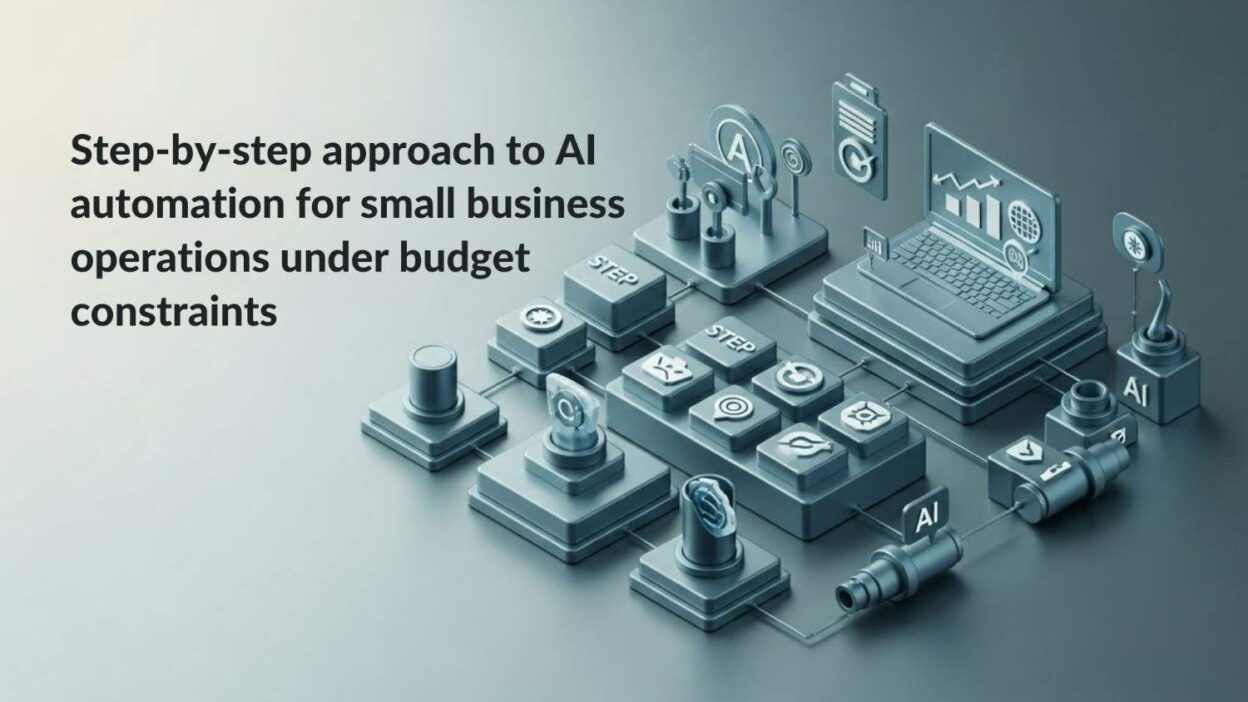
This step-by-step guide provides a practical roadmap. Identify high-impact opportunities through operational audits. Set realistic budgets aligned with business size. Choose appropriate tools matching specific needs. Implement systematically rather than haphazardly.
Budget constraints need not prevent automation adoption. Free tools deliver surprising functionality. Modest paid subscriptions unlock enterprise capabilities. ROI materializes quickly when implementations target the right processes. Financial risk remains minimal under phased approaches.
Starting small builds confidence and capability. Master email automation before tackling complex workflows. Perfect appointment scheduling before implementing full CRM systems. Each success creates momentum for the next initiative. Patience delivers superior long-term results.
Your competitors already explore automation opportunities. Customer expectations assume automated experiences. Market conditions reward operational efficiency. Delay creates disadvantages that compound over time.
The tools and strategies discussed throughout this guide represent proven approaches. Thousands of small businesses report transformative results. Implementation risks have decreased substantially. Success patterns emerge clearly across industries.
AI automation for small business operations improves more than just efficiency metrics. Employee satisfaction increases when tedious work disappears. Teams focus on activities utilizing their unique talents. Job fulfillment strengthens retention significantly.
Revenue impacts extend far beyond cost reduction. Faster customer response improves conversion rates. Consistent follow-up nurtures relationships systematically. Marketing effectiveness multiplies through automation. Growth accelerates without proportional expense increases.
Technology will only become more capable and accessible. Early adopters build advantages that multiply over time. Learning curves flatten through experience. Automation maturity separates thriving businesses from struggling competitors.
Take action immediately by auditing your current operations. Document time-consuming repetitive tasks. Calculate potential savings from automation. Research appropriate tools for your highest-priority needs.
Free trials enable risk-free exploration. Test multiple platforms before committing budgets. Evaluate ease of use and support quality. Choose partners positioned for long-term success.
Your transformed business operations await your decision. AI automation for small business operations makes dramatic improvement achievable under budget constraints. The technology exists today to revolutionize how you work.
Begin with a single automation project this week. Schedule one process for improvement. Research appropriate tools. Commit to implementation within thirty days. Momentum builds from that crucial first step.
Success requires commitment to continuous improvement. Monitor results rigorously. Optimize based on actual performance. Expand gradually as capabilities grow. Long-term thinking produces extraordinary outcomes.
The future belongs to businesses leveraging technology strategically. AI automation for small business operations represents one of the most impactful investments available. Small companies implementing these solutions position themselves for sustainable success. Your transformation begins now.