Introduction
TL;DR Running a mid-size SaaS company comes with mounting pressure. You need to scale operations without burning through capital. Your team works overtime handling repetitive tasks that drain productivity. Customer support tickets pile up faster than your agents can respond. Manual processes consume hours that could go toward innovation.
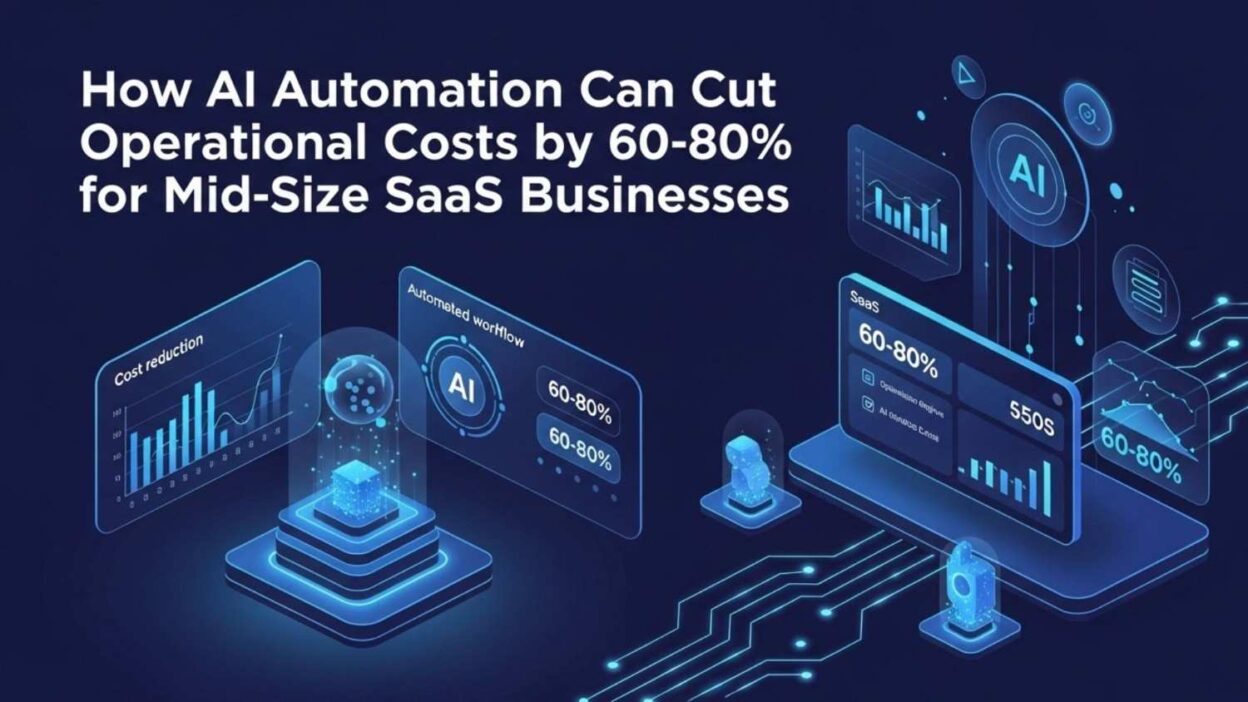
AI automation for mid-size SaaS businesses offers a solution that addresses these pain points directly. Companies implementing intelligent automation see operational cost reductions ranging from 60% to 80% within the first year. These aren’t just numbers on a spreadsheet. Real businesses transform their bottom line while improving service quality.
This blog explores how your SaaS company can leverage AI automation to slash costs while maintaining quality. You’ll discover specific strategies that work for businesses at your scale. We’ll examine real implementation pathways that deliver measurable ROI.
Table of Contents
Understanding the Cost Crisis in Mid-Size SaaS Operations
Mid-size SaaS companies occupy a challenging position in the market. You’ve grown past the startup phase but haven’t reached enterprise scale. This middle ground creates unique financial pressures that threaten profitability.
The Hidden Drain of Manual Processes
Your team spends approximately 40% of their workweek on repetitive tasks. Data entry consumes hours that skilled professionals could spend on strategic initiatives. Invoice processing takes days when it should take minutes. Employee onboarding requires weeks of manual coordination across departments.
These manual processes cost more than time. Human error rates in repetitive tasks average 5-7% across industries. Each mistake requires additional hours to identify and correct. Your team fixes problems instead of preventing them.
Scaling Challenges Without Proportional Revenue Growth
Revenue growth doesn’t always match operational demands in mid-size SaaS businesses. You add customers but need more support staff to serve them. New features require additional development resources. Marketing campaigns demand increased budget allocation.
The traditional solution involves hiring more people. Each new employee brings salary costs plus benefits, equipment, and training expenses. Your operational costs grow linearly while revenue growth remains unpredictable.
Customer Expectations vs. Available Resources
Modern SaaS customers expect instant responses and seamless experiences. They want 24/7 support availability without considering your staffing constraints. Product updates need to ship faster while maintaining zero bugs.
Meeting these expectations with traditional staffing models becomes financially impossible. Your support team can’t work around the clock. Developers need sleep. QA testing takes time.
What AI Automation Actually Means for SaaS Companies
AI automation represents more than chatbots and auto-responders. Modern AI systems handle complex decision-making that previously required human judgment. These tools learn from patterns and improve performance over time.
Beyond Basic Automation Tools
Traditional automation follows rigid if-then rules. Click this button, send that email. AI automation for mid-size SaaS businesses works differently. Machine learning models analyze context and adapt responses based on specific situations.
Your customer sends a support inquiry. AI automation reads the message, understands the technical issue, searches your knowledge base, and generates a relevant solution. The system handles edge cases that would stump rule-based automation.
Intelligence That Learns and Adapts
Every interaction makes AI systems smarter. Customer service bots improve response accuracy after analyzing thousands of conversations. Fraud detection models identify new threat patterns without manual programming updates.
This learning capability creates compounding value over time. Your investment today builds an asset that becomes more valuable tomorrow. Six months after deployment, AI automation for mid-size SaaS businesses operates significantly better than day one.
Integration With Existing SaaS Infrastructure
Modern AI tools connect seamlessly with your current tech stack. They plug into Salesforce, HubSpot, Slack, and other platforms your team already uses. No need to rip out existing systems and start fresh.
APIs enable AI automation to access data across your organization. Customer information flows from your CRM into automated workflows. Support ticket data feeds into predictive analytics models. Everything works together without creating data silos.
The 60-80% Cost Reduction Breakdown
Let’s examine where AI automation for mid-size SaaS businesses delivers the most significant cost savings. These percentages come from documented case studies across multiple companies in the SaaS sector.
Customer Support Automation: 50-70% Savings
Customer support represents one of the largest operational expenses for SaaS companies. AI-powered chatbots handle 60-80% of tier-one support inquiries without human intervention. These bots resolve password resets, billing questions, and basic troubleshooting instantly.
Your support team focuses on complex issues that require human expertise. Agent productivity increases because they’re not answering the same questions repeatedly. Customer satisfaction improves due to instant response times.
AI automation analyzes support tickets to identify common issues. The system suggests knowledge base articles or product improvements to reduce future ticket volume. This proactive approach prevents problems before customers encounter them.
Sales Process Optimization: 30-50% Savings
Sales teams waste approximately 65% of their time on non-selling activities. Manual data entry, meeting scheduling, and follow-up emails consume hours. AI automation eliminates these time sinks completely.
Intelligent systems qualify leads automatically based on behavioral data and firmographic information. Your sales reps only engage with prospects who match your ideal customer profile. Conversion rates increase while cost per acquisition decreases.
Email sequences personalize themselves based on prospect behavior. Someone downloads a pricing guide receives different messaging than someone who attended a webinar. AI automation for mid-size SaaS businesses creates custom journeys at scale.
Operations and Administration: 60-75% Savings
Back-office operations offer tremendous automation potential. Invoice processing that took three days completes in three minutes. Expense report approvals happen automatically based on policy rules and historical patterns.
Employee onboarding workflows trigger automatically when HR enters new hire information. The system provisions accounts, schedules training, and sends welcome materials without manual coordination. New employees become productive faster.
Data reconciliation across systems happens continuously instead of quarterly. AI automation identifies discrepancies and flags them for review. Your finance team catches errors before they impact reporting.
Product Development Efficiency: 40-60% Savings
AI automation accelerates software development through intelligent code review and testing. Automated systems scan every pull request for security vulnerabilities, performance issues, and code quality problems. Developers get instant feedback instead of waiting for manual review cycles.
Testing automation generates test cases automatically based on code changes. AI identifies edge cases that human testers might miss. Your QA process becomes more thorough while requiring fewer person-hours.
Bug triage systems analyze incoming issues, categorize them by severity, and route them to appropriate team members. Developers spend time fixing problems instead of sorting through tickets.
Key Areas Where AI Automation Delivers Maximum ROI
Not all automation opportunities provide equal returns. Focus your initial efforts on high-impact areas that deliver quick wins and build momentum for broader transformation.
Intelligent Customer Service Systems
Implementing AI-powered customer service creates immediate cost savings. Chatbots handle routine inquiries 24/7 without additional staffing costs. Your existing support team becomes more productive by focusing on complex issues.
Sentiment analysis helps prioritize urgent customer issues automatically. Frustrated customers get routed to human agents immediately. Routine questions receive instant automated responses. Every customer feels heard and valued.
AI automation for mid-size SaaS businesses includes conversation intelligence that identifies upsell opportunities during support interactions. A customer asking about a basic feature learns about premium capabilities that solve their problem better.
Automated Lead Qualification and Nurturing
Marketing automation existed before AI, but modern systems operate at a different level. AI scoring models evaluate lead quality more accurately than manual methods. Your sales team stops wasting time on unqualified prospects.
Behavioral signals trigger personalized content delivery automatically. Someone who visits your pricing page three times receives different messaging than a first-time blog reader. Every prospect experiences a relevant journey.
Predictive models identify accounts most likely to convert in the next 30 days. Your team prioritizes outreach based on buying probability. Close rates increase while customer acquisition costs decrease.
Financial Operations and Reporting
AI automation transforms finance departments from reactive to proactive. Real-time expense monitoring catches budget overruns immediately. Forecasting models predict cash flow with greater accuracy than spreadsheet projections.
Invoice processing systems extract data from PDFs, match them to purchase orders, and route approvals automatically. Your accounts payable team handles exceptions instead of processing every transaction manually.
Revenue recognition calculations happen automatically as contracts update. Your finance team generates monthly reports in hours instead of weeks. Board meetings feature current data rather than information from 45 days ago.
DevOps and System Monitoring
AI-powered monitoring tools predict system failures before they occur. Machine learning models identify anomalous patterns that signal impending issues. Your team fixes problems proactively instead of responding to outages.
Resource allocation optimization reduces cloud infrastructure costs by 20-40%. AI automation for mid-size SaaS businesses scales computing resources based on predicted demand rather than fixed allocations. You pay for what you need when you need it.
Security threat detection improves dramatically with AI analysis. Systems identify suspicious patterns across millions of events per second. Potential breaches get flagged and contained automatically.
Implementation Roadmap for Mid-Size SaaS Companies
Starting your AI automation journey requires strategic planning. You can’t automate everything overnight. Smart implementation follows a phased approach that builds capabilities progressively.
Assessment and Prioritization Phase
Begin by mapping current processes across all departments. Identify repetitive tasks that consume significant time. Calculate the fully loaded cost of each process including salaries, overhead, and opportunity costs.
Rank automation opportunities by potential impact and implementation complexity. Quick wins with high ROI should come first. These early successes build organizational momentum and justify continued investment.
Interview team members who perform these tasks daily. They understand nuances and edge cases that might not appear in process documentation. Their input ensures automation solutions address real needs.
Pilot Program Selection
Choose one high-impact area for your initial pilot program. Customer support automation often provides the best starting point because results are easily measurable. Ticket volume, response time, and resolution rates provide clear metrics.
Set specific success criteria before implementation begins. Define what success looks like in concrete terms. Avoid vague goals like “improve efficiency.” Instead, target specific outcomes like “reduce average response time from 4 hours to 15 minutes.”
Allocate dedicated resources to the pilot program. Someone needs to own this project and drive it forward. Part-time attention leads to part-time results.
Technology Selection and Integration
Research AI automation platforms designed specifically for SaaS businesses. Generic tools often lack integrations you need. Purpose-built solutions understand your tech stack and business model.
Evaluate vendor support and training resources. The technology matters less than your team’s ability to use it effectively. Strong vendor partnerships accelerate time to value.
Start with tools that integrate easily into existing workflows. Your team already juggles multiple systems. Adding complex new platforms creates adoption resistance.
Training and Change Management
Technical implementation represents only half the challenge. Team members need training to work alongside AI automation effectively. Some may fear job displacement.
Communicate clearly about how AI automation for mid-size SaaS businesses augments human capabilities rather than replacing people. Show how automation eliminates tedious work and enables team members to focus on valuable activities.
Create champions within each department who embrace the new tools. These advocates help their peers adapt and identify additional automation opportunities.
Measurement and Optimization
Track KPIs weekly during initial deployment. Rapid iteration improves results faster than waiting for quarterly reviews. Problems surface quickly and get resolved before they impact broader operations.
Gather feedback from users constantly. They interact with AI automation daily and spot issues or opportunities that metrics might miss. Their insights drive continuous improvement.
Document lessons learned for future automation phases. Each implementation teaches you about your organization’s readiness and capacity for change. Apply these lessons to subsequent projects.
Real Cost Savings Examples from Mid-Size SaaS Companies
Theory sounds great, but numbers tell the real story. These examples show actual results from mid-size SaaS businesses implementing AI automation.
Customer Support Transformation Case
A 150-person SaaS company serving 5,000 customers faced overwhelming support ticket volume. Their 12-person support team worked overtime handling 200 daily tickets. Average response time stretched to 6 hours.
They implemented AI automation for mid-size SaaS businesses through an intelligent chatbot and ticket routing system. The bot resolved 65% of incoming inquiries instantly. Complex tickets routed automatically to agents with relevant expertise.
Results appeared within 60 days. Response time dropped to 12 minutes. The company maintained service quality while reducing support headcount from 12 to 5 agents. Annual savings totaled $420,000 in salary and overhead costs.
Sales Operations Efficiency Gains
A project management SaaS company struggled with long sales cycles and low conversion rates. Their 8-person sales team spent 70% of time on administrative tasks. Only 30% went toward actual selling activities.
AI automation transformed their sales process through intelligent lead scoring, automated email sequences, and meeting scheduling. Sales reps received only qualified leads with high conversion probability. Automated systems handled all follow-up communications.
Deal velocity increased by 40% while close rates jumped from 18% to 31%. The company maintained the same sales team size while doubling revenue. Customer acquisition cost decreased by 52%.
Financial Operations Streamlining
A HR SaaS company with $15 million annual revenue employed three full-time accountants. Monthly close took 15 business days. Manual processes created error rates requiring constant reconciliation work.
They deployed AI automation for accounting workflows including invoice processing, expense management, and revenue recognition. The system handled routine transactions automatically while flagging exceptions for human review.
Monthly close time dropped to 3 business days. The company reduced accounting staff to one senior accountant plus part-time contractor support. Annual savings exceeded $180,000 while financial accuracy improved significantly.
Common Concerns and How to Address Them
Mid-size SaaS leaders often hesitate to implement AI automation due to legitimate concerns. Understanding these obstacles helps you develop strategies to overcome them.
Job Displacement Fears
Team members worry that AI automation for mid-size SaaS businesses will eliminate their positions. This fear creates resistance that undermines implementation efforts.
Address concerns directly through transparent communication. Explain how automation eliminates tedious work rather than eliminating jobs. Show how team members can develop new skills and take on more strategic responsibilities.
Many companies redeploy team members rather than conducting layoffs. Support agents become customer success managers. Data entry specialists transform into analysts who interpret insights.
Implementation Complexity
AI automation sounds technically intimidating to leaders without engineering backgrounds. They worry about lengthy deployments that disrupt operations.
Modern AI tools are designed for business users rather than data scientists. Many platforms offer no-code interfaces that marketing and operations teams can configure independently. Technical complexity has decreased dramatically in recent years.
Start small to prove value before expanding. A single automated workflow demonstrates feasibility and builds confidence. Success breeds enthusiasm for broader implementation.
Data Security and Privacy
SaaS companies handle sensitive customer data. Leaders rightfully question whether AI automation introduces security vulnerabilities. Compliance requirements add additional complexity.
Choose vendors who prioritize security and maintain relevant certifications. SOC 2, ISO 27001, and GDPR compliance should be table stakes. Review security documentation before making purchasing decisions.
AI automation for mid-size SaaS businesses should enhance security rather than compromise it. Automated systems identify threats faster and enforce policies more consistently than manual approaches.
ROI Uncertainty
CFOs demand clear financial justification before approving significant technology investments. Calculating ROI for AI automation feels challenging without historical data.
Build conservative financial models based on documented case studies from similar companies. Underestimate benefits and overestimate costs. If projections still show strong returns, the investment makes sense.
Structure vendor agreements with performance-based pricing when possible. Pay more when automation delivers results. This approach shifts risk to vendors who believe in their technology.
Integration With Legacy Systems
Many mid-size SaaS companies run on tech stacks assembled over years. Legacy systems lack modern APIs that enable easy integration. Replacing everything isn’t feasible.
Modern AI automation platforms include integration layers designed to work with older systems. Screen scraping, RPA, and other techniques enable automation even without API access.
Focus initial efforts on areas where integration is straightforward. Prove value in modern systems before tackling legacy infrastructure. Success justifies investment in modernization.
Future-Proofing Your SaaS Business With AI
Cost reduction represents just the beginning of AI automation’s value. Forward-thinking SaaS leaders build capabilities that create long-term competitive advantages.
Building Scalability Without Proportional Cost Growth
Traditional SaaS scaling requires adding headcount as customer numbers grow. AI automation for mid-size SaaS businesses breaks this correlation. Your infrastructure handles 10,000 customers as efficiently as 1,000 customers.
Automated systems don’t require training, time off, or management overhead. They work continuously without quality degradation. Growth becomes less capital-intensive and more profitable.
This scalability lets you compete with larger competitors while maintaining mid-size flexibility. You deliver enterprise-level service without enterprise-level costs.
Creating Data-Driven Decision Making Capabilities
AI automation generates valuable data as it operates. Customer interaction patterns reveal product opportunities. Support ticket trends identify user experience friction. Sales data shows which messaging resonates.
Machine learning models surface insights that would remain hidden in spreadsheets. Patterns emerge from millions of data points. Your decisions get grounded in evidence rather than intuition.
Predictive analytics enables proactive strategy rather than reactive problem-solving. You spot trends before competitors notice them. Market shifts become opportunities rather than threats.
Enhancing Product Innovation Speed
AI automation accelerates product development cycles significantly. Automated testing catches bugs earlier when they’re cheaper to fix. Code analysis tools maintain quality standards without slowing velocity.
Your development team ships features faster while maintaining stability. Time-to-market advantages help you capture market share before competitors launch similar capabilities.
Customer feedback loops become automated and faster. AI systems analyze feature requests, bug reports, and usage patterns to inform product roadmaps. Your product evolves in alignment with customer needs.
Improving Customer Retention and Expansion
AI automation identifies at-risk customers before they churn. Behavioral signals trigger retention workflows automatically. Your customer success team intervenes early when intervention makes a difference.
Expansion opportunities surface through usage pattern analysis. Customers using features near plan limits become candidates for upgrades. Cross-sell recommendations personalize themselves based on actual product usage.
Customer lifetime value increases while customer acquisition cost decreases. Your business model becomes more sustainable and profitable. Growth relies less on constant new customer acquisition.
Getting Started: Your 90-Day Action Plan
You’ve learned how AI automation for mid-size SaaS businesses delivers 60-80% cost reductions. Now you need a practical plan to begin your transformation journey. This 90-day roadmap provides a clear starting point.
Discovery and Planning
Conduct a comprehensive process audit across all departments. Document time spent on repetitive tasks. Calculate fully loaded costs including salaries, tools, and overhead. Identify bottlenecks that slow operations and frustrate team members.
Research AI automation platforms designed for mid-size SaaS companies. Request demos from three to five vendors. Evaluate integration capabilities with your existing tech stack. Check references from similar companies.
Build a business case with conservative ROI projections. Include implementation costs, training expenses, and vendor fees. Calculate expected savings based on documented case studies. Present recommendations to executive leadership.
Pilot Implementation
Select one high-impact process for your pilot program. Customer support or sales automation typically offer the quickest wins. Set specific success metrics before implementation begins.
Work with your chosen vendor to deploy the initial automation. Configure workflows to match your specific processes. Integrate with existing systems to ensure data flows correctly. Test thoroughly before opening to real users.
Train team members who will work with the new automation daily. Address concerns and gather feedback continuously. Document issues and work with vendors to resolve them quickly.
Measurement and Expansion
Analyze results from your pilot program weekly. Track KPIs against your predefined success criteria. Identify areas where automation exceeds expectations and where it underperforms.
Gather detailed feedback from users. What works well? What feels clunky? What additional automation would help? These insights inform your next implementation phase.
Plan your next automation phase based on lessons learned. Prioritize additional opportunities using the same impact versus complexity framework. Secure budget for expanded implementation. Build momentum by sharing early wins across the organization.
Frequently Asked Questions About AI Automation for Mid-Size SaaS Businesses
How much does AI automation cost to implement?
Initial implementation costs for AI automation for mid-size SaaS businesses typically range from $25,000 to $100,000 depending on scope. Software subscriptions add $1,000 to $10,000 monthly. Most companies see positive ROI within 6-8 months. The investment pays for itself quickly through operational savings.
Will AI automation replace my team members?
AI automation for mid-size SaaS businesses augments human capabilities rather than replacing people. Team members shift from repetitive tasks to strategic work that requires human judgment. Most companies redeploy staff rather than conduct layoffs. Your team becomes more valuable as they develop skills working alongside AI systems.
How long does implementation take?
Simple automation workflows deploy in 2-4 weeks. Comprehensive implementations across multiple departments take 3-6 months. Pilot programs often launch within 30 days. Timeline depends on integration complexity and organizational readiness for change.
What if my team resists the change?
Change management matters as much as technical implementation. Communicate benefits clearly and address job security concerns directly. Involve team members in planning and deployment. Start with volunteers who become champions for broader adoption. Success stories overcome resistance better than mandates.
Can AI automation work with my existing software?
Modern AI automation platforms integrate with popular SaaS tools like Salesforce, HubSpot, Slack, and Zendesk. API connections enable data flow between systems. Even legacy software can connect through screen scraping and RPA technology. Integration capabilities should factor heavily into vendor selection.
What’s the biggest mistake companies make with AI automation?
Trying to automate everything at once creates complexity that overwhelms teams. Start with one high-impact area and prove value. Build capabilities progressively rather than attempting comprehensive transformation immediately. Quick wins create momentum for broader change.
How do I measure success?
Define specific KPIs before implementation begins. Customer support might track response time and ticket volume. Sales measures conversion rates and deal velocity. Operations monitors processing time and error rates. Track metrics weekly and adjust based on results.
Is AI automation secure enough for sensitive data?
Enterprise-grade AI automation for mid-size SaaS businesses includes robust security features. Look for SOC 2 compliance, encryption, and role-based access controls. Many AI platforms offer better security than manual processes because they enforce policies consistently. Review vendor security documentation carefully during evaluation.
What happens if the AI makes mistakes?
AI systems include confidence scores that flag uncertain decisions for human review. Start with human-in-the-loop workflows where people approve AI recommendations. Accuracy improves over time as models learn from feedback. Most implementations maintain human oversight for critical decisions.
Can small teams handle AI automation management?
Yes, modern AI automation for mid-size SaaS businesses is designed for small teams without dedicated AI specialists. No-code interfaces let business users configure workflows. Vendors provide training and support during implementation. One person can manage automation that delivers significant value.
How quickly will I see cost savings?
Some savings appear immediately as automation handles tasks previously done manually. Full cost reduction typically materializes within 3-6 months as you optimize workflows and potentially reduce headcount through attrition. Most companies see 60-80% cost reduction within the first year of comprehensive implementation.
What if my business processes are unique?
AI automation platforms offer customization that adapts to your specific workflows. While best practices provide starting points, modern tools configure to match your unique processes. Custom training ensures AI models understand your specific business context and terminology.
Read More:-GitHub Copilot vs Cursor vs Antigravity: Which is Your Best Coding Agent
Conclusion

AI automation for mid-size SaaS businesses delivers transformative cost reductions of 60-80% while improving service quality. The technology has matured beyond early adoption risks. Companies implementing intelligent automation gain competitive advantages that compound over time.
Your mid-size SaaS company faces unique pressures that make cost efficiency critical. Traditional scaling approaches require proportional headcount growth that threatens profitability. Customer expectations continue rising while budgets remain constrained.
AI automation solves these challenges by handling repetitive work that currently consumes your team’s time. Customer support becomes faster and more consistent. Sales processes optimize themselves based on real behavioral data. Operations run smoothly with minimal manual intervention. Product development accelerates without sacrificing quality.
The 60-80% cost reduction comes from documented improvements across multiple operational areas. Customer support automation saves 50-70% through intelligent chatbots and routing systems. Sales optimization cuts costs by 30-50% while improving conversion rates. Administrative operations reduce expenses by 60-75% through workflow automation. Product development becomes 40-60% more efficient through automated testing and code review.
Implementation doesn’t require massive upfront investment or lengthy deployment timelines. Start with one high-impact pilot program that delivers quick wins. Prove value before expanding to additional departments. Build organizational capability progressively rather than attempting comprehensive transformation immediately.
Common concerns about job displacement, technical complexity, and security have clear solutions. Modern AI automation for mid-size SaaS businesses is designed for business users rather than data scientists. No-code interfaces make implementation accessible to marketing and operations teams. Security features often exceed what manual processes provide.
Your 90-day action plan provides a clear starting point. Spend the first month on discovery and planning. Use month two for pilot implementation. Dedicate month three to measurement and expansion planning. This phased approach builds momentum while managing risk.
The future belongs to SaaS companies that embrace AI automation now. Early adopters create sustainable competitive advantages that become harder to replicate over time. Your automated infrastructure scales efficiently as customer numbers grow. Data-driven insights inform better strategic decisions. Product innovation accelerates. Customer satisfaction improves.
Cost reduction represents just the beginning of AI automation’s value. The technology transforms how your entire organization operates. Manual processes that took hours complete in minutes. Errors decrease. Customer experiences improve. Your team focuses on work that requires human creativity and judgment.
The question isn’t whether to implement AI automation for mid-size SaaS businesses. The question is how quickly you can get started. Competitors are already gaining ground. Every month you delay costs money and market position.
Start your AI automation journey today. Select one process that consumes significant time and delivers clear value when automated. Research vendors who specialize in mid-size SaaS companies. Build your business case with conservative projections. Present recommendations to leadership.
Your mid-size SaaS company has tremendous potential. AI automation unlocks that potential by removing operational constraints that limit growth. The technology works. The ROI is proven. The time to act is now.
Take the first step today. Your future self will thank you for the decision. Your team will appreciate focusing on meaningful work. Your customers will enjoy better service. Your investors will celebrate improved profitability. AI automation for mid-size SaaS businesses transforms good companies into great ones.