Introduction
TL;DR Medical clinics face a constant scheduling nightmare. Phone lines stay jammed during business hours. Patients wait endlessly to book appointments. Front desk staff spend entire days managing calendars manually. No-shows devastate clinic efficiency and revenue.
AI appointment booking for healthcare clinics transforms this chaotic reality completely. Intelligent systems handle scheduling automatically around the clock. Patients book visits instantly without phone calls. Staff focus on patient care instead of calendar management. Clinics operate at maximum capacity with minimal administrative overhead.
This guide explores how artificial intelligence revolutionizes medical appointment scheduling. You’ll discover cutting-edge technologies reshaping clinic operations today. You’ll learn specific implementation strategies that drive measurable improvements. You’ll understand exactly how AI booking systems deliver better patient experiences and stronger financial performance.
Table of Contents
The Current State of Healthcare Appointment Scheduling
Traditional appointment booking creates frustration for everyone involved. Patients call during limited business hours only. They navigate phone trees and wait on hold indefinitely. Busy front desk staff juggle ringing phones while checking in arriving patients.
Double bookings happen frequently in manual scheduling environments. Staff members book the same time slot accidentally. Patients arrive expecting to see doctors who are already occupied. Chaos erupts in waiting rooms regularly.
No-show rates devastate clinic productivity nationwide. Approximately 30% of medical appointments end in no-shows across the healthcare industry. Empty appointment slots represent lost revenue that clinics never recover. Staff sit idle while patients who need care can’t access available times.
After-hours scheduling remains impossible with traditional phone-based systems. Patients who work standard business hours struggle to book appointments. They must take breaks during work to call clinics. Many give up entirely and seek care elsewhere.
Paper scheduling systems create additional complications. Staff maintain multiple appointment books across providers. Coordination becomes nightmarish as practices grow. Information gets lost between pages and transitions.
Emergency rescheduling overwhelms staff during crisis periods. Flu seasons or provider absences require contacting dozens of patients. Staff spend entire days on the phone rearranging schedules. Regular operations grind to a halt during these disruptions.
How AI Appointment Booking for Healthcare Clinics Works
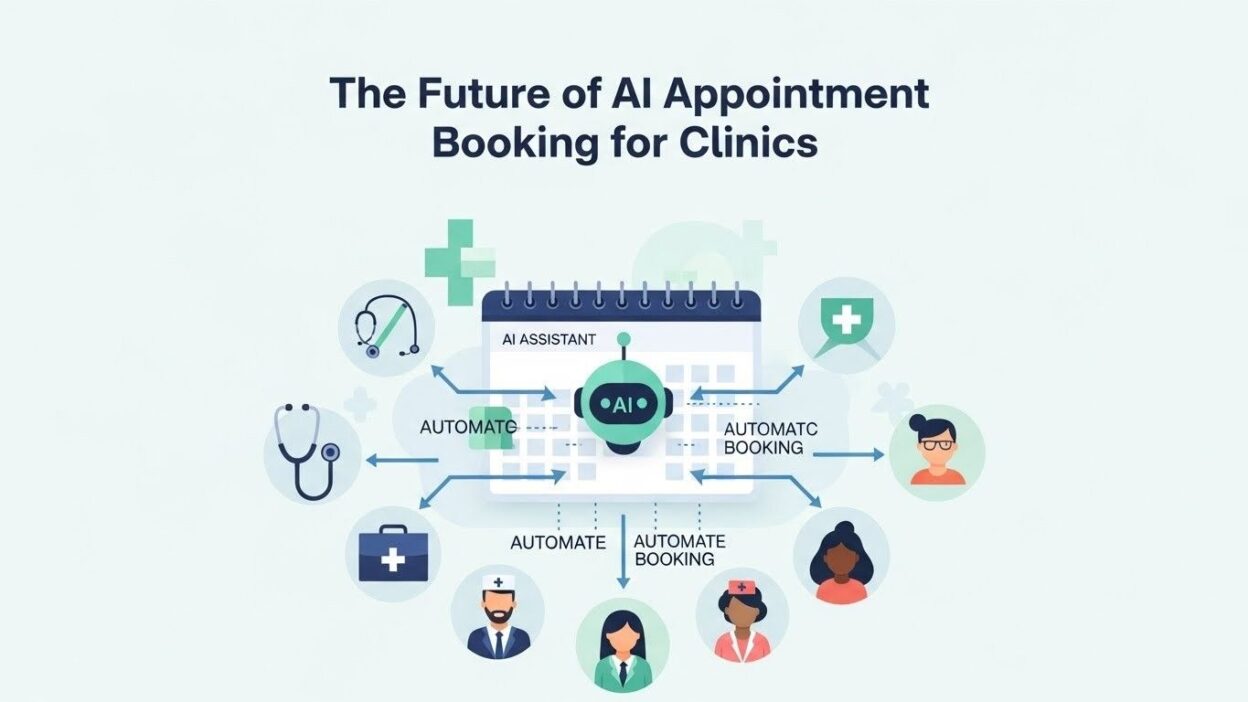
AI appointment booking for healthcare clinics uses sophisticated technology to automate scheduling completely. The system integrates with existing electronic health records seamlessly. It accesses provider calendars, availability rules, and patient information automatically.
Patients interact with AI scheduling through multiple convenient channels. Website chatbots handle booking requests conversationally. Mobile apps provide intuitive scheduling interfaces. Voice assistants allow hands-free appointment booking. SMS text messaging enables quick scheduling via familiar messaging.
Natural language processing understands patient requests regardless of phrasing. Someone might say “I need to see Dr. Smith next Tuesday afternoon” or “My daughter needs a checkup soon.” The AI comprehends both requests accurately. It identifies the appropriate appointment type and ideal timeframe.
The system applies complex scheduling rules automatically. It considers provider specialties, exam room requirements, and appointment duration standards. It accounts for buffer times between appointments. It respects provider lunch breaks and meeting commitments.
Real-time availability checking happens instantly across all providers. Patients see actual open slots without phone calls. They select convenient times immediately. Double bookings become impossible because the system locks selected slots instantly.
Confirmation and reminder automation begins immediately after booking. Patients receive confirmation messages through their preferred channels. The system sends strategic reminders before appointments. No-show rates plummet through intelligent reminder sequences.
Integration with insurance verification systems adds another efficiency layer. The AI checks coverage and eligibility automatically. It alerts patients about authorization requirements upfront. Financial surprises get eliminated before appointments occur.
24/7 Patient Access Eliminates Scheduling Barriers
AI scheduling systems never close for business. Patients book appointments at midnight or during lunch breaks easily. Weekend scheduling happens without inconvenience. Global accessibility serves diverse patient populations across time zones.
Working professionals benefit enormously from after-hours scheduling access. They browse available appointments while commuting home. They book visits during evening relaxation time. No work disruptions occur for simple scheduling tasks.
Parent schedules become more manageable with round-the-clock access. Mothers book pediatric appointments after putting children to bed. Families coordinate multiple appointments during quiet evening hours. Stress levels decrease when scheduling happens conveniently.
Emergency situations get handled promptly regardless of time. Patients with urgent concerns book same-day appointments at 2 AM. The AI identifies urgent requests through keyword analysis. It prioritizes critical cases appropriately.
International patients and travelers schedule appointments across time zones effortlessly. Someone in Asia books appointments at US clinics during their daytime hours. The AI handles time zone conversions automatically. Geographic barriers disappear completely.
Phone call volume during business hours decreases by 60-80%. Staff members redirect energy toward patient care and complex tasks. Callers with questions get faster assistance. Overall patient satisfaction improves dramatically.
Multilingual capabilities expand access for diverse communities. AI systems converse in Spanish, Mandarin, Arabic, and dozens of other languages. Language barriers no longer prevent appointment booking. Clinics serve entire communities effectively.
Intelligent Calendar Optimization Maximizes Clinic Capacity
AI systems analyze scheduling patterns to optimize provider calendars automatically. They identify underutilized time slots across the schedule. They recommend adjustments that increase patient throughput. Clinic capacity expands without adding providers or extending hours.
Appointment type sequencing improves through machine learning. The system learns which appointment types work well consecutively. It avoids scheduling complex cases before lunch when provider energy wanes. It clusters similar appointment types for efficiency.
Buffer time optimization happens dynamically based on historical data. The AI knows which providers consistently run behind schedule. It builds appropriate buffers for those individuals. It tightens schedules for punctual providers. Waiting room delays decrease across the board.
Same-day appointment availability increases through intelligent gap filling. The AI identifies cancellation gaps and offers them to waitlisted patients instantly. Previously wasted time slots generate revenue automatically. Patients with urgent needs access care faster.
Multi-provider coordination becomes seamless through AI scheduling. Patients needing to see multiple specialists book coordinated appointments automatically. The system finds times when all required providers have availability. Patient convenience improves while minimizing clinic visits.
Seasonal demand patterns get anticipated and accommodated proactively. The AI recognizes flu season scheduling surges. It adjusts availability rules to handle increased volume. Providers avoid burnout through intelligent workload distribution.
Equipment and room utilization optimization adds another efficiency dimension. The AI knows which appointments require specialized equipment. It schedules these appointments when resources are available. Costly equipment sits idle less frequently.
Dramatic Reduction in No-Shows Through Smart Reminders
AI appointment booking for healthcare clinics includes sophisticated reminder systems that virtually eliminate no-shows. The technology sends strategically timed reminders through patient-preferred channels. Customized messaging increases engagement and compliance.
Initial confirmation messages arrive immediately after booking. Patients receive details about appointment time, location, and preparation requirements. Early confirmation allows ample planning time.
First reminders arrive one week before appointments typically. This timing allows patients to reschedule if conflicts arise. Early identification of scheduling problems prevents last-minute cancellations.
Second reminders come 24-48 hours before appointments. These reminders include specific preparation instructions. They confirm patients still plan to attend. Response mechanisms allow easy cancellation if needed.
Final reminders arrive the morning of same-day appointments. These last-chance notifications catch patients who forgot despite earlier reminders. They include directions, parking information, and check-in procedures.
Personalized reminder content increases effectiveness substantially. The AI references specific appointment purposes in reminders. It includes provider names and faces. Personal touches make generic reminders feel individually crafted.
Two-way communication allows patients to confirm, cancel, or reschedule instantly. Simple text replies like “confirm” or “cancel” trigger appropriate actions. Rescheduling happens through conversational exchanges. Friction disappears from appointment management.
Intelligent escalation occurs when patients don’t respond to reminders. The system tries alternative contact methods automatically. It notifies clinic staff about high-risk no-show appointments. Proactive outreach prevents empty appointment slots.
No-show predictive analytics identify high-risk appointments before they happen. Machine learning analyzes patient history, appointment characteristics, and behavioral patterns. It flags likely no-shows for special attention. Intervention rates improve through data-driven targeting.
Seamless Integration With Electronic Health Records
Modern AI scheduling systems connect directly to major EHR platforms. Epic, Cerner, Allscripts, Athenahealth, and other systems integrate smoothly. Bidirectional data flow maintains consistency across all systems.
Patient demographic information populates automatically from EHR records. Names, dates of birth, contact information, and insurance details transfer seamlessly. Data entry redundancy disappears completely.
Medical history informs scheduling decisions automatically. The AI knows when patients need annual physicals. It recognizes overdue preventive care appointments. It suggests appropriate appointment types based on health conditions.
Provider notes influence future scheduling through AI analysis. The system identifies when providers request follow-up appointments. It books these appointments automatically or prompts patients to schedule. Care continuity improves through intelligent follow-up management.
Lab results and test orders trigger automatic scheduling. When providers order follow-up tests, the AI schedules them immediately. Patients leave appointments with their next visit already confirmed. Care gaps close automatically.
Medication refill requests get coordinated with appointment scheduling. The AI recognizes when patients need appointments for prescription renewals. It proactively offers booking opportunities. Provider workload balances better through this coordination.
Clinical protocols get enforced automatically through scheduling rules. Certain conditions require specific appointment frequencies. The AI ensures compliance with medical protocols. Quality of care improves through systematic appointment management.
Billing information flows automatically from scheduling to revenue cycle systems. Appointment data triggers billing workflows instantly. Claim submission happens faster. Revenue cycle efficiency improves dramatically.
Personalized Patient Experiences Through Machine Learning
AI systems learn individual patient preferences over time. They remember preferred appointment times, favorite providers, and communication channel preferences. Each scheduling interaction becomes more personalized.
Appointment type recommendations improve through historical analysis. The system suggests preventive care appointments when they’re due. It recognizes patterns in care needs. Patients receive proactive health management support.
Provider matching algorithms consider multiple patient preference factors. Some patients prefer female physicians. Others prioritize physician experience levels. The AI respects these preferences automatically during scheduling.
Language and cultural considerations get applied intelligently. Patients receive communications in their native languages. Cultural appointment preferences get respected. Healthcare access improves for diverse populations.
Accessibility accommodations happen automatically for patients with special needs. The AI knows which patients require longer appointment times. It identifies mobility assistance requirements. It schedules accordingly without requiring repeated explanations.
Family scheduling optimization bundles appointments intelligently. Parents scheduling multiple children see coordinated appointment options. The AI minimizes clinic visits while maximizing scheduling efficiency.
Commute time optimization considers patient home addresses. The AI suggests appointment times that avoid rush hour traffic. It recommends clinic locations closest to patient homes or workplaces. Convenience factors into every scheduling decision.
Handling Complex Scheduling Scenarios Automatically
AI appointment booking for healthcare clinics manages complicated scheduling situations that challenge human schedulers. Multi-step appointment sequences get coordinated automatically. Pre-operative consultations, procedures, and follow-ups book as unified packages.
Specialist referrals trigger automatic scheduling workflows. Primary care providers refer patients to specialists electronically. The AI books specialist appointments immediately. Patients receive confirmation before leaving their primary care visit.
Surgical scheduling coordinates multiple resources simultaneously. The AI checks surgeon availability, operating room schedules, anesthesiologist calendars, and equipment availability. It finds optimal times when all resources align. Complex procedures get scheduled in minutes instead of hours.
Recurring appointment management happens automatically without manual intervention. Patients needing weekly therapy or monthly monitoring get standing appointments. The AI manages these series intelligently. Cancellations and rescheduling cascade appropriately across future appointments.
Group appointment scheduling accommodates multiple patients simultaneously. Diabetes education classes, prenatal groups, and support sessions fill optimally. The AI balances class sizes automatically. It manages waitlists when sessions reach capacity.
Telemedicine appointments integrate seamlessly with in-person scheduling. Patients see both virtual and physical appointment options. The AI recommends appropriate formats based on appointment types. Hybrid care delivery becomes effortless.
Provider coverage during absences gets managed automatically. The AI identifies when primary providers are unavailable. It suggests alternative providers with appropriate expertise. Continuity of care continues despite individual provider schedules.
Emergency appointment insertion happens intelligently without schedule disruption. The system identifies optimal insertion points for urgent cases. It minimizes disruption to existing appointments. Critical care access improves without chaos.
Cost Reduction Through Automated Scheduling Operations
Administrative staffing requirements decrease by 40-60% with AI scheduling. Clinics reduce front desk personnel or redirect them to higher-value activities. Labor costs decline substantially while service quality improves.
Phone system expenses drop dramatically with reduced call volume. Clinics downsize expensive phone infrastructure. Hold time announcements and complex phone trees become unnecessary. Technology budgets optimize toward productive investments.
No-show revenue recovery adds significant financial value. Each prevented no-show generates $150-300 in recovered revenue typically. Across hundreds of appointments monthly, this recovery reaches six figures annually for mid-sized practices.
Overtime costs for scheduling staff disappear completely. AI systems handle evening and weekend booking without premium labor costs. Clinics eliminate expensive after-hours staffing expenses.
Training costs decrease when onboarding new staff members. Scheduling systems require minimal training compared to complex manual processes. New employees become productive faster. Training budgets shrink while capabilities expand.
Error correction expenses vanish with automated scheduling accuracy. Wrong appointment times, double bookings, and miscommunication mistakes become rare. The costs of fixing scheduling errors disappear almost entirely.
Marketing costs per acquired patient decrease through better accessibility. Easy scheduling converts more website visitors into booked appointments. Advertising dollars work harder when booking friction disappears. Patient acquisition costs optimize naturally.
Competitive Advantages in Crowded Healthcare Markets
Clinics offering AI scheduling attract patients away from competitors. Modern consumers expect digital convenience in all services. Healthcare practices providing this experience win market share.
Online reviews improve when scheduling becomes effortless. Patients praise convenient booking systems enthusiastically. Star ratings increase across Google, Yelp, and healthcare-specific review platforms. Positive reviews attract new patients organically.
Younger patient demographics prefer AI-powered scheduling overwhelmingly. Millennials and Gen Z patients avoid phone calls whenever possible. Clinics meeting their preferences capture this valuable demographic. Long-term patient relationships begin with modern scheduling.
Employer health programs direct employees toward convenient providers. Companies want healthcare partners that minimize employee time away from work. Easy scheduling makes clinics attractive to corporate health programs.
Patient retention improves when scheduling convenience builds loyalty. Satisfied patients stay with practices long-term. They schedule preventive care appointments regularly. Lifetime patient value increases substantially.
Physician recruitment benefits from operational efficiency. Doctors prefer joining practices with modern technology infrastructure. AI scheduling demonstrates clinic innovation and efficiency. Top medical talent chooses technologically advanced practices.
Payer partnerships strengthen when clinics demonstrate operational excellence. Insurance companies prefer efficient provider networks. AI scheduling proves clinic sophistication. Contract negotiations become more favorable.
Data Analytics and Insights for Clinic Management
AI appointment booking for healthcare clinics generates valuable operational intelligence. Dashboard analytics reveal scheduling patterns and opportunities. Management makes data-driven decisions about staffing, hours, and capacity.
Provider utilization metrics show productivity levels across the team. Managers identify providers with excess capacity. They recognize scheduling inefficiencies that waste resources. Strategic adjustments optimize the entire operation.
Peak demand timing analysis reveals when patients most want appointments. Clinics adjust hours to match patient preferences. They staff appropriately during high-demand periods. Resources align perfectly with patient needs.
Appointment type trending shows which services grow or decline. Management spots emerging care needs early. They adjust service offerings proactively. Revenue optimization happens through informed service mix management.
Patient demographic analysis reveals community health trends. Clinics identify underserved populations. They develop targeted outreach programs. Community health improves through data-informed initiatives.
Cancellation pattern analysis identifies systemic scheduling problems. High cancellation rates for specific appointment types signal issues. Management investigates and resolves underlying problems. Operational quality improves continuously.
Revenue forecasting becomes accurate with robust scheduling data. Financial projections use actual booking trends. Budget planning improves substantially. Financial surprises decrease dramatically.
Competitor benchmarking compares clinic performance against industry standards. Management sees how their scheduling efficiency ranks. They identify improvement opportunities through comparative analysis.
Privacy and Security in AI Scheduling Systems
Medical appointment data requires stringent protection. AI scheduling platforms implement enterprise-grade security measures. Patient information stays completely secure throughout all processes.
HIPAA compliance gets built into system architecture fundamentally. Encryption protects data in transit and at rest. Access controls limit information visibility appropriately. Audit trails document all data access comprehensively.
Patient consent management happens transparently within scheduling workflows. Systems explain data usage clearly. Patients control their information actively. Privacy regulations get satisfied automatically.
Secure authentication prevents unauthorized scheduling access. Multi-factor authentication protects patient accounts. Provider systems use role-based access controls. Security breaches become extremely difficult.
Data anonymization protects patient privacy in analytics and reporting. Aggregate insights emerge without exposing individual information. Management gains intelligence while respecting patient confidentiality.
Vendor security certifications provide assurance about platform safety. Reputable AI scheduling providers maintain SOC 2, HITRUST, and other security certifications. Third-party audits verify security claims independently.
Breach response procedures get established before incidents occur. Systems include monitoring and alert capabilities. Response plans exist for various security scenarios. Patient trust remains intact even if problems arise.
Mobile-First Design for Modern Patient Expectations
Smartphone usage dominates patient interaction preferences. AI scheduling systems prioritize mobile experiences fundamentally. Apps and responsive websites work flawlessly on all devices.
Native mobile apps provide optimal performance and features. Patients install clinic apps for streamlined appointment management. Push notifications remind about appointments effectively. App store ratings boost clinic reputation.
Progressive web apps offer app-like experiences without downloads. Patients access full scheduling functionality through mobile browsers. Installation friction disappears while capabilities remain comprehensive.
Touch-optimized interfaces make mobile booking effortless. Large buttons accommodate finger taps accurately. Minimal typing requirements respect mobile input limitations. Scheduling happens in seconds on small screens.
Location services enhance mobile scheduling experiences. Systems suggest nearby clinic locations automatically. Directions integrate seamlessly from scheduling confirmation. Patients arrive confidently at correct locations.
Mobile wallet integration stores appointment information conveniently. Apple Wallet and Google Pay receive appointment passes automatically. Patients access appointment details instantly from locked screens.
Offline functionality ensures scheduling works despite connectivity issues. Apps cache essential information locally. Booking requests queue and send when connection restores. Unreliable mobile networks don’t prevent scheduling.
Implementation Strategies for Healthcare Clinics
Successful AI scheduling deployment requires careful planning and execution. Clinics should approach implementation strategically for optimal results.
Vendor selection demands thorough evaluation across multiple criteria. Feature sets must align with specific clinic needs. Integration capabilities matter enormously for EHR connectivity. Pricing models should offer clear value propositions.
Pilot programs prove value before full commitment. Start with single departments or provider groups. Measure results carefully during pilot phases. Expand gradually based on demonstrated success.
Staff training ensures smooth transition to new systems. Front desk personnel need comprehensive platform education. Providers should understand patient-facing scheduling experiences. Universal training prevents confusion and resistance.
Patient communication about new scheduling options drives adoption. Email campaigns announce availability. Waiting room signage promotes digital scheduling. Website updates highlight convenient booking options.
Phased feature rollout prevents overwhelming users. Start with basic appointment booking functionality. Add reminders and rescheduling capabilities next. Introduce advanced features gradually over months.
Legacy system transition requires careful planning. Maintain old and new systems temporarily during transition. Migrate data systematically to prevent information loss. Verify data integrity throughout migration processes.
Performance monitoring establishes continuous improvement cycles. Track key metrics weekly during initial months. Compare results against baseline measurements. Celebrate wins and address challenges promptly.
Frequently Asked Questions About AI Appointment Scheduling
How accurate is AI scheduling compared to human schedulers?
AI scheduling achieves 99%+ accuracy rates consistently. The technology eliminates common human errors like double bookings and transcription mistakes. It applies complex scheduling rules perfectly every time. Accuracy improves continuously through machine learning. Human schedulers make occasional errors despite their best efforts.
Will AI scheduling replace front desk staff completely?
No, AI scheduling redirects staff toward higher-value activities. Front desk personnel focus on patient greeting, registration verification, and complex problem solving. They handle situations requiring human judgment and empathy. Staff roles evolve rather than disappear. Most clinics maintain similar headcount while dramatically improving efficiency.
How do elderly patients handle AI scheduling systems?
Modern AI scheduling accommodates all age groups effectively. Voice-based booking works excellently for seniors uncomfortable with typing. Simple interfaces minimize confusion. Many systems offer phone-based AI assistance that mimics human conversation. Clinics typically maintain traditional scheduling options alongside AI systems initially.
What happens if the AI scheduling system experiences downtime?
Reputable platforms maintain 99.9% uptime through redundant infrastructure. Brief outages rarely occur. Systems include automatic failover to backup servers. Many platforms offer offline scheduling queues that process when systems restore. Downtime impacts prove minimal compared to staff absences in traditional scheduling.
How quickly can clinics implement AI appointment booking?
Implementation timelines range from 2-8 weeks typically. Simple deployments with basic features launch faster. Complex EHR integrations require more time. Most clinics see significant benefits within the first month. Full optimization happens over 3-6 months as staff and patients adopt new workflows.
Does AI scheduling work for multi-location healthcare systems?
Yes, enterprise AI scheduling excels at managing multiple locations. Patients see availability across all clinic sites. They book at whichever location offers convenience. Central management maintains consistent policies across locations. Multi-site coordination becomes simpler than single-location management was previously.
Can patients still call to schedule appointments if they prefer?
Absolutely. AI systems typically include phone-based conversational AI. Patients calling clinics interact with voice assistants that sound natural. These systems handle scheduling through normal conversation. Patients who dislike phone AI can request human assistance. Clinics maintain flexibility to accommodate all patient preferences.
How much does AI appointment booking cost healthcare clinics?
Pricing varies based on clinic size and feature requirements. Small practices pay $200-500 monthly typically. Large multi-provider clinics invest $1,000-3,000 monthly. Enterprise healthcare systems negotiate custom pricing. Most clinics achieve positive ROI within 3-6 months through efficiency gains and no-show reduction.
Read More:-Why AI Workflow Automation Matters for Scaling B2B SaaS Companies
Conclusion

AI appointment booking for healthcare clinics represents the inevitable future of medical scheduling. The technology solves fundamental problems that manual processes never could address. Patient access improves dramatically. Operational efficiency multiplies. Financial performance strengthens substantially.
Early adopters gain significant competitive advantages in their markets. Patients choose clinics offering convenient scheduling over competitors requiring phone calls. Provider recruitment becomes easier when practices demonstrate technological sophistication. Revenue grows while costs decrease simultaneously.
Implementation barriers continue falling as technology matures. Cloud-based solutions require minimal technical infrastructure. Pricing models fit clinics of all sizes affordably. Support resources guide successful deployments from planning through optimization.
Patient expectations will only increase regarding digital scheduling convenience. Healthcare must meet standards set by other industries like restaurants and salons. Clinics failing to modernize will lose patients to more accessible competitors.
The healthcare staffing shortage makes operational efficiency essential. Clinics cannot hire their way to better scheduling. Automation provides the only sustainable solution. AI scheduling allows smaller teams to serve more patients excellently.
Data security and privacy protections have reached enterprise standards. HIPAA compliance concerns no longer justify avoiding AI scheduling. Reputable platforms protect patient information better than paper systems ever could.
Your clinic should evaluate AI scheduling solutions immediately. Identify your biggest scheduling pain points. Research platforms addressing those specific challenges. Request demonstrations from leading vendors.
Start small with pilot programs if full commitment feels premature. Test AI scheduling with one provider or department. Measure results rigorously. Expand based on proven outcomes.
The future of healthcare scheduling is already here. Thousands of clinics worldwide have deployed AI booking successfully. Their patients enjoy unprecedented access. Their staff focus on care instead of calendars. Their financial performance exceeds previous benchmarks.
Your competition is implementing these systems right now. They’re capturing market share through superior patient experiences. The gap widens daily between modern clinics and those clinging to outdated processes.
Make the decision today to explore AI appointment booking for healthcare clinics. Your patients deserve convenient access. Your staff deserves efficient workflows. Your clinic deserves the competitive advantages that AI scheduling delivers.