Introduction
TL;DR API integration has traditionally consumed countless developer hours. Teams spend weeks mapping data fields between different systems manually.
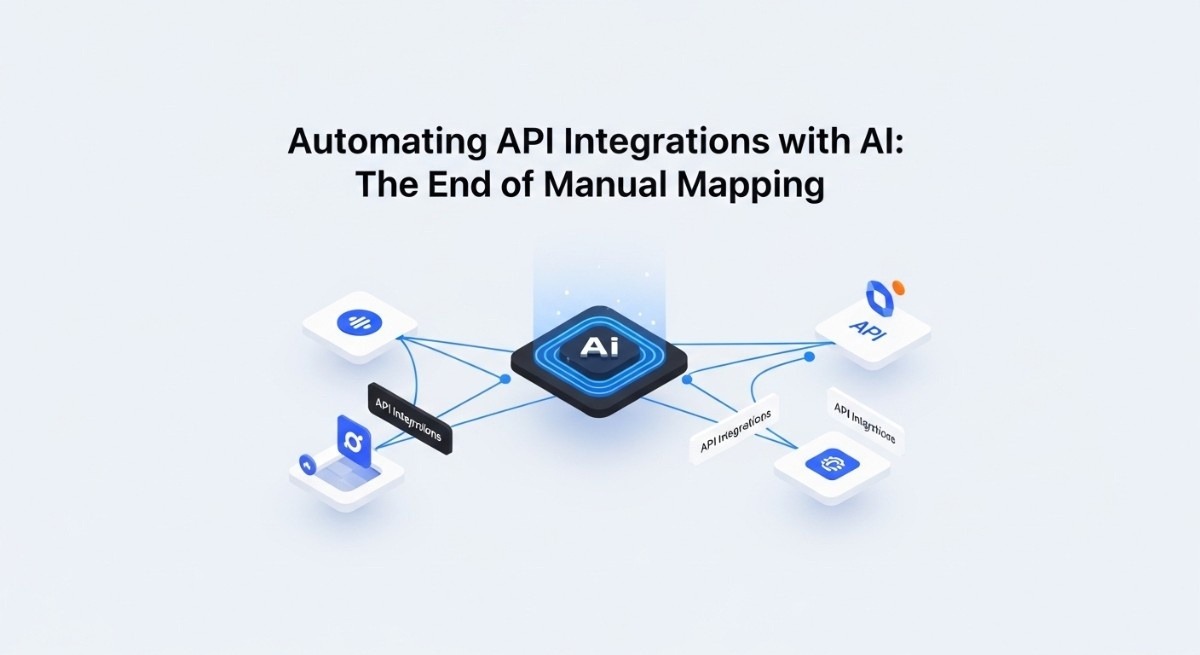
AI API integration automation is revolutionizing how businesses connect their software systems. The technology promises to eliminate tedious mapping work that has plagued development teams for decades.
Every enterprise runs dozens of applications that need to communicate. Customer relationship management systems must talk to marketing platforms. E-commerce stores need to sync with inventory management software. Payment processors require connections to accounting systems.
Manual integration creates bottlenecks that slow digital transformation. Companies wait months for developers to build connections between critical business systems.
Artificial intelligence offers a radical alternative. Machine learning algorithms can understand data structures and create mappings automatically.
This comprehensive guide explores whether AI truly delivers on its promise to end manual API integration work.
Table of Contents
Understanding Traditional API Integration Challenges
API integrations form the connective tissue of modern business technology. Every connection between systems requires careful planning and precise execution.
Manual field mapping represents the most time-consuming integration task. A developer must understand the data structure of both systems completely. Identifying which field in System A corresponds to which field in System B demands detailed analysis.
Documentation gaps complicate this process tremendously. Many APIs lack comprehensive documentation about their data models. Developers spend hours experimenting to discover how systems actually structure information.
Data type mismatches create constant headaches. One system stores phone numbers as strings while another uses integers. Date formats vary wildly across different platforms. Currency values need conversion and proper decimal handling.
Authentication complexities add another layer of difficulty. OAuth flows, API keys, JWT tokens, and custom authentication schemes each require different implementation approaches. Security requirements vary dramatically between enterprise and consumer applications.
Rate limiting forces developers to implement retry logic and backoff strategies. APIs restrict how many requests you can make per minute or hour. Exceeding these limits breaks integrations and causes data synchronization failures.
Error handling requires anticipating dozens of potential failure scenarios. Network timeouts, malformed responses, and unexpected data types all need graceful handling. Building robust error recovery takes as much time as the core integration logic.
Version management becomes a nightmare as APIs evolve. Breaking changes in API updates can shatter existing integrations overnight. Maintaining compatibility across multiple API versions multiplies development complexity.
Testing integration code demands setting up complex environments. You need access to both systems with appropriate test data. Reproducing production scenarios in development environments proves consistently challenging.
How AI API Integration Automation Actually Works
Artificial intelligence approaches API integration through multiple sophisticated techniques. Understanding these mechanisms reveals both capabilities and limitations.
Schema discovery algorithms analyze API responses to understand data structures. The AI makes sample API calls and examines the returned JSON or XML. Pattern recognition identifies field types, relationships, and hierarchies automatically.
Machine learning models train on thousands of common API patterns. The system learns that fields named email, email_address, or contact_email likely serve the same purpose. This knowledge transfers across different integration projects.
Natural language processing interprets field names and API documentation. The AI reads descriptions like “customer_first_name” and understands it represents a person’s given name. Semantic understanding connects fields that manual regex matching would miss.
Mapping suggestion engines propose connections between source and destination fields. AI API integration automation analyzes both schemas and recommends how data should flow. Developers review and approve suggestions rather than creating mappings from scratch.
Transformation logic gets generated automatically for common data conversions. Converting date formats, splitting full names into first and last, or normalizing phone numbers happens without custom coding. The AI recognizes these patterns and applies appropriate transformations.
Intelligent testing creates synthetic data matching expected schemas. The system generates realistic test records and validates that mappings work correctly. Edge cases get identified and handled before production deployment.
Monitoring algorithms detect schema drift when APIs change. The AI notices when response structures differ from expectations. Alerts notify developers about potential integration breaks before users encounter problems.
Self-healing capabilities attempt to repair broken integrations automatically. When schema changes occur, the AI tries to remap affected fields. Simple changes get fixed without human intervention.
Key Technologies Powering Intelligent API Integration
Multiple AI technologies combine to enable automated integration capabilities. Each contributes specific strengths to the overall solution.
Large language models understand natural language in API documentation. GPT-4 and similar models read endpoint descriptions and parameter explanations. This comprehension guides intelligent mapping decisions.
Computer vision for documentation parsing extracts information from poorly formatted API specs. Some vendors provide documentation only as PDFs or images. OCR combined with understanding reconstructs usable schema information.
Graph neural networks model relationships between data entities. APIs often return nested objects with complex relationships. Graph algorithms understand these hierarchies and preserve them during mapping.
Transfer learning applies knowledge from previous integrations to new projects. The AI recognizes similar patterns across different APIs. Solutions that worked for previous CRM integrations inform new e-commerce connections.
Reinforcement learning optimizes integration performance over time. The system tracks which mappings succeed and which cause errors. Successful patterns get reinforced while problematic approaches get abandoned.
Anomaly detection identifies unusual API responses that might indicate problems. Statistical models learn normal response patterns. Deviations trigger investigations before they cascade into larger issues.
Clustering algorithms group similar APIs together. Understanding that Salesforce, HubSpot, and Zoho CRM share common patterns accelerates integration. The AI applies proven approaches from one system to similar alternatives.
Bayesian inference handles uncertainty in ambiguous mapping scenarios. When multiple fields could potentially match, probability calculations suggest the most likely correct mapping. Confidence scores help developers prioritize review efforts.
Practical Use Cases Where AI Automation Excels
Certain integration scenarios benefit dramatically from AI assistance. Understanding these sweet spots helps organizations deploy the technology effectively.
CRM to marketing automation connections represent ideal AI automation candidates. Customer data structures across these platforms follow predictable patterns. Contact information, company details, and activity tracking map relatively consistently.
AI API integration automation handles these repetitive integrations far faster than manual approaches. What once took weeks now completes in hours. Developers configure rather than code from scratch.
E-commerce to fulfillment system integrations involve standard order data. Product SKUs, quantities, shipping addresses, and payment information follow established conventions. AI recognizes these patterns instantly across different platforms.
Payment gateway connections benefit from AI’s understanding of financial data requirements. Credit card fields, billing addresses, and transaction amounts have well-defined formats. Automated mapping reduces errors in these critical integrations.
Calendar and scheduling API integrations leverage AI’s temporal reasoning. The technology understands date formats, time zones, and recurring event patterns. Complex scheduling logic gets generated automatically.
Communication platform integrations like email and SMS benefit from AI. The systems understand message structures, recipient lists, and metadata requirements. Connecting different messaging platforms becomes straightforward.
Data warehouse ETL processes use AI to map source systems to analytical schemas. Understanding which operational fields feed which analytical dimensions happens automatically. Data engineering timelines compress significantly.
Multi-system synchronization keeps customer data consistent across platforms. AI identifies the same customer record across different systems. Deduplication and record matching happen intelligently without extensive custom logic.
Limitations and Scenarios Requiring Human Expertise
AI automation handles many integration tasks brilliantly but cannot solve everything. Understanding these limitations prevents misplaced expectations and project failures.
Complex business logic requires human understanding that AI lacks. Custom pricing calculations, territory assignment rules, and approval workflows need domain expertise. Algorithms cannot infer unique business requirements from API schemas alone.
Edge cases in data transformation often confuse automated systems. Unusual name formats, international address structures, or legacy data quirks need human judgment. AI trained on common patterns misses rare but important scenarios.
Security and compliance requirements demand human oversight. Deciding which data can cross system boundaries involves legal and regulatory considerations. AI cannot assess GDPR implications or industry-specific compliance needs.
Custom authentication implementations require manual configuration. While AI handles standard OAuth and API keys well, proprietary security schemes need developer attention. Understanding unique security models exceeds current AI capabilities.
Performance optimization for high-volume integrations needs human expertise. Batch size decisions, caching strategies, and concurrent request management require experience. AI suggests configurations but cannot tune for specific infrastructure constraints.
Error recovery strategies for critical integrations demand careful design. How your system behaves when external APIs fail affects business continuity. These architectural decisions need human consideration of business impact.
Idempotency implementation ensures operations can safely retry. Financial transactions and inventory updates must handle duplicate requests correctly. Designing idempotent operations requires understanding both systems deeply.
API contract negotiation with vendors involves business relationships. Rate limits, access tiers, and custom endpoints get negotiated between companies. AI cannot conduct these business conversations effectively.
Leading AI-Powered Integration Platforms to Consider
Multiple vendors offer AI API integration automation capabilities. Each platform takes a different approach with distinct strengths.
Zapier’s AI features identify potential automation opportunities from user behavior. The platform suggests integrations based on the apps you connect. Natural language automation creation lets non-technical users build workflows.
The pricing starts free for basic automations with paid tiers scaling to enterprise needs. The user-friendly interface makes AI capabilities accessible to business users. Limited customization options constrain complex integration scenarios.
Workato provides enterprise-grade AI integration capabilities. The platform learns from your integration patterns and suggests improvements. Recipe recommendations accelerate building new connections.
Enterprise pricing reflects advanced features and security capabilities. The learning curve is steeper than simpler alternatives. Deep customization options suit complex business requirements.
Tray.io combines visual workflow building with intelligent automation suggestions. The AI analyzes your data and proposes transformation logic. Schema mapping gets recommended based on field name analysis.
The platform targets technical business users and citizen developers. Pricing scales with automation complexity and data volumes. Extensive connector library covers most common business applications.
MuleSoft Composer includes AI-assisted integration design. The Salesforce-owned platform particularly excels at CRM integrations. Intelligent suggestions guide mapping decisions throughout the design process.
Tight Salesforce integration makes it ideal for organizations heavily invested in that ecosystem. Premium pricing reflects enterprise positioning. The platform handles high-volume production workloads reliably.
n8n offers open-source flexibility with AI enhancement capabilities. Self-hosting provides complete control over your integration infrastructure. Community-contributed nodes expand platform capabilities continuously.
Free for self-hosted deployments with paid cloud options available. Technical users appreciate the code-first approach when needed. Less polished than commercial alternatives but highly extensible.
Building Custom AI Integration Solutions In-House
Some organizations choose to develop proprietary AI integration capabilities. This approach suits companies with unique requirements and strong technical teams.
OpenAI API provides language model capabilities for custom integration tools. Your development team can build intelligent mapping suggestions using GPT-4. The API handles natural language understanding of field names and documentation.
Cost scales with API usage volume requiring careful budget planning. Token-based pricing can become expensive for high-volume integration scenarios. Caching and optimization reduce costs while maintaining functionality.
LangChain framework simplifies building AI-powered applications. The toolkit provides components specifically useful for integration tasks. Document parsing, schema understanding, and mapping logic all leverage LangChain capabilities.
Open-source licensing allows unlimited customization for your specific needs. The active community provides support and shares implementation patterns. Learning curve requires investment in understanding the framework architecture.
Hugging Face transformers enable semantic field matching. Pre-trained models understand relationships between similar concepts. Fine-tuning on your integration data improves matching accuracy for domain-specific terminology.
Model hosting options range from cloud services to on-premises deployment. Privacy-sensitive data can remain within your infrastructure. Performance tuning ensures real-time mapping suggestions.
Vector databases like Pinecone store embeddings of field names and schemas. Semantic search finds similar fields across different APIs quickly. This powers intelligent mapping recommendations based on previous integrations.
Embedding historical integration decisions creates institutional knowledge. New projects benefit from lessons learned in previous work. The system becomes smarter with each integration completed.
Graph databases model API schemas and their relationships. Neo4j or similar platforms represent data structures and mappings. Querying the graph reveals insights about integration patterns.
Visualization of the integration landscape helps teams understand system connections. Impact analysis shows which integrations an API change might affect. This architectural view informs better decision-making.
Implementation Best Practices for AI Integration Projects
Successful AI API integration automation requires thoughtful planning and execution. These practices improve outcomes and reduce integration risks.
Start with a pilot project on a non-critical integration. Choose systems where failure causes minimal business disruption. Learning how AI automation works in your environment pays dividends.
The pilot reveals strengths and limitations specific to your technology stack. Team members gain experience before tackling mission-critical integrations. Lessons learned inform your broader automation strategy.
Maintain human oversight of AI-generated mappings initially. Developers should review all suggested connections before approving them. Trust builds gradually as the system proves accuracy.
Spot-checking even after establishing confidence catches edge cases. Automated testing validates mappings but human review provides additional assurance. Critical integrations warrant more scrutiny than routine connections.
Document AI decisions for future troubleshooting and auditing. Understanding why specific mappings were chosen helps debug issues later. Compliance requirements may demand audit trails of data flow decisions.
Version control for integration configurations enables rollback capabilities. Treating integration logic as code provides all the benefits of software development practices. Changes get tracked, reviewed, and deployed systematically.
Implement comprehensive monitoring from day one. Track success rates, data quality metrics, and error patterns. Early problem detection prevents small issues from becoming crises.
Alerting thresholds should trigger before user impact occurs. Dashboard visibility helps teams stay informed about integration health. Historical trending reveals gradual degradation requiring attention.
Build fallback mechanisms for when AI suggestions fail. Human escalation paths ensure integrations complete even when automation struggles. Hybrid approaches combine AI efficiency with human reliability.
Manual override capabilities give developers control when needed. The system should gracefully handle human corrections to AI suggestions. Learning from these corrections improves future automation.
Measuring ROI and Success Metrics
Quantifying the value of AI integration automation justifies investment. Specific metrics demonstrate impact on efficiency and business outcomes.
Development time reduction represents the most obvious benefit. Track hours spent on integration projects before and after AI adoption. Many organizations report 50-70% time savings on routine integrations.
Comparing manual integration timelines to AI-assisted projects shows concrete value. Multiply time saved by developer hourly costs to calculate direct savings. These numbers persuade executives about technology value.
Integration maintenance burden decreases with intelligent automation. Schema change handling that previously required developer intervention happens automatically. Measuring support ticket reduction quantifies this benefit.
Mean time to repair integration failures improves with AI monitoring. Problems get detected and often resolved without human intervention. Uptime improvements translate to better business continuity.
Developer satisfaction increases when tedious work gets automated. Survey your technical team about job satisfaction before and after AI adoption. Happier developers produce better work and stay with companies longer.
Talent retention has significant financial implications. Replacing experienced developers costs six to nine months of salary. Improving retention through better tooling provides substantial value.
Time to market for new integrations affects competitive positioning. Launching features faster creates business advantages. Measuring this metric demonstrates strategic value beyond cost savings.
Revenue impact of faster integration may dwarf efficiency savings. E-commerce integrations that launch weeks earlier capture additional sales. Calculate these opportunity costs when evaluating ROI.
Data quality improvements prevent downstream issues. Integration errors corrupt databases and analytics. Measuring error rates and data accuracy shows quality benefits.
Future Trends in AI-Powered Integration
The technology continues evolving rapidly. Understanding emerging trends helps organizations plan future integration strategies.
Autonomous integration systems will require minimal human involvement. AI will discover new APIs, propose integrations, and implement them automatically. Developers will approve rather than build integrations.
Natural language integration creation already shows promise. Describing desired data flows conversationally will generate working integrations. Technical expertise requirements will decrease dramatically.
Real-time adaptation to API changes will become standard. AI API integration automation will detect schema modifications and adjust mappings instantly. Breaking changes will cause fewer integration failures.
Predictive integration maintenance will fix problems before they occur. Machine learning models will forecast API reliability issues. Proactive failover to alternative data sources will prevent disruptions.
Semantic data mapping will transcend field name matching. AI will understand business concepts deeply. Customer lifetime value calculations will map correctly even when field names differ completely.
Cross-system data governance will leverage AI for policy enforcement. Automated systems will ensure data flows comply with privacy regulations. Sensitive information will get masked or blocked automatically.
Integration marketplaces will offer pre-built AI-optimized connectors. These connectors will adapt to your specific instance configurations. Setup time will drop from days to minutes.
Collaborative AI will learn from entire communities of users. When one organization solves an integration challenge, the solution benefits others. Collective intelligence will accelerate the entire ecosystem.
Frequently Asked Questions
Can AI really eliminate manual API integration work completely?
Not completely, but it dramatically reduces manual effort. AI API integration automation handles routine mapping and transformation tasks excellently. Complex business logic, security decisions, and edge cases still need human expertise. Most organizations see 50-70% reduction in integration development time.
How accurate are AI-generated API mappings?
Accuracy varies based on API complexity and documentation quality. Well-documented REST APIs with standard naming conventions achieve 85-95% accurate automated mapping. Custom or poorly documented APIs require more human correction. The technology improves continuously as models train on more data.
What happens when external APIs change unexpectedly?
Modern AI integration platforms detect schema changes through continuous monitoring. Intelligent systems attempt automatic remapping when changes occur. Critical changes trigger alerts for human review. This approach catches problems far faster than manual monitoring.
Do we need data scientists to implement AI integration tools?
No. Current platforms target developers and integration specialists without AI expertise. User-friendly interfaces hide complexity behind visual builders. Understanding API concepts matters more than machine learning knowledge. Technical teams can implement solutions without specialized AI training.
How much does AI integration automation actually cost?
Costs range from free open-source tools to enterprise platforms exceeding $50,000 annually. Mid-market solutions typically cost $500-2,000 monthly. Calculate ROI by comparing subscription costs to developer time saved. Most organizations achieve positive ROI within three to six months.
Can AI handle integrations for industry-specific or custom APIs?
Yes, though effectiveness varies. Common industry patterns like healthcare HL7 or financial FIX protocols have strong AI support. Completely proprietary APIs need more manual configuration initially. The system learns from these custom integrations to handle similar cases better.
What about security and compliance in AI-managed integrations?
AI platforms must comply with SOC 2, GDPR, and industry regulations. Choose vendors with appropriate certifications. Data encryption in transit and at rest is standard. Human oversight ensures sensitive data handling meets your compliance requirements.
How long does it take to implement AI-powered integration automation?
Initial platform setup takes one to two weeks. First integrations require learning the system and processes. Most organizations achieve proficiency within 30-60 days. Time to value varies based on integration complexity and team experience.
Read More:-Navigating AI Ethics: How to Build Bias-Free Automated Systems
Conclusion

AI API integration automation represents a fundamental shift in how organizations connect software systems. The technology delivers on promises to reduce manual mapping work dramatically.
Traditional API integration consumed weeks of developer time per connection. Field mapping, transformation logic, and error handling required meticulous manual coding. Teams struggled to keep pace with business demands for system connectivity.
Artificial intelligence automates the most tedious aspects of this work. Schema discovery, intelligent mapping suggestions, and automatic transformation generation accelerate development. What once took weeks now completes in days or hours.
The technology excels at routine integrations between well-documented systems. CRM platforms, e-commerce systems, and marketing tools connect with minimal manual effort. Standard data patterns get recognized and mapped automatically.
Limitations remain for complex scenarios requiring deep business logic. Custom calculations, unique workflows, and proprietary security schemes need human expertise. AI augments rather than completely replaces skilled integration developers.
Leading platforms offer varying approaches to intelligent automation. Zapier targets business users with simple AI-assisted workflows. Workato and MuleSoft provide enterprise-grade capabilities for complex requirements. Open-source options suit organizations building custom solutions.
Implementation success requires thoughtful planning and realistic expectations. Starting with pilot projects builds team confidence and reveals platform strengths. Maintaining human oversight ensures accuracy while trust develops.
Measurable benefits justify investment through multiple dimensions. Development time reductions of 50-70% create immediate cost savings. Faster time to market for new integrations provides competitive advantages. Improved data quality prevents downstream problems across systems.
The technology continues advancing rapidly. Future systems will operate more autonomously with less human intervention. Natural language integration creation will democratize capabilities beyond technical specialists.
Organizations delaying adoption risk falling behind competitors. Integration backlogs prevent digital transformation initiatives. Manual processes cannot scale to meet growing connectivity demands.
Starting your AI integration journey today positions your organization for future success. Begin with non-critical systems to learn platform capabilities. Gradually expand automation as confidence and competence grow.
The end of manual API mapping may not be completely here yet. Significant reductions in manual work are already reality for organizations embracing AI automation. The technology transforms integration from a development bottleneck into a streamlined process.
Your development teams deserve tools that eliminate tedious work. Freeing skilled engineers from repetitive mapping allows focus on high-value challenges. Innovation accelerates when routine tasks get automated.
Business agility depends on rapid system integration capabilities. Market opportunities require quick technology responses. AI automation provides the speed modern business demands.
Evaluate leading platforms against your specific integration requirements. Consider factors like existing technology stack, team skills, and budget constraints. Most vendors offer free trials enabling hands-on assessment.
The question is no longer whether to adopt AI API integration automation. Forward-thinking organizations now ask how quickly they can implement these capabilities. Competitive pressure makes intelligent automation inevitable.
Human expertise remains essential for successful integrations. AI amplifies human capabilities rather than replacing developers entirely. The partnership between human judgment and machine efficiency produces optimal results.
Take the first step toward automated integration today. Your future self will thank you for eliminating countless hours of manual mapping work. The technology has matured sufficiently for production use across most integration scenarios.
Manual API integration is not completely dead but its dominance is ending. AI automation reshapes the landscape toward efficiency, accuracy, and speed. Organizations embracing this shift will thrive in an increasingly connected digital world.