Introduction
TL;DR Education has followed the same basic model for centuries. One teacher. Thirty students. One curriculum. One pace.That model works for some students. It fails the rest quietly, invisibly, and at enormous cost.The student who already mastered fractions sits bored while the teacher re-explains the concept. The student who missed a key prerequisite falls further behind every class. Neither gets what they actually need.AI agents in personalized learning EdTech are dismantling this one-size-fits-all structure from the inside out.These intelligent systems do not just deliver content. They observe, analyze, adapt, and respond to each learner individually. They catch gaps before they grow. They accelerate students who are ready to move faster. They never lose patience, never forget a student’s history, and never deliver a lesson the same way twice if the first approach did not land.The EdTech industry has been building toward this moment for years. The tools now exist to deliver on the promise of genuinely personalized education at scale.
This blog covers how AI agents in personalized learning EdTech work, what they are accomplishing across real educational environments, and where this technology is heading next.
Table of Contents
What AI Agents Actually Are in the Context of EdTech
Suggested word count: ~300 words | Secondary keyword: intelligent tutoring systems AI EdTech
Agents Versus Algorithms — A Critical Distinction
Most people hear AI and think of a recommendation engine or a chatbot. Those are useful tools. They are not AI agents.
An AI agent perceives its environment, makes decisions, takes actions, and evaluates outcomes. It operates with a degree of autonomy that standard algorithms do not possess.
In education, this distinction matters enormously. A recommendation algorithm suggests the next video. An AI agent monitors comprehension in real time, identifies a knowledge gap, generates a targeted explanation, delivers a diagnostic question, evaluates the response, and adjusts the next learning step accordingly.
AI agents in personalized learning EdTech do not just serve content. They actively manage the learning process for each individual student.
The Core Architecture Behind Educational AI Agents
Educational AI agents combine several capabilities in a single intelligent loop. Perception tools gather data from student interactions — answers given, time spent, errors made, questions asked.
Reasoning models analyze that data against learning objectives and pedagogical frameworks. Decision engines select the next instructional action from a repertoire of possible responses.
Natural language processing layers handle student input in their own words. Generative AI components produce explanations, examples, and feedback that adapt dynamically to each student’s demonstrated understanding.
The loop runs continuously. Every interaction produces new data. Every new data point refines the agent’s model of the student. The result is a learning experience that gets more personalized the longer a student uses it.
FAQ: Are AI agents in education the same as AI tutors?
AI tutors are one specific application of AI agents in education. The broader agent category also includes curriculum planners, assessment designers, feedback generators, and learning path optimizers. An AI tutor converses with a student. An AI learning agent manages the entire instructional sequence, including when to tutor, when to test, when to review, and when to advance.
How AI Agents Deliver Personalized Learning at Scale
Real-Time Learner Modeling: Building a Dynamic Student Profile
Every student interaction feeds the learner model. Response accuracy, response time, error patterns, skipped content, revisited sections, and session duration all contribute to a continuously updated picture of each learner.
This learner model goes far beyond a gradebook. It maps conceptual mastery at a granular level. It tracks confidence alongside accuracy. It identifies which instructional formats produce better retention for each individual.
AI agents in personalized learning EdTech use this model to make instructional decisions that a single teacher serving thirty students could never replicate for each child simultaneously.
Adaptive Content Sequencing: Right Lesson, Right Moment
Traditional curricula move every student through the same sequence at the same pace. Adaptive sequencing breaks that constraint entirely.
The AI agent selects the next learning activity based on the current state of each student’s knowledge model. A student who demonstrates strong conceptual understanding gets challenging extension material. A student showing a specific misconception gets a targeted corrective explanation.
The sequence is not predetermined. It evolves with every new data point the agent collects. This is the mechanism that makes AI agents in personalized learning EdTech fundamentally different from digital textbooks or recorded video courses.
Automated Feedback: Closing the Learning Loop Instantly
Feedback timing is one of the most well-researched variables in learning science. Immediate feedback dramatically outperforms delayed feedback on both retention and motivation.
Human teachers cannot provide immediate individual feedback to thirty students simultaneously. AI agents can.
When a student submits an answer, the agent evaluates it within milliseconds. It identifies the specific error type, selects an explanation strategy matched to that error, and delivers targeted feedback before the student moves on.
This instant feedback loop keeps students in the productive struggle zone. It prevents confusion from calcifying into deep misconceptions.
FAQ: How does adaptive learning AI know when a student is struggling?
The agent monitors multiple signals simultaneously. Response accuracy is the most obvious. Error pattern consistency matters more. A student who makes the same type of error across different problem contexts signals a conceptual gap, not a careless mistake. Time-on-task and abandonment signals reinforce the picture. The agent flags struggle states and shifts strategy before the student gives up entirely.
Key Applications of AI Agents in Personalized Learning EdTech Today
K-12 Education: Closing the Achievement Gap
Achievement gaps in K-12 education are stubborn. Students who fall behind in foundational skills rarely catch up without targeted intervention. Teachers with thirty students and limited planning time cannot identify every at-risk learner early enough.
AI agents in personalized learning EdTech change this dynamic at the classroom level. The agent continuously monitors every student’s progress. It alerts the teacher when a student shows early signs of falling behind. It simultaneously provides the struggling student with targeted practice that directly addresses their specific knowledge gap.
Schools using AI-powered adaptive learning platforms report significant reductions in achievement gap measures within a single academic year. Students who previously fell invisibly through the cracks receive constant, responsive support.
Higher Education: Scaling Personalized Support Across Large Cohorts
University courses often enroll hundreds of students per section. Teaching assistants cover basic support. Professors focus on lectures. Individual mentorship at scale is structurally impossible.
AI agents fill the gap between lectures and human support hours. They answer conceptual questions at any hour. They guide students through problem-solving processes. They generate personalized study plans based on each student’s demonstrated knowledge gaps ahead of exams.
Students who previously waited days for office hours answers now get immediate, accurate, personalized support. Course completion rates and exam performance both improve measurably in institutions that have deployed these systems.
Corporate Learning and Development: Reskilling at Business Speed
Corporate L&D faces a version of the same problem. Large workforces need new skills fast. Training programs built for average employees waste time for advanced learners and overwhelm beginners.
AI agents in personalized learning EdTech serve the corporate market with equal power. They assess each employee’s current skill level on day one. They build a personalized learning path toward the target competency. They adjust that path as the employee demonstrates mastery or surfaces gaps.
Organizations using AI-powered L&D platforms report reskilling timelines shrinking by 30 to 50 percent. Employees reach productive competency faster. Learning content never covers ground the employee already mastered.
Language Learning: The Most AI-Transformed EdTech Category
Language learning is the single EdTech category where AI agents have already achieved the most visible consumer impact. Apps powered by AI agents now adapt vocabulary, grammar focus, and speaking practice to each learner’s demonstrated proficiency in real time.
Conversational AI agents give language learners an infinitely patient speaking partner available at any hour. The agent corrects pronunciation, models correct grammar, and adjusts complexity based on demonstrated fluency.
Intelligent Tutoring Systems: The Proven Foundation of AI in EdTech
Suggested word count: ~300 words | Secondary keyword: intelligent tutoring systems AI learning outcomes
What Decades of ITS Research Tells Us
Intelligent tutoring systems have existed as a research category since the 1980s. Decades of studies confirm their effectiveness. Students who learn with ITS show outcomes comparable to one-on-one human tutoring, which Benjamin Bloom’s famous research identified as the most effective instructional mode ever studied.
AI agents in personalized learning EdTech build on this validated foundation. Modern AI capabilities, including large language models, computer vision for handwriting recognition, and speech recognition for spoken input, extend what ITS can do well beyond earlier systems.
How Modern AI Agents Surpass Classic ITS Limitations
Classic ITS were expensive to build and inflexible to update. Creating a new subject domain required years of expert authoring work. Each system worked only in its specific domain.
Modern AI agents powered by large language models adapt to new domains without exhaustive expert programming. A well-designed AI agent can tutor students in mathematics, creative writing, and history using the same underlying architecture with different knowledge configurations.
Generative AI components allow modern systems to produce novel explanations, examples, and analogies on demand. The agent never repeats the exact same explanation twice if the first one did not produce understanding.
FAQ: What evidence supports AI agents improving student learning outcomes?
Multiple large-scale studies show statistically significant learning gains from AI-powered adaptive systems. The RAND Corporation’s multi-year study of adaptive math platforms found meaningful improvement in standardized test scores. Carnegie Learning’s MATHia platform, built on ITS principles, shows consistent positive effect sizes across diverse student populations. Corporate L&D studies report 30 to 50 percent faster time-to-competency with AI-personalized programs.
AI Agents and Teachers: Partners, Not Replacements
Suggested word count: ~300 words | Secondary keyword: AI teaching assistant EdTech classroom
What AI Agents Free Teachers to Do
The fear that AI will replace teachers misunderstands what AI agents actually do well. No AI agent replicates the relational depth of a skilled human teacher.
AI agents handle the instructional tasks that consume enormous teacher time without requiring human judgment: content delivery, drill practice, immediate feedback, progress monitoring, and early warning detection.
Freeing teachers from these tasks gives them more time for the work only humans do well. Motivating reluctant learners. Building trust with students in difficult home situations. Facilitating rich discussions. Making ethical judgments about individual student needs.
AI agents in personalized learning EdTech make teachers more effective, not redundant.
AI-Powered Teacher Dashboards: Actionable Insight at the Class Level
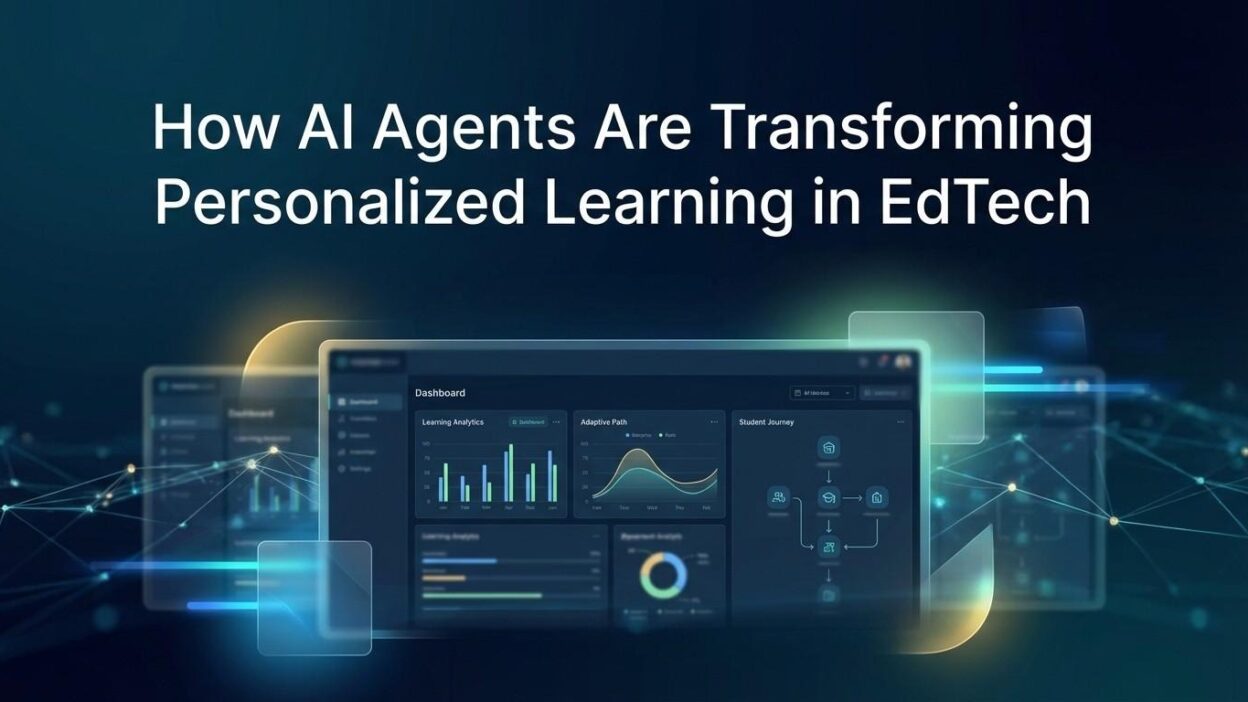
The data AI agents collect about each student also produces class-level insight for teachers. Dashboard tools synthesize individual student learning models into clear class-wide pictures.
A teacher sees at a glance which concept the largest share of students struggle with today. They see which students are accelerating and which show early warning signals. They receive AI-generated recommendations for small group instruction targeting the specific gaps the agent identified.
This data-driven visibility was previously impossible for a single teacher managing thirty students. AI agents make it standard practice.
FAQ: How do AI agents support teachers rather than replace them?
AI agents handle high-frequency, low-judgment instructional tasks at scale. Teachers handle high-judgment, high-relationship tasks that require human presence. The data AI agents produce gives teachers better information to make more targeted instructional decisions. Schools that frame AI adoption as a teacher amplification strategy report higher teacher satisfaction and stronger student outcomes than schools that frame it as a cost-cutting measure.
Honest Challenges: What AI Agents in EdTech Still Cannot Do
Data Privacy Remains the Number-One Concern
AI agents collect detailed behavioral data about learners who are often minors. Every interaction, error, hesitation, and progression gets logged and analyzed.
COPPA in the US, GDPR in Europe, and equivalent regulations globally impose strict requirements on how EdTech companies collect, store, and use student data.
AI agents in personalized learning EdTech must operate within these frameworks rigorously. Any data governance failure carries serious legal and reputational consequences for the platform and the institution deploying it.
Equity and Access Gaps Remain Structural Challenges
AI agents deliver their value through digital devices and internet connections. Students without reliable device access or broadband connectivity cannot access these tools.
The digital divide means the students who would benefit most from personalized AI support often have the least access to it. Deploying AI agents equitably requires solving the access problem first.
Motivation and Social Learning Are Beyond the Agent’s Reach
AI agents deliver outstanding individualized instruction. They do not replicate the motivational impact of a teacher who believes in a struggling student. They do not replicate the social learning that happens in collaborative group projects.
Education is not purely a knowledge transfer problem. Belonging, identity, motivation, and social skill development are core educational outcomes that AI agents cannot address alone.
FAQ: What are the biggest risks of over-relying on AI agents in education?
Over-reliance risks include reduced teacher professional judgment, student disengagement from social learning, data privacy exposure for minors, and algorithmic bias in learner modeling. Schools that deploy AI agents most successfully use them as one component in a rich educational environment, not as a replacement for human-centered pedagogy.
Where AI Agents in Personalized Learning EdTech Are Heading Next
Multimodal AI Agents: Seeing, Hearing, and Reading Learners
Next-generation AI agents will incorporate multimodal perception. Computer vision will read facial expressions to detect confusion or boredom. Speech analysis will assess fluency and emotional state in real time. Handwriting recognition will analyze the reasoning process embedded in a student’s written work.
AI agents in personalized learning EdTech will move from analyzing what students answer to understanding how they think.
Collaborative AI Agents: Supporting Group Learning
Current AI agents primarily optimize individual learning. Future systems will manage collaborative learning environments. They will observe group dynamics, identify which students dominate and which disengage, and intervene to create more equitable collaborative learning experiences.
This capability will extend AI agent value into project-based learning, debate preparation, and collaborative problem-solving, areas where current systems contribute little.
Lifelong Learning Companions: Agents That Grow With the Learner
The most transformative future application is the persistent learning companion. An AI agent that follows a learner from elementary school through higher education to professional development maintains a longitudinal model of that individual’s learning style, strengths, gaps, and goals.
This persistent companion recommends learning opportunities, flags skill gaps before they become career problems, and connects learning across formal and informal contexts throughout a lifetime.
Frequently Asked Questions: AI Agents in Personalized Learning EdTech
What are AI agents in personalized learning EdTech?
AI agents in personalized learning EdTech are autonomous software systems that observe individual learner behavior, analyze knowledge gaps, make instructional decisions, and deliver personalized content, feedback, and learning paths without requiring constant human direction. They differ from standard edtech tools by operating in a continuous perception-decision-action loop tailored to each learner.
How do AI agents personalize learning for each student?
AI agents build a dynamic learner model from interaction data. This model tracks concept mastery at a granular level, preferred learning formats, error patterns, confidence levels, and engagement signals. The agent uses this model to select the next instructional activity, explanation style, difficulty level, and feedback approach uniquely matched to that student’s current state.
Which EdTech platforms currently use AI agents for personalized learning?
Platforms including Khan Academy, Carnegie Learning’s MATHia, Duolingo, Coursera, and Khanmigo deploy varying degrees of AI agent capability. Enterprise L&D platforms including Docebo, Cornerstone OnDemand, and 360Learning integrate AI-driven personalization engines. The category is expanding rapidly with new entrants launching AI-native platforms built around agent architectures from the ground up.
Are AI agents in EdTech safe for children to use?
AI agents in EdTech can operate safely for children when platforms comply with COPPA, GDPR-K, and equivalent child data protection laws. Key safety requirements include data minimization, parental consent mechanisms, transparent data usage policies, and prohibition of behavioral advertising targeting minors. Parents and school administrators should audit platform compliance policies before deployment.
How much do AI-powered personalized learning platforms cost for schools?
Pricing varies widely. Consumer-facing apps like Duolingo offer free tiers with premium upgrades under $15 per month. K-12 school platform licenses range from $20 to $80 per student per year depending on subject coverage and feature depth. Enterprise L&D platforms typically price on per-seat annual contracts ranging from $15 to $100 per learner annually depending on scale and customization requirements.
Read More:-Building an AI “Second Brain” for Your Engineering Team
Conclusion
The gap between what education delivers today and what learners actually need has always been enormous.
Every student learns differently. Every student arrives with a different knowledge history. Every student needs feedback at a different moment and in a different form.
Human teachers give everything they have to bridge that gap. The structural constraints of classrooms, curricula, and time make closing it fully impossible without technological support.
AI agents in personalized learning EdTech provide that support at a scale, speed, and level of individual precision that changes what education can deliver.
Students who fell silently behind now get caught early. Students ready to accelerate no longer wait. Teachers who wanted to know more about each student’s daily progress now have that visibility in real time.
The technology is not perfect. Data privacy demands constant vigilance. Equity of access remains a structural challenge. The human dimensions of great teaching remain irreplaceable.
AI agents in personalized learning EdTech work best as powerful tools in the hands of skilled, caring educators who use them to amplify their own effectiveness.
The schools, universities, and organizations deploying these tools now are building a measurable, compounding advantage in learner outcomes. Every year of data makes the agents smarter. Every learner they serve makes the model stronger.
AI agents in personalized learning EdTech are not coming. They are here. The only question left is how quickly your organization will put them to work.