Introduction
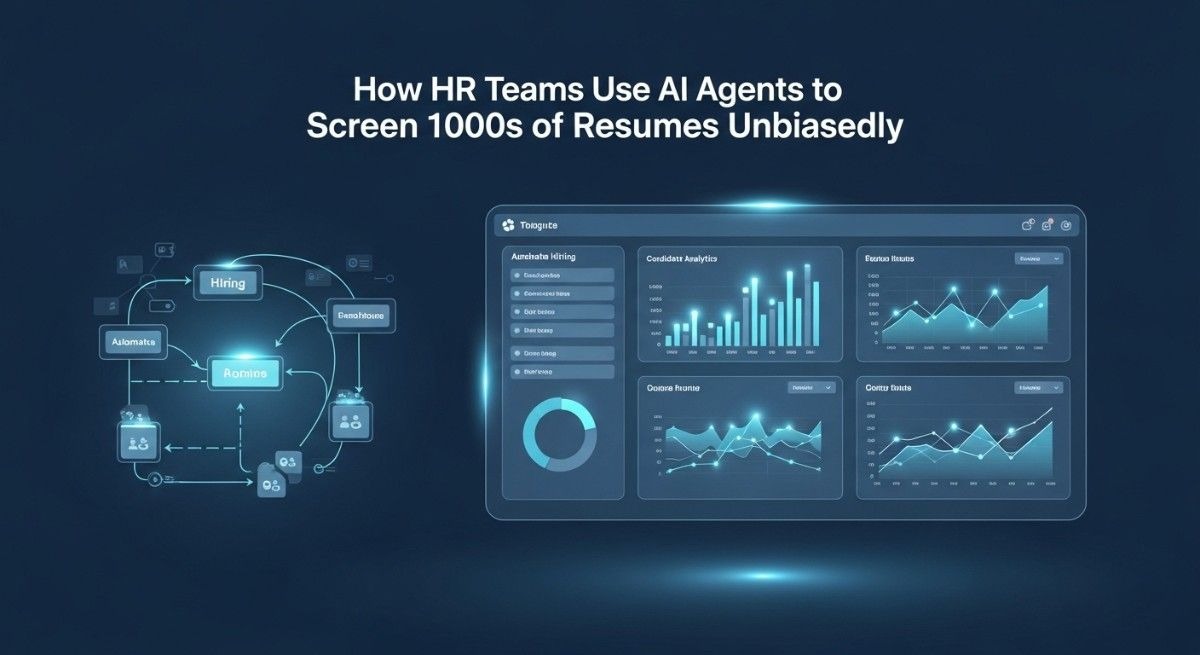
TL;DR Hiring at scale is one of the hardest challenges HR teams face. A single job posting at a major company can attract five thousand applications in 48 hours. Reading every resume carefully is physically impossible for a small recruiting team. Decisions get rushed. Biases creep in. Great candidates get missed. This is precisely why AI agents for unbiased resume screening at scale have become one of the most transformative tools in modern human resources.
This blog explains exactly how HR teams deploy AI agents to handle massive applicant volumes without sacrificing fairness or quality. You will learn how these systems work, where they succeed, what risks to watch for, and how leading organizations are building more equitable hiring pipelines with AI at the center.
Table of Contents
The Problem With Traditional Resume Screening
Manual resume screening is slow, expensive, and riddled with bias. These are not opinions. They are documented problems that cost organizations top talent every hiring cycle.
A recruiter reviews an average resume for six to eight seconds during an initial screen. That is not enough time to evaluate a candidate fairly. Decisions made in eight seconds rely on shortcuts, familiarity, and unconscious associations rather than genuine merit.
Affinity bias causes recruiters to favor candidates with similar backgrounds to themselves. Name bias causes candidates with names perceived as foreign to receive fewer callbacks even with identical qualifications. Educational prestige bias causes recruiters to skip qualified candidates from non-target schools. These patterns repeat consistently across industries and organizations.
The Volume Problem
Volume amplifies every problem in manual screening. A recruiter reviewing 500 resumes per week makes worse decisions by Thursday than on Monday. Cognitive fatigue degrades judgment. Consistency disappears. The 400th resume receives fundamentally less attention than the 50th.
High-growth companies compound this challenge. Rapid hiring cycles, multiple open roles, and tight timelines force recruiters to screen faster. Speed and quality trade off against each other. Candidates receive uneven treatment based on when their resume arrived in the queue rather than what it contains.
AI agents for unbiased resume screening at scale solve the volume problem directly. These systems do not get tired. They evaluate the 50,000th resume with the same rigor as the first.
The Cost of Biased Hiring
Biased hiring produces homogeneous teams. Homogeneous teams make worse decisions than diverse ones according to decades of organizational research. The cost is not just ethical. It is financial.
McKinsey research consistently shows that companies in the top quartile for ethnic and gender diversity outperform competitors by 25 to 36 percent in profitability. Diverse teams bring broader perspectives. They identify risks that homogeneous groups miss. They connect with wider customer bases more effectively.
Legal exposure adds another dimension. Discriminatory screening practices violate employment law in most jurisdictions. Lawsuits, regulatory investigations, and reputational damage follow organizations that fail to address systemic screening bias. AI agents for unbiased resume screening at scale reduce this legal and ethical risk significantly.
What AI Agents for Resume Screening Actually Do
AI agents for unbiased resume screening at scale are not simple keyword filters. Modern systems use natural language processing, machine learning, and structured evaluation frameworks to assess candidates against role requirements comprehensively.
Resume Parsing and Data Extraction
The first function is extraction. An AI agent reads every resume regardless of format. PDF, Word document, LinkedIn export, or plain text — the agent parses each one consistently. It extracts work experience, skills, education, certifications, projects, and accomplishments into a structured data format.
This structured extraction creates a standardized candidate profile from each resume. Variation in resume formatting no longer disadvantages candidates who use non-standard templates. Every candidate starts from the same structured data baseline regardless of how their resume looks.
Skills and Competency Matching
The agent compares extracted candidate data against the job requirements defined by the hiring team. It scores each candidate on specific skills, years of experience, domain knowledge, and required certifications. This scoring reflects actual job requirements rather than subjective impressions.
Advanced agents go beyond keyword matching. They understand semantic relationships between skills. A candidate listing PyTorch experience receives credit for machine learning skills even if the job description says TensorFlow. A candidate with staff management experience matches a people leadership requirement even if exact phrases differ.
This semantic understanding is critical for AI agents for unbiased resume screening at scale. Rigid keyword matching excludes qualified candidates who use different vocabulary to describe the same competencies.
Bias Reduction Through Anonymization
Many AI resume screening systems anonymize candidate data before scoring. They remove names, photos, addresses, graduation years, and other demographic indicators that do not predict job performance.
Anonymization forces the evaluation to focus on what actually matters. Skills, experience, and accomplishments drive the score. A candidate’s name, perceived gender, or zip code does not influence the outcome. This is the core mechanism by which AI agents for unbiased resume screening at scale improve on human screening.
Ranking and Shortlisting
After scoring, the agent ranks candidates and produces a shortlist based on configurable thresholds. The hiring team receives a ranked list with scoring breakdowns explaining why each candidate ranked where they did.
Transparency in ranking is critical for accountability. Recruiters can see which skills each candidate was scored on and why specific candidates ranked above others. This explainability supports human oversight and allows teams to catch and correct any unexpected patterns in the rankings.
How AI Agents Reduce Specific Types of Bias
Understanding which bias types AI agents address helps HR leaders set realistic expectations. AI agents for unbiased resume screening at scale target several well-documented bias patterns, though no system eliminates bias entirely.
Name and Demographic Bias
Studies from the National Bureau of Economic Research found that resumes with traditionally white-sounding names received 50 percent more callbacks than identical resumes with traditionally Black-sounding names. This bias operates entirely below conscious awareness for most recruiters.
AI agents that anonymize names before scoring eliminate this mechanism. The agent never knows a candidate’s name during evaluation. Scoring depends entirely on qualifications. Callback rates between demographic groups converge when this bias source is removed from the process.
Affinity and Similarity Bias
Human reviewers unconsciously favor candidates who remind them of themselves. Shared alma maters, similar career paths, and common hobbies trigger positive impressions that have nothing to do with job fit.
AI agents score candidates against objective criteria defined in the job requirements. The agent has no alma mater to recognize. It has no career path to identify with. Candidate similarity to the reviewer is simply not a variable in the scoring model. This eliminates affinity bias at the screening stage.
Beauty and Presentation Bias
Resume formatting, font choices, and visual design create subconscious impressions during human review. A beautifully formatted resume from a less qualified candidate sometimes advances over a plain resume from a more qualified one.
AI agents process content, not design. They extract data from resumes and discard formatting information before evaluation begins. A candidate with a plain text resume competes on equal footing with one who hired a professional resume designer. Presentation bias disappears from the scoring process.
Recency and Fatigue Bias
Human reviewers remember recent resumes more clearly than earlier ones. The last candidate reviewed before a break often receives more favorable treatment due to simple recency effects. Fatigue degrades consistency across long review sessions.
AI agents for unbiased resume screening at scale apply identical evaluation criteria to every candidate regardless of sequence. The 10,000th resume in the queue receives the same analytical attention as the first. Fatigue and recency bias are mechanically impossible in AI-driven screening.
Technology Behind AI Resume Screening Agents
The technology powering AI agents for unbiased resume screening at scale has advanced significantly in recent years. Understanding the components helps HR leaders evaluate vendor claims and ask the right questions during procurement.
Natural Language Processing
Natural language processing allows AI agents to read and understand resume content as text rather than just scanning for keywords. NLP models parse sentence structure, identify entities like company names and job titles, and understand contextual relationships between pieces of information.
Modern NLP models trained on millions of professional documents understand industry-specific terminology, job title equivalencies across sectors, and the relationship between experience descriptions and underlying skills. This language understanding is what separates sophisticated AI screening agents from simple applicant tracking system filters.
Machine Learning and Scoring Models
Scoring models assign numerical values to candidate qualifications based on training data and configured weights. HR teams specify which qualifications matter most for a given role. The model applies these weights consistently across every candidate.
Well-designed scoring models are auditable. HR teams can inspect which factors drove each candidate’s score. This auditability is essential for identifying unintended patterns and maintaining legal defensibility. Black-box models that produce scores without explanation are inappropriate for hiring decisions.
Large Language Model Integration
Many cutting-edge AI resume screening systems now integrate large language models for deeper understanding. These models assess the quality and relevance of work experience descriptions rather than just checking whether keywords appear.
An LLM can evaluate whether a candidate’s described accomplishments demonstrate the level of impact a senior role requires. It can identify whether project descriptions suggest individual contributor work or team leadership. This contextual assessment goes beyond what keyword matching or simple NLP can deliver.
Bias Testing and Auditing Frameworks
Responsible AI screening vendors build bias testing into their systems. They run regular audits comparing screening outcomes across demographic groups. They test whether their models produce disparate impact on protected categories. They publish findings and update models when bias patterns emerge.
HR teams implementing AI agents for unbiased resume screening at scale should demand this kind of ongoing bias auditing from vendors. A system that was unbiased at deployment can develop bias as role requirements change or as the applicant pool shifts. Continuous monitoring is essential.
Implementation Best Practices for HR Teams
Deploying AI agents for unbiased resume screening at scale successfully requires more than selecting a vendor and turning on the software. Organizations that achieve strong outcomes follow a structured implementation approach.
Define Clear, Job-Relevant Criteria
AI screening is only as fair as the criteria it evaluates. HR teams must define qualifications that genuinely predict job performance. Including requirements that correlate with demographic characteristics rather than job performance introduces bias through the criteria themselves.
Requiring specific university degrees when the job does not genuinely require them screens out candidates from non-traditional educational backgrounds without improving hire quality. Requiring specific years of experience rather than demonstrated competency excludes career changers and accelerated learners. Criteria definition is where bias most commonly enters AI screening systems.
Audit Screening Outcomes Regularly
After each hiring cycle, analyze your shortlist demographics. Compare the demographic composition of applicants against the demographic composition of candidates who advance. Significant disparities signal potential bias in your screening criteria or model.
Regular outcome audits create accountability. They surface problems before they compound into systemic discrimination. They demonstrate to regulators and candidates that your organization takes fair hiring seriously. AI agents for unbiased resume screening at scale require ongoing oversight to deliver on their promise.
Keep Humans in the Decision Loop
AI agents screen and rank. Humans decide. This distinction is critical. No AI system should make final hiring decisions autonomously. The agent’s role is to give recruiters a better-organized, more fairly evaluated candidate pool to work with.
Recruiters review AI rankings with fresh attention freed from administrative processing burden. They apply judgment to edge cases the AI flags for human review. They make hiring recommendations that the organization owns and can defend. Human oversight is not a weakness in AI-assisted hiring. It is the essential safeguard that makes the system trustworthy.
Train Recruiters on AI Literacy
Recruiters working with AI screening tools need to understand what the technology does and does not do. They need to know how scores are calculated. They need to recognize when the AI’s ranking might not reflect the full candidate picture.
AI literacy training prevents two failure modes. The first is blind trust where recruiters accept AI rankings without critical evaluation. The second is blanket skepticism where recruiters ignore AI outputs and revert to pure manual review. Trained recruiters use AI insights as one strong input alongside their own professional judgment.
Start With a Pilot Before Full Deployment
Run your AI screening system in parallel with manual screening for the first few hiring cycles. Compare outcomes between the two methods. Identify cases where AI and human reviewers disagreed. Investigate the reasons for disagreement.
Parallel running builds recruiter confidence in the system. It surfaces unexpected model behaviors before they affect real hiring outcomes. It gives HR leadership data to evaluate whether the system is delivering the fairness and efficiency improvements the organization sought.
Risks and Limitations to Understand
AI agents for unbiased resume screening at scale are powerful tools with real limitations. Responsible implementation requires honest acknowledgment of what these systems cannot do.
AI Can Encode Historical Bias
Machine learning models trained on historical hiring data learn from past decisions. If your organization historically hired more men than women in engineering roles, a model trained on those outcomes learns to prefer male candidates. The AI perpetuates the bias it was trained to find patterns in.
This is why bias-aware AI vendors do not train models on historical hiring outcomes. They train on job requirements and demonstrated competencies. They audit continuously for disparate impact. Organizations should ask vendors directly how their models handle this training data risk.
Criteria Quality Determines Fairness Quality
A fair AI system running on biased criteria produces biased outcomes. The technology is only as fair as the human decisions that define what it evaluates. If your job requirements include unnecessary filters that correlate with demographic characteristics, the AI will apply those filters efficiently and at scale.
AI efficiency amplifies whatever criteria you give it. Fair criteria applied efficiently produce fair outcomes. Biased criteria applied efficiently produce biased outcomes at much higher speed and volume. Criteria definition is the most important human decision in AI-assisted screening.
Transparency and Legal Compliance
Employment law in many jurisdictions requires employers to explain hiring decisions to candidates and regulators. Black-box AI systems that cannot explain why a candidate was rejected create compliance risks. Organizations need screening systems that produce auditable, explainable scoring breakdowns.
Emerging AI regulations in the European Union and several US states specifically address automated hiring tools. New York City Local Law 144 requires bias audits for automated employment decision tools and candidate notification. Organizations deploying AI agents for unbiased resume screening at scale must track regulatory requirements in every jurisdiction where they hire.
Resume Quality Does Not Equal Job Performance
Resumes are self-reported marketing documents. They do not predict job performance directly. Candidates with strong resume writing skills advance through resume screening regardless of whether those skills predict success in the target role.
AI screening improves on human screening but does not solve the fundamental limitation of resumes as a selection tool. Organizations that combine AI screening with structured skills assessments, work samples, and competency-based interviews achieve significantly better hiring outcomes than those relying on resume screening alone.
Real-World Results From AI Resume Screening
The evidence for AI agents for unbiased resume screening at scale comes from organizations across sectors that have measured outcomes carefully. The results are genuinely encouraging when implementation is thoughtful.
Diversity Improvements in Hiring Pipelines
Unilever implemented AI-assisted resume screening and video interview analysis across graduate recruiting. The process removed names and universities from initial review. Diverse candidate representation in interview pools increased substantially. Hire quality metrics improved simultaneously. The program became a global template for AI-assisted fair hiring.
Multiple technology companies report similar outcomes. When demographic indicators are removed from initial screening, candidate pools diversify. Talent from non-traditional educational backgrounds, career changers, and candidates from underrepresented groups advance at higher rates when evaluated purely on demonstrated skills and experience.
Efficiency Gains for HR Teams
Organizations report screening time reductions of 70 to 90 percent after implementing AI resume screening. A process that took three weeks of recruiter time collapses to three days. Recruiters spend the saved time on candidate engagement, interview preparation, and hiring manager collaboration rather than manual resume review.
These efficiency gains compound across hiring cycles. A company hiring 500 people per year at three weeks per role spends roughly 1,500 recruiter-weeks on screening annually. AI screening returns most of that capacity for higher-value activities. The operational ROI is substantial even before accounting for quality improvements.
Candidate Experience Improvements
Faster screening means faster communication with candidates. AI-assisted pipelines provide acknowledgment and status updates more quickly than manual ones. Candidates report higher satisfaction with organizations that communicate promptly regardless of outcome.
Speed matters particularly for top candidates. High-demand professionals receive multiple offers. Slow hiring processes lose competitive candidates to faster-moving competitors. AI agents for unbiased resume screening at scale help organizations compete for top talent by compressing screening timelines without sacrificing evaluation quality.
Frequently Asked Questions
Can AI completely eliminate bias in resume screening?
AI agents for unbiased resume screening at scale significantly reduce specific bias types including name bias, affinity bias, presentation bias, and fatigue bias. They do not eliminate all bias. Bias can enter through the criteria HR teams define, through training data that reflects historical discrimination, and through model design choices. Continuous auditing, careful criteria definition, and human oversight are necessary to maintain fairness over time. AI improves substantially on manual screening but requires ongoing management to deliver consistently unbiased results.
What are the legal requirements for AI-based resume screening?
Legal requirements vary by jurisdiction and continue to evolve rapidly. New York City requires bias audits for automated employment decision tools and notification to candidates. The European Union’s AI Act classifies hiring AI as high-risk requiring specific transparency and oversight measures. EEOC guidelines in the United States apply to AI tools that produce disparate impact on protected categories. Organizations deploying AI agents for unbiased resume screening at scale should consult employment law specialists and track regulatory developments in every hiring location.
How do AI screening agents handle candidates who do not fit traditional resume formats?
Modern AI screening systems are designed to handle diverse resume formats including skills-based resumes, portfolio-based applications, and non-linear career paths. The best systems evaluate demonstrated competencies rather than requiring specific credential patterns. Career changers, self-taught professionals, and candidates with non-traditional educational backgrounds receive fair evaluation when the AI scores on relevant skills and accomplishments rather than credential checklists. The quality of criteria definition determines how well the system handles non-traditional candidates.
How much does AI resume screening cost?
Pricing varies widely by vendor, volume, and capability level. Basic AI screening integrations with applicant tracking systems start at a few hundred dollars per month. Enterprise platforms with advanced bias auditing, LLM-powered analysis, and comprehensive reporting cost tens of thousands of dollars annually. Most organizations find that cost per hire decreases significantly with AI-assisted screening when they account for recruiter time savings and reduced time-to-fill. ROI calculations should include both direct screening cost reduction and the value of faster hiring cycles.
Should candidates be informed that AI screens their resumes?
Transparency with candidates is both an ethical best practice and an emerging legal requirement in many jurisdictions. Organizations should disclose in job postings when AI tools are used in the screening process. They should explain what the AI evaluates and how human review fits into the process. They should provide candidates with a mechanism to request human review of AI-generated decisions. Proactive transparency builds candidate trust and reduces legal exposure from non-disclosure challenges.
How do AI screening agents handle skills gaps and career transitions?
This depends heavily on how the HR team configures the evaluation criteria. Systems that require exact skill matches penalize career changers. Systems that evaluate transferable skills and demonstrated learning ability serve career transitioners better. HR teams can configure AI agents for unbiased resume screening at scale to weight adjacent skills, value demonstrated growth trajectories, and give credit for skills developed outside traditional employment contexts. Configuration quality determines how well the system handles non-linear career paths.
Read More:-How to Debug AI Agent Loops That Get Stuck
Conclusion

Hiring fairly at scale was genuinely impossible before AI. Manual screening could not handle thousands of applications without introducing bias, inconsistency, and fatigue errors. The math simply did not work. AI agents for unbiased resume screening at scale change that fundamental constraint.
These systems do not replace human judgment. They expand human capacity. Recruiters freed from manual resume processing focus their expertise on candidate engagement, interview quality, and hiring decisions. The human parts of hiring become more human when AI handles the mechanical parts.
The fairness benefits are real and measurable. Removing names eliminates name bias. Consistent scoring criteria eliminate fatigue bias. Anonymized evaluation eliminates affinity bias. Diverse candidates who were systematically disadvantaged by human screening reach interview pools at higher rates when AI agents for unbiased resume screening at scale apply objective criteria consistently.
The risks are also real. Biased criteria produce biased AI outcomes at scale. Historical training data encodes past discrimination. Legal requirements are multiplying and evolving. Successful implementation requires criteria designed for fairness, continuous outcome auditing, human oversight at decision points, and recruiter training on appropriate AI use.
Organizations that get this balance right build hiring pipelines that are faster, fairer, and more competitive for top talent simultaneously. Those advantages compound over time. Better hiring produces better teams. Better teams produce better business outcomes. The investment in AI agents for unbiased resume screening at scale is ultimately an investment in organizational performance.
Start where your screening pain is greatest. Identify your highest-volume roles. Define job-relevant criteria carefully. Choose a transparent, auditable AI screening solution. Run a parallel pilot to validate outcomes. Build recruiter literacy before full deployment. Measure fairness outcomes alongside efficiency gains from day one. The results will justify the effort.