Introduction
TL;DR Global supply chains have never faced more complexity. Manufacturers juggle thousands of suppliers across dozens of countries. Demand fluctuates wildly while lead times stretch unpredictably. Traditional logistics management crumbles under this pressure.
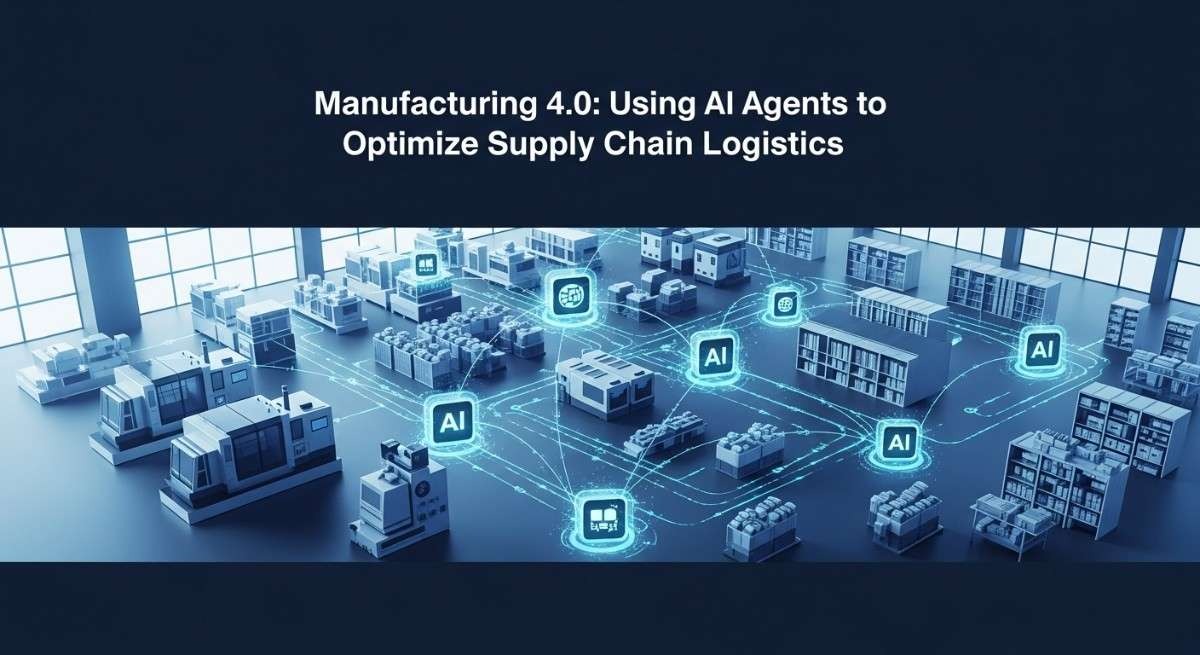
AI agents for supply chain logistics are transforming how manufacturers operate. These intelligent systems predict disruptions before they happen. They optimize routes in real-time and coordinate activities across entire networks. The result? Lower costs, faster delivery, and resilient operations that adapt to any challenge.
This comprehensive guide explores how Manufacturing 4.0 leverages artificial intelligence to revolutionize supply chain management. You’ll discover practical strategies, real-world applications, and implementation roadmaps. Let’s examine how intelligent automation is reshaping industrial logistics forever.
Table of Contents
Understanding Manufacturing 4.0 and Digital Transformation
The Fourth Industrial Revolution builds upon digital foundations laid in previous decades. Manufacturing 4.0 connects physical production with digital intelligence. Sensors track every machine and product in real-time. Data flows seamlessly from factory floors to executive dashboards.
This transformation extends far beyond factory walls. Supply chains become intelligent networks rather than linear sequences. Every supplier, warehouse, and transportation route connects through digital systems. Information moves at the speed of light while physical goods follow optimized paths.
Smart factories emerged as the visible face of Manufacturing 4.0. Robots work alongside humans with unprecedented safety and efficiency. 3D printing enables on-demand production of complex parts. Predictive maintenance prevents equipment failures before they occur. These innovations grab headlines but supply chain intelligence delivers equally revolutionary impact.
The Evolution From Traditional to Smart Logistics
Traditional supply chain management relied on experience and manual planning. Logistics coordinators maintained spreadsheets tracking shipments and inventory. Phone calls and emails coordinated activities across partners. This approach worked adequately in stable, predictable markets.
Modern markets move too fast for human-speed coordination. Customer expectations demand same-day delivery and perfect order accuracy. Global disruptions create cascading failures throughout traditional supply chains. The pandemic exposed how fragile manual coordination truly is.
Digital logistics systems emerged to handle growing complexity. Transportation management systems tracked shipments electronically. Warehouse management software coordinated inventory movements. These tools improved visibility but still required substantial human oversight. Decisions remained manual even when information became digital.
What Makes Manufacturing 4.0 Different
Integration defines Manufacturing 4.0 supply chains. Every system communicates with every other system automatically. Production schedules trigger procurement orders without human intervention. Inventory levels adjust transportation routes dynamically. The entire supply chain operates as one intelligent organism.
Autonomy reaches new levels through artificial intelligence. Systems make decisions independently within defined parameters. Machine learning algorithms optimize continuously based on outcomes. Human managers set strategy while AI handles tactical execution. This division of labor maximizes both human creativity and machine efficiency.
Real-time responsiveness separates smart logistics from legacy systems. Traditional planning worked in weekly or monthly cycles. AI agents for supply chain logistics react within milliseconds. Disruptions trigger instant replanning across the entire network. Agility becomes the default rather than an aspirational goal.
What Are AI Agents for Supply Chain Logistics?
AI agents for supply chain logistics are autonomous software systems that manage specific supply chain functions. Each agent specializes in particular tasks like demand forecasting, route optimization, or inventory management. These digital workers operate continuously without fatigue or distraction.
An AI agent monitoring supplier performance tracks thousands of data points simultaneously. It analyzes delivery times, quality metrics, and communication patterns. The agent identifies concerning trends before they become critical problems. Corrective actions get recommended or implemented automatically depending on severity.
These agents learn from every interaction and outcome. Machine learning algorithms identify what works in your specific environment. Performance improves month over month without additional programming. Your supply chain becomes smarter through experience.
Key Capabilities of Supply Chain AI Agents
Predictive analytics enable agents to forecast future conditions accurately. Historical data combines with external factors like weather and economic indicators. The AI identifies patterns that humans miss in overwhelming data volumes. Forecasts become more accurate than traditional statistical methods.
Optimization algorithms find the best solutions among millions of possibilities. Route planning considers traffic, fuel costs, delivery windows, and vehicle capacity simultaneously. AI agents for supply chain logistics evaluate combinations far beyond human cognitive capacity. Near-optimal solutions emerge in seconds rather than hours.
Autonomous decision-making within preset boundaries eliminates delays. The agent doesn’t need approval for routine decisions. Exceptions get escalated to human managers automatically. This hybrid approach combines efficiency with appropriate oversight. Decisions happen at machine speed when possible and human speed when necessary.
How AI Agents Differ From Traditional Software
Legacy supply chain software provides tools for human operators. The system displays information and accepts commands. People analyze data and make decisions. Software executes those decisions but contributes no intelligence. The human remains the bottleneck.
AI agents for supply chain logistics make decisions independently. They analyze situations and choose actions without constant human direction. The agent understands context and applies learned rules. People set strategic direction while AI handles operational details. The intelligence moves from human to software.
Traditional systems operate on fixed rules programmed during implementation. Market conditions change but software behavior remains static. Updates require developers and lengthy deployment cycles. AI agents adapt continuously through machine learning. The system evolves alongside your business automatically.
Core Applications of AI Agents in Supply Chain Logistics
Demand forecasting accuracy improves dramatically with AI analysis. Traditional forecasting relies on historical averages and seasonal patterns. AI agents for supply chain logistics incorporate hundreds of variables simultaneously. Weather forecasts, social media trends, economic indicators, and competitive actions all inform predictions.
A beverage manufacturer deployed AI demand forecasting across their distribution network. The system reduced forecast error from 18% to 7% within six months. Inventory costs dropped by $2.3 million annually. Stockouts decreased by 65% while overstock situations nearly disappeared. Customer satisfaction improved as product availability increased.
Route optimization delivers immediate cost savings and service improvements. AI agents calculate optimal delivery sequences considering real-time traffic and customer priorities. Drivers receive updated routes dynamically as conditions change. Fuel consumption decreases while on-time deliveries increase.
Inventory Management and Warehouse Optimization
Intelligent inventory agents balance competing objectives effortlessly. Carrying costs push toward minimal stock while service levels demand buffer inventory. AI finds the optimal balance point for each SKU. Replenishment orders trigger automatically at calculated reorder points. Working capital decreases while product availability improves.
Warehouse operations benefit from AI coordination of activities. Receiving schedules align with put-away capacity. Pick paths get optimized based on order patterns. Labor allocation adjusts to predicted demand throughout the day. AI agents for supply chain logistics orchestrate hundreds of simultaneous activities flawlessly.
An electronics distributor implemented AI warehouse management across five facilities. Pick productivity increased 34% through optimized routing. Receiving dock congestion disappeared through intelligent scheduling. Order accuracy reached 99.7% as AI caught potential errors before execution. The facilities handled 40% more volume without additional headcount.
Supplier Relationship and Risk Management
AI agents monitor supplier performance across multiple dimensions continuously. Delivery punctuality, quality metrics, communication responsiveness, and financial stability all factor into assessments. The system identifies deteriorating suppliers before failures occur. Procurement teams receive early warnings enabling proactive intervention.
Risk assessment becomes comprehensive through AI analysis of global factors. Political instability, natural disasters, and economic conditions get monitored across all supplier regions. The agent calculates supply chain vulnerability scores automatically. Alternative sourcing strategies get developed for high-risk scenarios.
A automotive manufacturer deployed AI supplier risk management globally. The system identified potential disruptions 73 days earlier than traditional monitoring on average. Production shutdowns from supplier failures decreased by 87% year over year. Alternative suppliers got qualified proactively rather than reactively during crises.
Transportation and Fleet Management
Intelligent route planning adapts to changing conditions minute by minute. Traffic incidents trigger automatic rerouting of affected vehicles. Delivery appointments get rescheduled proactively when delays become inevitable. Customers receive accurate ETAs throughout the journey. AI agents for supply chain logistics transform transportation from reactive firefighting to proactive orchestration.
Fleet maintenance predictions prevent costly breakdowns. AI analyzes sensor data from vehicles continuously. Patterns indicating impending failures trigger maintenance scheduling. Repairs happen during planned downtime rather than unexpected breakdowns. Vehicle uptime increases while maintenance costs decrease.
Carrier selection optimization ensures best cost and service balance. The AI evaluates carriers based on price, reliability, and route suitability. Freight gets allocated automatically to optimal carriers. Performance feedback loops improve future allocations. Shipping costs decrease while service levels improve.
Implementation Strategies for AI Supply Chain Agents
Start with comprehensive data assessment and preparation. AI agents require quality data to learn effectively. Audit existing data sources for completeness and accuracy. Identify gaps that need filling before deployment. Clean data foundations determine AI success more than any other factor.
Most manufacturers have decades of operational data trapped in legacy systems. Extract and consolidate this information into accessible formats. Historical shipment records, inventory transactions, and demand patterns provide training material. The AI learns what worked and what didn’t in your specific environment.
External data sources enhance internal information significantly. Weather data explains seasonal demand variations. Economic indicators predict market shifts. Supplier financial data enables risk assessment. AI agents for supply chain logistics become more intelligent by incorporating diverse information streams.
Choosing Between Build and Buy Approaches
Custom development offers maximum flexibility and competitive advantage. Your AI agents work exactly how you need them to work. Proprietary algorithms create differentiation competitors can’t easily replicate. Development costs seem high initially but deliver long-term value.
Commercial platforms provide faster deployment and lower initial investment. Vendors offer pre-built agents for common supply chain functions. Implementation timelines measure in weeks rather than months. Ongoing support and updates come included with licensing fees.
Hybrid approaches combine strengths of both strategies. Start with commercial platforms for standard functions. Develop custom agents for unique processes that provide competitive advantages. This pragmatic path balances speed with differentiation. Most manufacturers find hybrid implementations optimal.
Integration With Existing Systems
AI agents for supply chain logistics must connect seamlessly with current infrastructure. ERP systems contain master data and transactional records. WMS platforms control warehouse operations. TMS software manages transportation execution. The AI needs bidirectional communication with all these systems.
API-based integration provides the cleanest technical approach. Modern systems expose functionality through application programming interfaces. AI agents call these APIs to read data and trigger actions. Clean integrations prevent data duplication and synchronization issues. Information flows smoothly between systems.
Legacy systems lacking APIs require different integration strategies. Data extraction through database connections or file transfers enables access to information. Robotic process automation can control legacy applications where direct integration proves impossible. Every system can connect with appropriate technical approaches.
Pilot Programs and Phased Rollouts
Prove value through focused pilot projects before full deployment. Select one supply chain process causing significant pain currently. Implement AI agents addressing that specific challenge. Measure results against baseline performance metrics. Success builds organizational confidence and momentum.
A pharmaceutical manufacturer started with AI-powered demand forecasting for oncology products. These items had complex demand patterns traditional forecasting handled poorly. The pilot reduced forecast error by 43% within three months. Inventory costs dropped while product availability improved. Success led to enterprise-wide rollout across all product categories.
Expand gradually from pilot successes to adjacent processes. Each implementation provides learning opportunities. Technical teams develop expertise through repeated deployments. Change management improves as early adopters become advocates. Phased approaches manage risk while building organizational capability.
Measuring ROI and Performance Improvements
Cost reduction delivers the most visible financial benefits. AI agents for supply chain logistics optimize transportation routes saving fuel and time. Inventory optimization reduces carrying costs and warehouse space needs. Labor productivity increases as AI handles routine coordination tasks. These savings flow directly to the bottom line.
A consumer goods manufacturer documented $8.7 million in annual savings from AI logistics optimization. Transportation costs decreased 14% through better routing and carrier selection. Inventory holding costs fell 22% while service levels improved. Warehouse labor productivity increased 31% through intelligent task coordination. The AI implementation paid for itself in 11 months.
Service improvements often exceed cost savings in total value. On-time delivery rates increase as AI prevents delays proactively. Order accuracy improves through intelligent error detection. Customer satisfaction scores rise in response to better service. Happy customers buy more and cost less to retain.
Key Performance Indicators to Track
Perfect order rate measures the ultimate supply chain goal. This metric tracks orders delivered complete, on-time, undamaged, and with correct documentation. AI agents optimize toward this comprehensive measure. Improvements in perfect order rate directly correlate with customer satisfaction.
Inventory turnover indicates working capital efficiency. Higher turnover means capital isn’t trapped in excess stock. AI agents for supply chain logistics optimize inventory levels dynamically. Companies typically see 25-40% turnover improvements after AI implementation. Cash flow improves as inventory investment decreases.
Supply chain cycle time measures end-to-end speed. This tracks time from order placement to customer delivery. AI compression of cycle times enables competitive advantages. Faster fulfillment wins customers in time-sensitive markets. Cycle time reductions of 30-50% are common with intelligent logistics.
Calculating Total Value Beyond Hard Savings
Risk reduction value often exceeds direct cost savings. Supply chain disruptions cost manufacturers millions in lost production and rush charges. AI agents for supply chain logistics predict and prevent many disruptions. The value of avoided crises is substantial but often overlooked in ROI calculations.
Capacity utilization improvements create expansion value. Better logistics enables handling more volume through existing infrastructure. Companies avoid capital investments in warehouses and equipment. The AI effectively expands capacity without physical expansion costs.
Competitive positioning value emerges over longer timeframes. Companies with superior logistics attract customers from competitors. Reliable delivery and product availability build strong reputations. Market share gains compound over years. This strategic value dwarfs tactical cost savings but proves harder to quantify.
Industry-Specific Applications and Case Studies
Automotive manufacturing demands just-in-time precision with thousands of components. A single missing part halts entire assembly lines costing millions. AI agents for supply chain logistics coordinate supplier deliveries with production schedules perfectly. Tier 1 suppliers receive automated pull signals based on actual line consumption. Inventory at assembly plants dropped by 45% while production never stopped.
A German automaker implemented AI logistics across their European supply network. The system coordinated 847 suppliers delivering to 12 assembly plants. Parts arrived within 2-hour windows matching production needs exactly. Working capital decreased by €340 million annually. Production efficiency increased as material availability reached 99.97%.
Electronics manufacturing faces rapid product obsolescence and volatile demand. Components become worthless when newer models launch. AI demand forecasting dramatically reduces excess inventory risk. The system identifies trends in consumer preferences before they fully materialize. Production and procurement align with predicted demand rather than historical patterns.
Food and Beverage Supply Chains
Perishability creates unique challenges in food logistics. Products have limited shelf lives requiring rapid movement. Temperature control throughout the supply chain prevents spoilage. AI agents for supply chain logistics optimize for freshness alongside traditional cost and service metrics.
A dairy cooperative deployed AI across their distribution network. The system routed products based on production dates and shelf life. Retail stores received stock with maximum remaining freshness. Food waste decreased 34% while consumer complaints about expired products dropped 78%. Revenue increased as customers found fresher products reliably.
Seasonal demand swings challenge food manufacturers significantly. AI forecasting incorporates weather predictions, holiday timing, and promotional activities. Production plans adjust dynamically to predicted demand. Inventory moves to regional warehouses preemptively before demand spikes. Stockouts during peak seasons decreased by 62% while excess inventory after seasons dropped by 71%.
Pharmaceutical and Healthcare Logistics
Regulatory compliance complicates pharmaceutical supply chains immensely. Serialization requirements track individual units throughout distribution. Temperature excursions must be monitored and documented continuously. Product recalls need precise identification of affected batches. AI agents manage this complexity far better than manual processes.
Cold chain integrity monitoring uses AI analysis of temperature sensor data. The system detects patterns indicating equipment problems before failures occur. Products get rerouted automatically when temperature excursions happen. Complete chain of custody documentation generates automatically for regulatory audits. Compliance costs decreased 41% while quality assurance improved.
Clinical trial logistics present unique coordination challenges. Investigational drugs must reach research sites on precise schedules. AI agents for supply chain logistics coordinate manufacturing, distribution, and site delivery. Patient dosing schedules drive automated replenishment. Trial delays from supply issues decreased by 83% after AI implementation.
Overcoming Implementation Challenges
Data quality issues plague most AI implementations. Legacy systems contain incomplete and inaccurate information. Different systems define identical concepts differently. Reconciling these inconsistencies requires substantial effort. Companies underestimate data cleanup requirements consistently.
Dedicate resources to data quality improvement before AI deployment. Establish master data management processes and governance. Implement data validation rules preventing bad information from entering systems. Clean data foundations take time but determine AI success absolutely.
Change management resistance slows or stops many initiatives. Employees fear job loss from automation. Existing processes have institutional momentum resisting modification. Stakeholders doubt new technology will deliver promised benefits. Address these human factors as seriously as technical challenges.
Building Organizational Buy-In
Communicate AI benefits clearly across all organizational levels. Executives need to understand strategic value and competitive implications. Operational managers want to know how AI helps them achieve KPIs. Front-line workers need reassurance about their roles. Tailor messaging to each audience’s concerns and interests.
Involve key stakeholders early in planning and design. People support what they help create. Gather input on requirements and pain points. Share design decisions and explain tradeoffs. Early involvement creates ownership and reduces resistance later.
Celebrate quick wins and communicate results broadly. AI agents for supply chain logistics deliver visible improvements rapidly. Share success stories through internal communications. Recognize teams and individuals contributing to achievements. Momentum builds as success becomes undeniable.
Managing Technical Complexity
AI implementations require specialized skills many organizations lack internally. Data scientists, machine learning engineers, and integration specialists command high salaries. Building complete teams internally challenges mid-sized manufacturers. Talent shortages slow projects regardless of budget.
Partner with experienced AI implementation firms for knowledge transfer. Vendors should build capability within your organization during projects. Insist on training and documentation enabling internal support. The goal is independence rather than vendor dependence.
Start with simpler AI applications building toward complexity. Basic demand forecasting delivers value while building team experience. Route optimization follows as confidence grows. Complex multi-objective optimization comes last after mastery of foundations. Progressive sophistication manages risk and learning curves.
The Future of AI in Supply Chain Logistics
Autonomous supply chains will emerge over the next decade. AI agents for supply chain logistics will coordinate activities with minimal human oversight. Strategic decisions remain human but tactical execution becomes fully automated. Supply chains operate as self-regulating systems adapting to conditions automatically.
Digital twins create virtual replicas of physical supply chains. These simulations test scenarios before implementing changes in reality. What-if analysis identifies optimal strategies risk-free. Physical operations follow proven virtual strategies. Decision quality improves dramatically through consequence-free experimentation.
Blockchain integration will enable transparent multi-party coordination. Smart contracts execute automatically when conditions are met. Payments release upon confirmed delivery. All parties see identical information eliminating disputes. Trust comes from technology rather than relationships alone.
Emerging Technologies and Capabilities
Quantum computing will eventually enable optimization at unprecedented scales. Current AI agents evaluate thousands of scenarios quickly. Quantum systems will analyze billions of possibilities instantly. Supply chain optimization will reach theoretical perfection. This capability remains years away but promises revolutionary impact.
5G networks enable real-time coordination of mobile assets. Trucks, containers, and packages communicate continuously. Location tracking reaches centimeter accuracy. IoT sensors report conditions every second. The supply chain becomes fully visible in real-time. AI agents for supply chain logistics react to perfect information instantly.
Augmented reality will transform warehouse operations. Workers see AI-generated guidance overlaid on physical spaces. Picking paths appear visually in their field of view. Error prevention happens through visual confirmation. Human workers become cyborgs assisted by AI intelligence.
Sustainability and Circular Economy Integration
Environmental considerations increasingly influence supply chain decisions. Carbon footprint tracking becomes mandatory in many markets. AI agents optimize for emissions alongside cost and service. Route planning includes environmental impact calculations. The greenest path emerges when costs are comparable.
Circular economy principles require reverse logistics excellence. AI agents for supply chain logistics coordinate product returns and refurbishment. Materials get routed to recycling facilities automatically. Remanufactured components return to production systems seamlessly. Closed-loop supply chains become economically viable through AI coordination.
Waste reduction targets benefit from intelligent inventory management. AI prevents overproduction and excess inventory. Products reach end customers before expiration. Disposal costs and environmental impact decrease simultaneously. Sustainability and profitability align through optimization.
Building Your AI Supply Chain Roadmap
Assessment comes first in any successful implementation. Document current processes and pain points thoroughly. Quantify problems in financial terms whenever possible. Identify quick wins delivering fast ROI. Map dependencies between different supply chain functions.
Prioritize opportunities based on impact and feasibility. High-impact, low-complexity projects should launch first. These quick wins build momentum and credibility. More complex initiatives follow as capability and confidence grow. The roadmap sequences projects for maximum cumulative value.
Define success metrics before starting each initiative. Establish baseline performance for comparison. Set realistic improvement targets based on industry benchmarks. Track progress weekly or monthly depending on project timeline. Visible progress maintains organizational commitment and energy.
Essential Capabilities and Prerequisites
Technology infrastructure must support AI workloads. Cloud computing provides scalable processing power most manufacturers need. On-premise alternatives exist but require substantial upfront investment. Hybrid approaches balance control with flexibility. Choose infrastructure matching your technical capabilities and requirements.
Data infrastructure determines what’s possible with AI. Central data repositories consolidate information from disparate sources. Data pipelines move information where needed automatically. AI agents for supply chain logistics consume massive data volumes continuously. Infrastructure must deliver information at the speed AI requires.
Organizational capabilities matter as much as technology. Continuous improvement culture embraces experimentation and learning. Cross-functional collaboration breaks down functional silos. Executive sponsorship provides resources and removes obstacles. Culture and leadership determine implementation success more than technology selection.
Investment Requirements and Timeline Expectations
Initial investments range from $100,000 for basic implementations to $5 million for comprehensive enterprise deployments. Software licensing, infrastructure, consulting, and internal labor all contribute to costs. Most mid-sized manufacturers spend $500,000-$1.5 million on first-phase implementations.
Timeline expectations should span 6-18 months for meaningful results. Data preparation alone consumes 2-4 months typically. System integration and configuration take another 3-6 months. Testing and refinement before full deployment add 1-3 months. Patient persistence pays dividends but quick results are unrealistic.
Ongoing costs include software licensing, infrastructure, and support personnel. Budget 20-30% of initial implementation cost annually for maintenance and enhancement. AI agents for supply chain logistics require continuous attention despite their autonomous nature. Plan for the long-term commitment not just initial deployment.
Read More:-How to Integrate AI into Your Existing SaaS Without Rewriting the Codebase
Conclusion

AI agents for supply chain logistics represent the future of manufacturing operations. Traditional manual coordination cannot match the speed and optimization AI delivers. Companies implementing intelligent logistics gain competitive advantages that compound over time. The question is not whether to adopt AI but how quickly you can deploy it successfully.
Manufacturing 4.0 demands supply chain excellence. Customer expectations rise continuously while markets grow more volatile. Only AI-powered logistics can adapt fast enough to thrive in this environment. Human managers set strategy while intelligent agents execute flawlessly at scale.
Implementation requires careful planning and realistic expectations. Data quality foundations determine success more than algorithm sophistication. Change management deserves equal attention to technical execution. Organizations succeeding at both deliver transformational results.
Start your AI logistics journey today by identifying your most pressing supply chain challenge. Quantify the problem’s financial impact. Research solution providers specializing in that domain. AI agents for supply chain logistics solve specific problems better than generic approaches. Focus creates faster success.
The manufacturers winning tomorrow’s competitive battles are building AI capabilities now. First-movers establish advantages that late adopters struggle to overcome. Your competitors already evaluate these technologies. Waiting means falling behind in an increasingly intelligence-driven industry.
Begin with pilot projects proving value before enterprise commitments. Success breeds confidence and organizational support. Each implementation builds capability for the next. AI agents for supply chain logistics transform operations one process at a time. The journey begins with a single step. Take that step today before your competition does.