Introduction
TL;DR Cloud infrastructure has become the backbone of modern business operations. System failures and bugs can cost companies millions in revenue and damage customer trust.
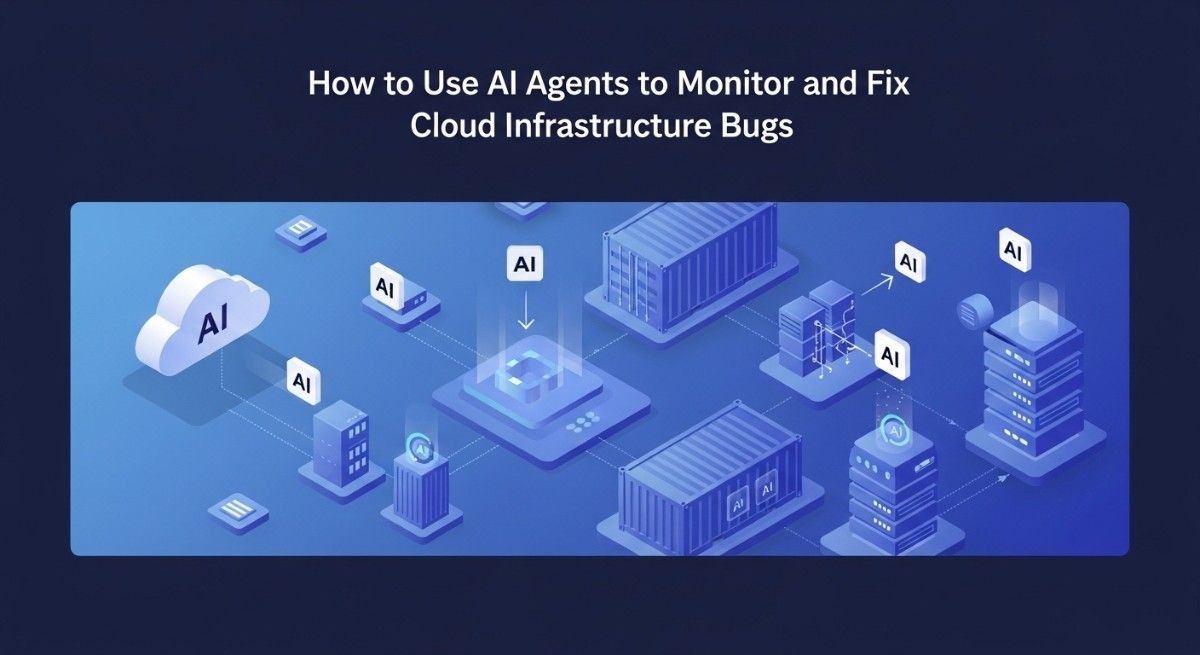
AI agents for cloud infrastructure are transforming how DevOps teams detect and resolve issues. These intelligent systems work around the clock to identify problems before they escalate into major outages.
Your cloud environment generates massive amounts of data every second. Human operators cannot possibly monitor every metric, log file, and performance indicator manually.
Artificial intelligence fills this critical gap. Machine learning algorithms spot patterns that humans miss and respond to incidents faster than any manual process.
This guide reveals practical strategies for implementing AI-powered monitoring and remediation in your cloud systems.
Table of Contents
Understanding AI Agents in Cloud Infrastructure Management
AI agents represent a fundamental shift in infrastructure operations. These autonomous software systems observe your cloud environment continuously and take action based on what they discover.
Traditional monitoring tools simply alert humans when problems occur. AI agents go several steps further by analyzing root causes and implementing fixes automatically.
The technology combines multiple disciplines into cohesive systems. Machine learning enables pattern recognition across vast datasets. Natural language processing helps agents understand log files and error messages. Reasoning engines determine appropriate responses to different scenarios.
Cloud environments create perfect conditions for AI deployment. Everything runs on software-defined infrastructure that APIs can control programmatically. Agents leverage these APIs to make configuration changes and deploy fixes without human intervention.
The business impact extends far beyond faster incident response. AI agents for cloud infrastructure reduce operational costs by automating repetitive troubleshooting tasks. Your engineering team focuses on strategic initiatives instead of fighting fires constantly.
Reliability improvements translate directly to better customer experiences. Applications stay online more consistently. Performance remains stable under varying load conditions. Users notice fewer disruptions and slowdowns.
Security postures strengthen when AI monitors for anomalies continuously. Unusual access patterns and configuration changes trigger immediate investigation. Potential breaches get detected in minutes rather than days or weeks.
Core Components of AI-Powered Cloud Monitoring Systems
Effective AI monitoring requires multiple integrated components working together. Data collection forms the foundation of any intelligent system.
Agents need access to comprehensive telemetry from every layer of your infrastructure. Server metrics like CPU utilization and memory consumption provide basic health indicators. Network traffic patterns reveal connectivity issues and bandwidth bottlenecks. Application logs contain detailed information about software behavior and errors.
Data pipelines transport this information to centralized processing systems. Stream processing frameworks handle real-time data flows efficiently. Time-series databases store metrics optimized for rapid querying and analysis.
Machine learning models trained on historical data identify normal behavior patterns. Anomaly detection algorithms flag deviations that might indicate problems. Classification models categorize issues by type and severity.
Knowledge bases store information about known problems and their solutions. Your organization’s tribal knowledge gets codified into machine-readable formats. Past incidents inform future responses through continuous learning.
Orchestration engines coordinate actions across multiple systems. An agent might need to restart services, adjust load balancer configurations, and notify team members simultaneously. Workflow automation ensures these steps execute in the correct sequence.
Decision frameworks determine when agents should act autonomously versus escalating to humans. Low-risk fixes happen automatically. High-stakes changes require approval from engineers. This balance maintains safety while maximizing automation benefits.
Integration points connect agents to your existing tools and platforms. APIs link monitoring systems to cloud provider management consoles. Webhooks trigger actions in incident management platforms. Chat integrations keep teams informed through their preferred communication channels.
Setting Up Data Collection for AI Analysis
Comprehensive data gathering enables accurate analysis and decision-making. Your AI agents need visibility into every component of your cloud infrastructure.
Infrastructure monitoring begins with compute resources. Virtual machines, containers, and serverless functions all generate valuable metrics. CPU and memory statistics reveal resource constraints. Disk I/O measurements identify storage bottlenecks. Network metrics show communication patterns between services.
Application performance monitoring captures user-facing behavior. Response times indicate how quickly your systems serve requests. Error rates reveal software bugs and integration failures. Transaction traces show the complete path of requests through distributed systems.
Log aggregation centralizes text-based diagnostic information. Application logs document software execution flow and errors. System logs record operating system events and security activities. Audit logs track configuration changes and access patterns.
Distributed tracing follows requests across microservices architectures. Trace data reveals which services contribute to overall latency. Performance problems get pinpointed to specific components quickly. This visibility is essential in complex distributed systems.
Synthetic monitoring proactively tests system functionality. Automated scripts simulate user interactions continuously. These health checks detect problems before real users encounter them. Geographic diversity in synthetic tests reveals regional issues.
Cost and billing data informs optimization decisions. Usage metrics get correlated with spending patterns. AI agents for cloud infrastructure identify wasteful resource allocation and recommend rightsizing opportunities.
Security event streams feed threat detection systems. Authentication logs reveal suspicious access attempts. Configuration change records help identify security drift. Vulnerability scan results highlight systems needing patches.
Training Machine Learning Models for Bug Detection
Effective AI requires models trained on relevant data from your specific environment. Generic models miss the nuances of your unique infrastructure patterns.
Historical incident data provides valuable training material. Your past outages and bugs contain lessons that inform future detection. Labeled datasets categorize previous problems by root cause and symptom patterns.
Normal baseline establishment helps identify anomalies accurately. Models learn what healthy system behavior looks like under various conditions. Weekend traffic patterns differ from weekday peaks. Holiday loads require different baselines than regular business days.
Feature engineering transforms raw metrics into meaningful signals. Simple CPU percentages become rate-of-change calculations that better indicate problems. Multiple correlated metrics combine into composite health scores.
Supervised learning works well when you have labeled historical data. Classification models predict whether current conditions indicate specific bug types. Regression models forecast future resource needs based on historical trends.
Unsupervised learning discovers patterns without predefined categories. Clustering algorithms group similar incidents together automatically. This reveals previously unrecognized problem categories in your infrastructure.
Time-series forecasting predicts future metric values. Capacity planning benefits from accurate growth projections. Proactive scaling prevents performance degradation before it occurs.
Model validation ensures accuracy before production deployment. Holdout datasets test performance on data the model has not seen. Precision and recall metrics quantify detection effectiveness. False positive rates determine whether alerts overwhelm your team.
Continuous retraining keeps models current as your infrastructure evolves. New services introduce different performance characteristics. Traffic patterns shift as your business grows. Models must adapt to remain effective.
Implementing Automated Bug Detection Workflows
Detection workflows transform model predictions into actionable insights. AI agents for cloud infrastructure need structured processes for evaluating and responding to potential issues.
Alert generation starts when models detect anomalies or predict problems. Thresholds determine which detections warrant immediate attention. Severity scoring prioritizes issues based on business impact.
Context enrichment adds relevant information to basic alerts. The affected service name, recent deployment history, and current traffic levels all help responders understand situations quickly. Geographic distribution of impact reveals whether problems are localized or widespread.
Correlation analysis groups related alerts together. A database failure might trigger dozens of downstream errors. Intelligent correlation prevents alert storms that overwhelm on-call engineers.
Root cause analysis examines multiple data sources to identify underlying problems. Application errors might stem from database performance issues. Database slowdowns could result from storage saturation. Agents trace symptom chains to fundamental causes.
Impact assessment quantifies business consequences. Revenue impact calculations prioritize commercial systems. User experience metrics reveal customer-facing degradation. Service level objective violations indicate breach of commitments.
Escalation logic routes issues to appropriate responders. Database problems go to database administrators. Network issues reach network engineering teams. Cross-functional problems involve multiple specialties simultaneously.
Notification delivery uses multiple channels to ensure visibility. Email alerts document issues formally. SMS messages reach on-call personnel urgently. Chat platform integrations keep entire teams informed. Phone calls escalate critical situations requiring immediate response.
Developing Intelligent Remediation Strategies
Detection alone provides limited value without effective remediation. AI agents must take corrective action to resolve problems automatically.
Playbook automation codifies standard operating procedures. Common fixes get documented as executable workflows. Restarting failed services, clearing full disk space, and adjusting configuration parameters all become automated responses.
Safety mechanisms prevent agents from causing additional problems. Dry-run modes simulate changes without actually executing them. Change windows restrict automated modifications to approved time periods. Approval gates require human confirmation for risky operations.
Rollback capabilities allow quick recovery from failed fixes. Configuration snapshots preserve system state before changes. Automated rollback triggers activate when fixes make situations worse. This safety net enables more aggressive automation.
Progressive remediation attempts simple fixes before complex interventions. Restarting a service might resolve temporary glitches. Scaling resources addresses capacity constraints. Configuration adjustments optimize performance under current conditions.
Dependency awareness prevents cascading failures. Agents understand relationships between components. Database maintenance considers dependent application services. Network changes account for traffic routing requirements.
Testing validation confirms fixes actually resolved problems. Post-remediation checks verify that symptoms disappeared. Performance metrics confirm systems returned to normal operation. User experience monitoring validates that customers see improvements.
Learning loops improve remediation strategies over time. Success rates for different fix types get tracked and analyzed. Ineffective approaches get deprioritized. Successful patterns receive more automation confidence. AI agents for cloud infrastructure become more effective through accumulated experience.
Integrating AI Agents with Cloud Provider Platforms
Cloud platform integration enables agents to monitor and control infrastructure effectively. Each major provider offers different APIs and tools.
AWS integration leverages CloudWatch for metrics and logs. EC2 APIs control compute resources. Auto Scaling Groups enable dynamic capacity adjustments. Lambda functions provide serverless execution for agent logic. Systems Manager automates configuration management and patching.
Azure Monitor provides comprehensive telemetry collection. Azure Resource Manager APIs control infrastructure provisioning. Azure Automation handles runbook execution. Application Insights delivers deep application monitoring. Logic Apps orchestrate multi-step remediation workflows.
Google Cloud Operations Suite centralizes monitoring capabilities. Compute Engine APIs manage virtual machines. Cloud Functions execute remediation code. Cloud Deployment Manager handles infrastructure as code. Stackdriver Logging aggregates log data across services.
Multi-cloud scenarios require unified agent platforms. Agents need consistent interfaces across different providers. Abstraction layers translate provider-specific APIs into common operations. This portability prevents vendor lock-in and simplifies operations.
Kubernetes deployments add container orchestration complexity. Prometheus collects metrics from containerized applications. Operators extend Kubernetes with custom resource management. Helm charts standardize agent deployment configurations. Service meshes like Istio provide additional observability and control.
Serverless architectures require different monitoring approaches. Function execution metrics replace traditional server monitoring. Cold start latencies need special attention. Cost optimization becomes more critical with pay-per-invocation pricing.
Infrastructure as code integration maintains consistency. Terraform and CloudFormation templates define desired state. Agents detect drift from defined configurations. Automated reconciliation brings systems back into compliance.
Real-World Use Cases and Implementation Examples
Practical examples illustrate how organizations deploy AI agents for cloud infrastructure successfully.
E-commerce platforms use agents to handle traffic spikes automatically. Black Friday and Cyber Monday create massive load increases. AI systems monitor conversion rates and page load times. Scaling decisions happen in seconds based on real-time demand. Revenue protection drives aggressive automation investment.
Financial services firms deploy agents for compliance and security. Unusual transaction patterns trigger immediate investigation. Configuration changes get audited against regulatory requirements. Security vulnerabilities receive automated patching. The highly regulated environment demands perfect audit trails.
Media streaming companies rely on agents for quality of service. Video buffering rates indicate network and server performance. Content delivery network optimization happens continuously. Regional outages trigger automatic traffic rerouting. User experience directly correlates with subscriber retention.
SaaS providers automate database performance optimization. Query performance degrades slowly over time as data grows. Index recommendations happen automatically based on query patterns. Partitioning strategies adapt to data distribution. Customer databases receive individualized tuning.
Gaming companies handle massive player count fluctuations. New game launches create unpredictable demand. Match-making services need consistent low latency. AI agents provision capacity across geographic regions. Player experience quality determines competitive success.
Healthcare systems maintain strict uptime requirements. Electronic health records must remain accessible constantly. Privacy regulations complicate monitoring and access. Automated failover ensures continuity during infrastructure problems. Patient safety depends on reliable systems.
Development platforms accelerate software delivery. Build and deployment pipeline performance affects developer productivity. Resource allocation optimizes for job completion time. Cost controls prevent runaway spending on development infrastructure.
Measuring Success and ROI of AI Infrastructure Agents
Quantifying agent effectiveness justifies investment and guides improvement. Multiple metrics reveal different aspects of value delivery.
Mean time to detection measures how quickly problems get identified. Baseline measurements from manual monitoring provide comparison points. AI systems typically detect issues minutes or hours faster. Earlier detection prevents small problems from becoming major outages.
Mean time to resolution tracks complete incident lifecycles. Automated remediation dramatically reduces resolution times. Incidents that previously took hours might resolve in minutes. This improvement directly translates to reduced downtime costs.
Incident volume reduction shows prevention effectiveness. Proactive fixes stop problems before they impact users. Trending analysis reveals whether total incidents decrease over time. The goal is fewer incidents rather than just faster response.
False positive rates indicate detection accuracy. Excessive false alarms create alert fatigue. Engineers start ignoring notifications when most prove irrelevant. Tuning efforts focus on maintaining high accuracy while minimizing false positives.
Automation coverage percentage shows what proportion of incidents get resolved without human intervention. Initial deployments might automate simple scenarios. Mature implementations handle majority of common problems automatically. This metric drives continuous expansion of automated remediation playbooks.
Cost savings from reduced downtime represent tangible financial benefits. Every minute of outage has calculable business impact. Multiplying incident reduction by cost per incident quantifies savings. These numbers justify agent platform investments to executive stakeholders.
Operational efficiency improvements free engineering time for strategic work. Engineers spend less time on repetitive troubleshooting. Innovation projects receive more attention and resources. Employee satisfaction improves when tedious work gets automated.
Security Considerations for AI Agent Deployment
Security requires careful attention when granting AI systems infrastructure control. AI agents for cloud infrastructure need robust security frameworks.
Access control limits what agents can modify. Role-based permissions restrict actions to necessary operations. Least privilege principles minimize potential damage from compromised agents. Separate credentials for different automation tasks contain security breaches.
Audit logging captures all agent actions comprehensively. Every configuration change gets recorded with full context. These logs enable forensic investigation after incidents. Compliance requirements often mandate detailed audit trails.
Secret management protects sensitive credentials. API keys and passwords need secure storage. Rotation policies limit credential lifetime. Dynamic secret generation reduces long-term credential exposure.
Change approval workflows add human oversight to risky operations. Production database modifications might require manual confirmation. Infrastructure deletions trigger approval requests. This governance balances automation benefits with risk management.
Anomaly detection monitors agent behavior itself. Unusual action patterns might indicate compromise. Agents monitoring other agents create defense in depth. This meta-monitoring catches sophisticated attacks.
Network segmentation isolates agent systems. Dedicated VPCs or subnets limit lateral movement. Firewall rules restrict agent communication to necessary endpoints. Network policies enforce security boundaries.
Encryption protects data in transit and at rest. TLS secures API communications. Database encryption safeguards sensitive monitoring data. Key management systems handle encryption keys securely.
Penetration testing validates security controls. Red team exercises attempt to compromise agent systems. Vulnerabilities get identified and remediated before real attacks. Regular security assessments maintain strong postures.
Common Challenges and Solutions
Organizations encounter predictable obstacles when implementing AI monitoring and remediation. Understanding these challenges accelerates successful deployment.
Data quality issues undermine model accuracy. Incomplete metrics create blind spots. Inconsistent log formats complicate parsing. Solutions involve standardizing telemetry collection and implementing data validation. Schema enforcement prevents malformed data from polluting training sets.
Alert fatigue occurs when systems generate too many notifications. Engineers become desensitized to constant alerts. Important issues get lost in noise. Addressing this requires intelligent correlation and severity scoring. Progressive alert reduction should accompany automation maturity.
Organization resistance stems from fear of automation. Engineers worry about job security. Managers question whether AI can really handle complex decisions. Change management and education programs address these concerns. Demonstrating value through pilot projects builds confidence.
Skills gaps limit implementation success. Traditional operations teams may lack machine learning expertise. Data scientists might not understand infrastructure deeply. Cross-training and hiring strategies build necessary capabilities. Partnership between infrastructure and data science teams produces best results.
Integration complexity slows initial deployment. Legacy systems lack modern APIs. Multiple cloud providers require different integrations. Phased approaches tackle integration incrementally. Starting with well-instrumented modern systems builds momentum.
Model drift reduces accuracy over time. Infrastructure changes alter normal behavior patterns. Models trained on old data become less effective. Continuous monitoring of model performance identifies drift. Regular retraining maintains accuracy.
Cost management prevents runaway spending. AI systems themselves consume significant resources. Data storage and processing add substantial expenses. Cost monitoring and optimization ensure positive ROI. Right-sizing agent infrastructure balances capability with expense.
Future Trends in AI-Powered Infrastructure Management
The field continues evolving rapidly. Understanding emerging trends helps plan long-term strategies.
Autonomous infrastructure represents the ultimate automation goal. Systems will self-heal without any human intervention. Capacity planning will happen automatically based on predicted demand. Engineers will focus entirely on architecture and strategy.
Natural language interfaces will simplify agent interaction. Operations teams will describe desired states conversationally. Agents will translate natural language into technical implementations. This democratizes infrastructure management beyond specialists.
Predictive failure prevention will replace reactive incident response. AI will identify component failures before they occur. Proactive replacements will happen during maintenance windows. Downtime from unexpected failures will become rare.
Collaborative AI agents will work together on complex problems. Network agents will coordinate with security agents. Application performance agents will share insights with infrastructure agents. This cooperation will solve multi-dimensional challenges.
Explainable AI will build trust in automated decisions. Agents will articulate reasoning behind recommended actions. Human operators will understand why specific fixes make sense. Transparency will accelerate automation adoption.
Edge computing integration will extend monitoring to distributed environments. IoT devices and edge nodes will receive intelligent monitoring. Agents will operate closer to data sources. Centralized and distributed intelligence will complement each other.
Quantum computing may eventually enhance AI capabilities. Complex optimization problems will become tractable. Resource allocation will reach theoretical optimums. This represents longer-term potential rather than immediate capability.
Frequently Asked Questions
How much does it cost to implement AI agents for cloud infrastructure monitoring?
Implementation costs vary based on scale and requirements. Small deployments might spend $10,000-50,000 on tooling and setup. Enterprise implementations can exceed $500,000 including personnel, infrastructure, and software licenses. Cloud-based agent platforms offer subscription pricing starting around $1,000 monthly.
Do AI agents completely eliminate the need for human DevOps engineers?
No. AI agents for cloud infrastructure augment human capabilities rather than replacing people entirely. Engineers focus on strategic architecture decisions and complex problem-solving. Agents handle routine monitoring and standard remediation tasks. The partnership between humans and AI delivers optimal results.
How long does it take to see benefits from AI infrastructure agents?
Initial value appears within weeks for simple automation scenarios. Comprehensive implementations delivering full ROI typically require six to twelve months. This timeline includes data collection, model training, and gradual automation expansion. Quick wins should be prioritized to maintain organizational momentum.
What happens if the AI agent makes a mistake and causes an outage?
Proper implementations include safety mechanisms preventing catastrophic errors. Rollback capabilities restore previous configurations quickly. Change approval workflows add human oversight for risky operations. Dry-run testing validates changes before production execution. These safeguards minimize risk substantially.
Can AI agents work with legacy infrastructure?
Yes, though implementation requires more effort. Legacy systems often need wrapper APIs providing modern interfaces. Agent capabilities may be limited compared to cloud-native environments. Gradual migration strategies combine legacy support with modern system optimization.
How do you handle sensitive data in AI monitoring systems?
Data masking removes sensitive information before analysis. Encryption protects data in transit and storage. Access controls limit who can view monitoring data. Compliance frameworks guide appropriate handling. Many agents analyze patterns without accessing actual sensitive content.
What skills does my team need to implement and maintain AI agents?
Essential skills include cloud infrastructure expertise, software development capabilities, and machine learning fundamentals. DevOps experience helps with integration and deployment. Data engineering knowledge enables effective telemetry pipelines. Teams can acquire skills through training or strategic hiring.
How do you measure whether AI agents are actually improving infrastructure reliability?
Track incident frequency, severity, and duration over time. Compare mean time to detection and resolution before and after deployment. Monitor business metrics like uptime percentage and customer satisfaction. Cost metrics reveal financial impact. Regular reporting demonstrates value to stakeholders.
Read More:-AI for EdTech: Building Personalized Learning Paths for Students
Conclusion
AI agents for cloud infrastructure represent a fundamental transformation in how organizations manage their technology systems. Manual monitoring and remediation cannot keep pace with the scale and complexity of modern cloud environments.
The technology has matured beyond experimental stages. Production deployments across industries demonstrate real business value. Faster incident detection, automated remediation, and reduced operational costs justify implementation investments.
Success requires thoughtful planning and phased execution. Start with comprehensive data collection establishing visibility across your infrastructure. Train models on your specific environment rather than relying solely on generic solutions. Implement safety mechanisms ensuring automated actions do not create new problems.
Integration with your existing tools and workflows determines practical effectiveness. AI agents for cloud infrastructure should complement your current processes rather than requiring complete operational overhauls. Gradual automation expansion builds confidence and demonstrates value incrementally.
Measuring results quantifies benefits and guides continuous improvement. Track incident metrics, resolution times, and automation coverage. Financial analysis proves ROI to stakeholders. These measurements inform ongoing optimization efforts.
The competitive landscape increasingly favors organizations with superior operational efficiency. Your competitors are likely exploring or implementing similar capabilities. Delaying adoption creates operational disadvantages that compound over time.
Security considerations deserve serious attention throughout implementation. Proper access controls, audit logging, and change management protect against risks. Thoughtful security architecture enables aggressive automation safely.
Your engineering team’s role evolves as AI handles routine tasks. Strategic thinking, architecture design, and complex problem-solving become primary focuses. This shift improves job satisfaction while driving business value.