Introduction
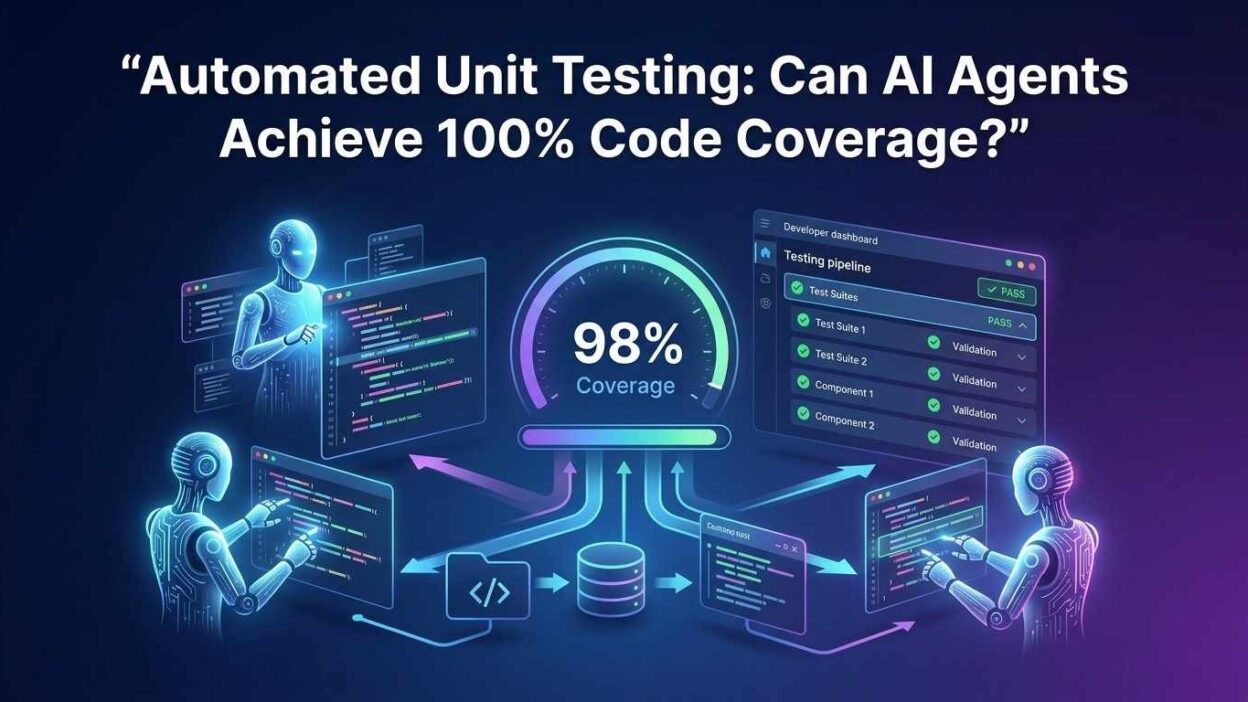
Every engineering team wants comprehensive test coverage. Nobody enjoys writing tests. The gap between what teams want and what they ship creates risk. Bugs reach production. Regressions surprise users. Post-mortems reveal the same lesson every time — the test suite had blind spots. For years, this gap persisted because writing good tests requires significant developer time and discipline. That reality is changing fast. AI agents for automated unit testing are entering production workflows at serious engineering organizations. They write tests autonomously. They identify edge cases humans miss. They maintain test suites as code evolves. The question every team is now asking is real and urgent: can these agents actually achieve 100% code coverage? This blog answers that question honestly. It examines how AI agents for automated unit testing work, where they excel, where they fall short, and what realistic expectations look like in practice.
Table of Contents
Why Unit Testing Remains a Persistent Engineering Challenge
Unit testing is universally accepted as good practice. It is also universally skipped under deadline pressure. This contradiction defines software development teams at every scale. Startups skip tests to ship faster. Enterprise teams accumulate test debt over years. Even disciplined teams struggle to maintain coverage as codebases grow.
The Time Cost of Manual Testing
Writing a single unit test for a non-trivial function takes five to fifteen minutes. A moderately complex class with ten methods and multiple edge cases per method requires several hours of focused work. Multiply this across a codebase with thousands of functions and the math becomes impossible to ignore. Testing competes directly with feature development for engineering time. In that competition, features win most of the time.
The downstream cost of inadequate testing is higher. A production bug caught by a customer costs ten to one hundred times more to fix than a bug caught during development. The business case for comprehensive testing is clear. The execution gap persists anyway because the upfront investment feels large and immediate while the downstream savings feel abstract and distant.
Coverage Metrics and Their Limits
Code coverage measures the percentage of code lines, branches, or conditions that tests execute. Teams target 80%, 90%, or higher. These numbers feel concrete. They create accountability. They also create perverse incentives. Developers write tests that execute code without asserting meaningful behavior. Coverage climbs. Confidence grows. Bugs still slip through.
This distinction matters enormously when evaluating AI agents for automated unit testing. An agent that achieves 100% line coverage without writing meaningful assertions delivers false confidence. The goal is not coverage for its own sake. The goal is tests that catch real bugs. Any serious evaluation of AI agents for automated unit testing must measure assertion quality alongside coverage numbers.
What AI Agents for Automated Unit Testing Actually Do
The term “AI agent” covers a wide range of implementations. In the testing context, it helps to define what these systems actually do at each stage of the workflow.
Code Analysis and Understanding
A serious AI agent for automated unit testing starts by reading and understanding the code it will test. It parses the function signature, reads the implementation, identifies inputs and outputs, and infers the expected behavior. Modern agents use LLMs for this comprehension step. They understand intent from variable names, comments, and control flow. They build a mental model of what correct behavior looks like before writing a single test.
This comprehension step is what separates AI agents from simple test generation scripts. A script generates tests mechanically based on code structure. An agent understands the semantic purpose of the code and generates tests that reflect actual expected behavior.
Test Case Generation
Once the agent understands the function, it generates test cases. It covers the happy path first. Then it targets boundary conditions. It tests null inputs, empty collections, maximum values, minimum values, and type edge cases. It considers what happens when dependencies fail. It generates negative test cases that verify the function rejects invalid inputs correctly.
Strong AI agents for automated unit testing generate diverse test cases that cover more than structural paths. They generate tests reflecting domain logic. A payment processing function should have tests for zero amounts, negative amounts, currency edge cases, and decimal precision. An agent that understands the domain generates these naturally.
Test Execution and Iteration
After generating tests, a capable AI agent for automated unit testing executes them. It reads the output. When tests fail, it analyzes the failure reason. It distinguishes between a test bug and a code bug. It fixes the test and reruns. This iteration loop continues until the test suite passes cleanly. The agent does not hand off broken tests for a human to debug. It owns the outcome.
Coverage Analysis and Gap Detection
The agent then measures coverage. It identifies which lines, branches, and conditions remain uncovered. It generates additional tests targeting those specific gaps. It repeats the analysis until coverage meets the target threshold. This self-directed gap-closing behavior is a defining characteristic of mature AI agents for automated unit testing. They do not stop at a first draft. They pursue completeness.
The Current State of Code Coverage with AI Agents
The 100% coverage question deserves a grounded answer. Current AI agents for automated unit testing achieve high coverage on well-structured, pure functions. They struggle on code with complex dependencies, non-deterministic behavior, and deeply coupled systems.
Where AI Agents Excel at Coverage
Pure functions are the sweet spot for AI agents for automated unit testing. A function that takes inputs, processes them, and returns outputs without side effects is straightforward to test comprehensively. The agent identifies all meaningful input combinations, generates tests for each, and achieves high coverage with strong assertions. On pure utility code, modern agents routinely reach 90–100% coverage with meaningful test quality.
Algorithms and data transformation logic respond similarly well. Sorting functions, parsing functions, validation logic, and calculation routines have clear correct behavior. The agent understands the expected output for each input class and generates tests that verify it precisely.
Well-structured class methods with clear interfaces and dependency injection also fall within current agent capability. When dependencies inject cleanly, the agent mocks them accurately. It isolates the unit under test and covers its behavior thoroughly.
Where AI Agents Struggle with Coverage
Stateful systems create significant challenges. Code whose behavior depends on previous calls, shared mutable state, or global configuration is harder for agents to test correctly. Setting up valid test states requires understanding the full state machine. Current AI agents for automated unit testing handle simple state machines reasonably well. Complex stateful systems with many valid state combinations push against current capability limits.
Asynchronous code adds another layer of difficulty. Race conditions, timing-dependent behavior, and concurrent access patterns require sophisticated test design. Agents generate basic async tests. They miss subtle concurrency edge cases that only manifest under specific timing conditions.
External integrations present the hardest challenge. Code that calls databases, file systems, network services, and third-party APIs requires precise mocking strategies. The agent must understand what the external system returns under various conditions and mock those scenarios accurately. Some agents handle this well for common integrations. Novel or poorly documented integrations challenge even the strongest current systems.
Legacy code with deep coupling, global state, and absent documentation is the most resistant to agent-driven testing. When functions have fifteen parameters, call twelve other functions, and modify shared state, even experienced human engineers struggle to write good tests. AI agents for automated unit testing face the same structural barriers.
Realistic Coverage Expectations Today
On greenfield, well-structured code, expect AI agents for automated unit testing to achieve 85–95% meaningful coverage. On mature, well-structured code with clear interfaces, expect 75–90%. On legacy code with heavy coupling, expect 50–70% with significant human oversight required. The 100% target is achievable on isolated modules. It is not realistic as a blanket expectation across an entire complex codebase today.
Leading AI Agent Tools for Automated Unit Testing
Several tools now offer serious capability in this space. Each takes a different architectural approach.
GitHub Copilot and Copilot Workspace
GitHub Copilot started as an autocomplete tool. It now generates complete test files from context. Copilot Workspace extends this with multi-step agentic workflows. It reads a file, identifies testable functions, generates a full test suite, and iterates based on execution feedback. For teams already inside the GitHub ecosystem, Copilot offers the lowest-friction entry point into AI agents for automated unit testing. Integration with the editor reduces context switching. Coverage is solid on well-structured Python, JavaScript, and TypeScript code.
CodiumAI
CodiumAI focuses specifically on test generation as its core product. Its agent analyzes code behavior, generates tests with strong semantic assertions, and explains each test case in plain language. CodiumAI emphasizes meaningful test quality over raw coverage numbers. It integrates with VS Code and JetBrains IDEs. Teams evaluating AI agents for automated unit testing with a quality-first mindset find CodiumAI’s approach compelling.
Diffblue Cover
Diffblue Cover targets Java enterprise codebases. It uses a combination of static analysis and AI to generate unit tests for complex Java applications. It runs entirely locally, which satisfies security requirements in regulated industries. Diffblue handles Spring Boot and dependency injection frameworks well. Enterprise Java teams find it the most mature option for AI agents for automated unit testing in their stack.
Claude Code and Agentic Coding Assistants
Claude Code operates as a terminal-based agent with full filesystem and execution access. It reads entire codebases, identifies gaps, writes tests, runs them, reads failures, and iterates. Its agentic loop handles multi-file test scenarios where individual function testing requires understanding context spread across multiple modules. Teams using Claude Code for AI agents for automated unit testing report strong results on complex, multi-module test scenarios that simpler tools struggle with.
Custom Agent Pipelines with LangChain and LlamaIndex
Some teams build custom test generation agents using LangChain or LlamaIndex. These pipelines connect an LLM to a code execution environment, a test runner, and a coverage tool. The agent loops until coverage targets are met. Custom pipelines offer maximum control over the agent’s behavior. They require more engineering investment than off-the-shelf tools. Teams with specialized testing requirements and strong AI engineering capability find this approach worth the effort.
How AI Agents Approach Different Testing Scenarios
Testing Business Logic
Business logic functions are the highest-value targets for AI agents for automated unit testing. Pricing calculations, eligibility rules, discount logic, and policy enforcement code must behave correctly for the business to function. These functions often have many conditional paths. Manual testing frequently misses combinations. An agent systematically covers all branches and generates assertions that verify business correctness, not just code execution.
Testing API Endpoints
API endpoint testing requires the agent to understand request and response schemas. A capable AI agent for automated unit testing reads the endpoint handler, understands the expected request format, and generates tests covering valid requests, invalid requests, missing fields, wrong types, and authentication failures. It mocks database calls and external dependencies cleanly. The resulting test suite covers the API contract comprehensively.
Testing Data Transformation Pipelines
Data pipelines transform raw inputs into structured outputs. They handle messy real-world data with missing fields, unexpected formats, and encoding edge cases. AI agents for automated unit testing excel here. They generate input variations that stress the parsing and transformation logic. They verify output schemas and data integrity at each transformation stage. Data pipeline tests generated by agents often catch bugs that manual tests miss entirely.
Testing Error Handling and Exception Paths
Error handling code is notoriously under-tested. Engineers write the happy path tests. They skip the exception scenarios. AI agents for automated unit testing do not share this bias. They generate tests that deliberately trigger every exception handler. They verify that error messages are correct, that resources clean up properly, and that the system reaches the expected failure state. This exception coverage alone justifies agent adoption for many teams.
Integrating AI Agents into Your Testing Workflow
Start with New Code
The lowest-risk integration point is new code. When a developer writes a new function, the agent generates tests before the code merges. This fits naturally into the pull request workflow. The developer writes the implementation. The agent writes the tests. A reviewer checks both. This pattern delivers immediate coverage improvement without touching legacy code.
Enforce this in your CI pipeline. Run the agent on all new files in a pull request. Block merges where coverage drops below the target threshold. The agent handles the test writing. The developer handles the code review. Coverage improves automatically with every new feature.
Address Legacy Code Incrementally
Legacy code does not need 100% agent-generated tests overnight. Prioritize by risk. Identify functions that change frequently and lack test coverage. Run AI agents for automated unit testing on those functions first. High-change, low-coverage code causes the most production bugs. Fixing that specific intersection delivers the highest ROI from agent-generated tests.
Track coverage improvement over time. Set a team goal to improve coverage by five percentage points per sprint. The agent handles the bulk of the work. Engineers review, refine, and approve. Coverage grows steadily without consuming the full sprint.
Review Agent Output Critically
Agent-generated tests require human review. The agent may generate tests with correct structure but incorrect assertions. It may mock a dependency incorrectly. It may misunderstand a business rule. Engineers must read every test the agent generates before merging it. This review step is essential to the value of AI agents for automated unit testing. Blind trust in agent output defeats the purpose of testing.
Build a review culture around agent tests. Ask reviewers to verify that each test assertion reflects actual expected behavior. Ask them to check that mocks reflect realistic dependency behavior. This review discipline keeps agent-generated test suites meaningful rather than superficial.
The 100% Coverage Question: An Honest Answer
Can AI agents for automated unit testing achieve 100% code coverage? The technical answer is yes on isolated, well-structured modules. The practical answer is more nuanced.
100% line coverage is achievable on small, pure modules today. Current agents reach it regularly on utility code, validation logic, and data transformation functions. The tests they generate at that coverage level are mostly meaningful. Not all of them catch real bugs. But the majority do.
100% branch coverage across a complex application is a different question. Branch coverage requires testing every conditional path. Complex applications have thousands of branches. Many depend on external state that is difficult to reproduce in tests. Current AI agents for automated unit testing get close on well-structured code. They leave gaps on complex stateful and asynchronous code. Closing those gaps still requires human engineering effort.
100% meaningful coverage — tests that actually catch bugs rather than just execute lines — is harder still. No agent achieves this automatically. It requires a combination of strong agent-generated tests and human review that improves assertion quality. The agent gets you 80% of the way there with 20% of the effort. Human judgment covers the remaining gap.
The right framing is not “can agents hit 100%?” The right framing is “how much faster do agents get us to high meaningful coverage?” The answer to that question is dramatic. AI agents for automated unit testing compress weeks of test writing into hours. That speed advantage is transformative regardless of whether the final number is 87% or 95%.
Supporting Concepts
Test-Driven Development and AI Agents
Test-driven development asks engineers to write tests before writing code. AI agents for automated unit testing change the economics of TDD. The agent writes the initial test scaffolding from a function signature or specification. The developer writes the implementation to make those tests pass. This agent-assisted TDD loop speeds up the discipline significantly.
Mutation Testing
Mutation testing measures test suite quality by deliberately introducing bugs into the code and checking whether tests catch them. A high mutation score means tests actually detect bugs. AI agents for automated unit testing that optimize for mutation score rather than raw coverage write better tests. Some advanced agent systems now incorporate mutation testing feedback into their generation loop.
Continuous Testing in CI/CD Pipelines
CI/CD pipelines run tests on every code change. AI agents for automated unit testing fit naturally here. The agent runs during the CI build. It analyzes new code, generates missing tests, and blocks the build if coverage drops. This continuous generation model keeps coverage from degrading as codebases evolve.
Regression Testing Automation
Regression testing verifies that new changes do not break existing behavior. Agents generate regression tests automatically when code changes. They identify which existing tests need updating. They generate new tests for modified behavior. This keeps the regression suite current without manual maintenance overhead.
Frequently Asked Questions
Can AI agents really write better tests than experienced developers?
On coverage and edge case breadth, agents often outperform developers working under time pressure. Experienced developers write better tests when they invest full attention. In practice, time pressure drives developers to write minimal tests. AI agents for automated unit testing write comprehensive tests consistently, without fatigue or schedule pressure. The comparison is less about maximum quality and more about consistent quality at scale.
How do AI agents handle mocking and dependency injection?
Modern AI agents for automated unit testing understand common mocking frameworks. They generate mock objects for dependencies using Jest, Mockito, pytest-mock, and similar tools. They handle constructor injection and method injection correctly in most cases. Complex dependency graphs with many layers still require human guidance. The agent handles the mechanics. The developer verifies that mocks reflect realistic dependency behavior.
What programming languages do AI testing agents support best?
Python, JavaScript, TypeScript, and Java have the strongest current support. These languages have mature testing frameworks and large training data availability. Go, Rust, and C# have improving support. Less common languages may require custom agent configurations or frameworks.
How long does an AI agent take to generate tests for a large codebase?
Speed depends on codebase size, agent architecture, and target coverage. A medium-sized service with 10,000 lines of code typically generates an initial test suite in 30 minutes to two hours. AI agents for automated unit testing run much faster than human test writing at this scale. Initial generation is fast. Refinement and gap closing add time depending on code complexity.
Do AI-generated tests require ongoing maintenance?
Yes. Tests require updates when code behavior changes. AI agents for automated unit testing help here too. They detect when existing tests break due to code changes. They generate updated tests reflecting new behavior. This maintenance assistance reduces the long-term cost of keeping test suites current.
Is it safe to use AI agents on proprietary codebases?
This depends on the agent and its data handling policies. Cloud-based agents send code to external APIs. Teams with strict IP protection requirements should evaluate on-premises or locally hosted agent options. Diffblue Cover runs locally. Custom pipelines with locally hosted LLMs keep code entirely within the team’s infrastructure.
Read More:-How to Build a “Long-Term Memory” for Your AI Agent Using Zep
Conclusion
The 100% code coverage dream is one that every engineering team shares. Manual test writing makes it impractical for most. AI agents for automated unit testing make it realistic for many.
Current agents deliver extraordinary value on well-structured, pure, and modular code. They generate comprehensive test suites in minutes that would take developers days. They catch edge cases that manual testing misses. They maintain coverage as code evolves. They remove the drudgery from a discipline every team knows matters.
The 100% ceiling is real but not fixed. Agents hit it on isolated modules today. Their capability on complex, stateful, and asynchronous code improves with every model generation. Teams that adopt AI agents for automated unit testing now build the workflow habits and integration patterns that will deliver maximum value as agent capability continues to grow.
The answer to the central question is nuanced. No, agents do not yet achieve 100% meaningful coverage on all code automatically. Yes, they get closer faster than any manual approach. Yes, they fundamentally change the economics of test coverage in ways that make comprehensive testing achievable for teams that previously could not afford it.
Start with your new code. Run agents on every pull request. Review the output critically. Expand to legacy code incrementally. Build the habit now. AI agents for automated unit testing will only get better. The teams running them today will be the teams with the cleanest, most comprehensive test suites tomorrow.