Introduction
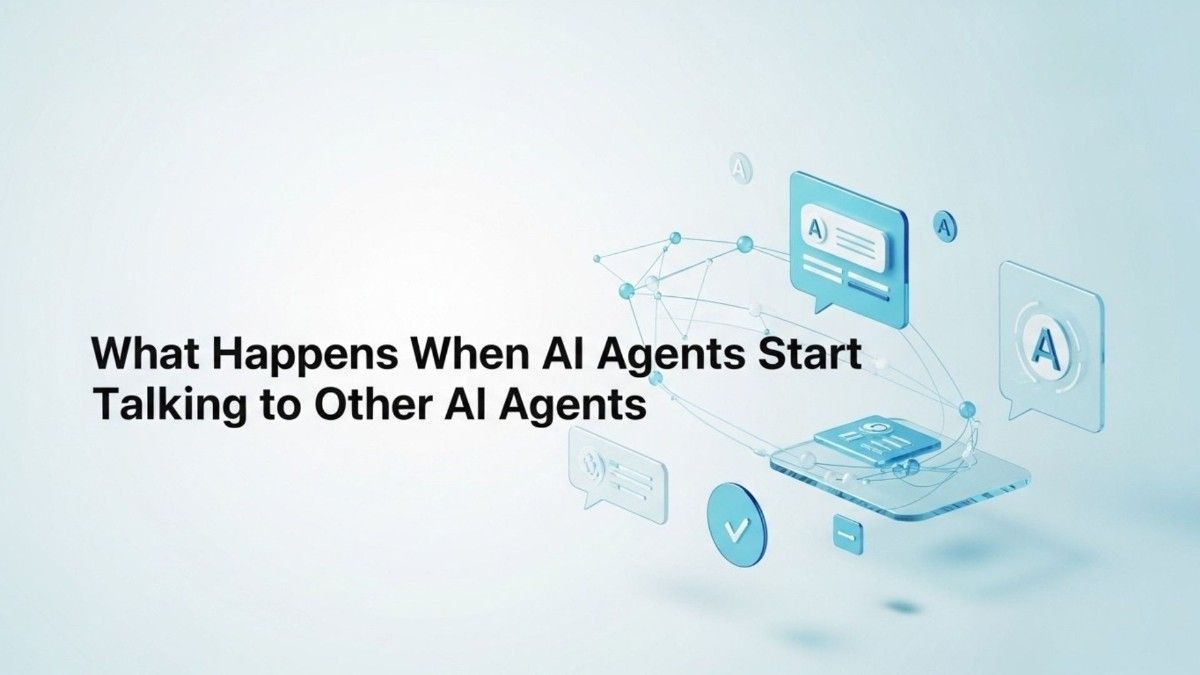
TL;DR Something fundamentally new is happening in the world of artificial intelligence. AI agents are no longer working in isolation. They are now talking to each other. They send instructions. They share data. They delegate subtasks. They negotiate outcomes. The era of AI agents communicating with other AI agents is here, and it is reshaping how businesses build intelligent systems.
This blog explains what this shift means in practical terms. You will understand how agent-to-agent communication works. You will see where it creates real value. You will also learn what risks it introduces and how to manage them.
Table of Contents
Understanding AI Agents and Why Communication Matters
An AI agent is a software system that perceives its environment, makes decisions, and takes actions to achieve a specific goal. Unlike a basic chatbot, an agent acts autonomously. It does not wait for a human to tell it each next step.
Early AI agents worked alone. They handled one task at a time. A scheduling agent managed calendars. A data extraction agent pulled records from documents. Each agent operated in its own lane.
That single-agent model has limitations. Complex real-world tasks require multiple capabilities. No single agent handles everything well. That is exactly why AI agents communicating with other AI agents has become a critical architectural pattern in modern AI development.
What Makes an AI Agent Different from Standard AI
Standard AI models respond to prompts. They produce outputs and stop. AI agents do something more. They maintain goals across multiple steps. They call tools. They remember context. They adjust strategies when results fall short.
An agent might search the web, summarize findings, write a report, and email it to a stakeholder — all without human intervention between steps. That autonomous, goal-directed behavior is what defines an agent.
When you connect multiple agents together, each one contributes its specialty. The network becomes far more capable than any individual component.
The Core Idea Behind Agent-to-Agent Communication
Agent-to-agent communication means one AI agent sends a message, request, or instruction to another AI agent. The receiving agent processes that input and responds with an action, result, or further query.
This communication can be simple. Agent A asks Agent B to summarize a document. Agent B returns the summary. Done.
It can also be complex. Agent A manages a research project. It delegates web research to Agent B, data analysis to Agent C, and report writing to Agent D. Each agent reports back. Agent A synthesizes the outputs and delivers a final result to the human user.
The concept of AI agents communicating with other AI agents enables this kind of distributed, collaborative intelligence at scale.
How AI Agents Actually Communicate
Understanding the mechanics helps demystify agent networks. AI agents do not communicate the way humans do. They exchange structured messages through defined protocols and APIs.
Message Passing and Structured Protocols
Most agent frameworks use a message-passing architecture. One agent constructs a message containing a task description, required inputs, and any relevant context. That message goes to the target agent through an API call or shared message queue.
The receiving agent reads the message, processes the task, and sends a structured response. The response includes the output, a status indicator, and sometimes metadata about how the task was completed.
Frameworks like LangChain, AutoGen, and CrewAI have built standardized ways to handle this exchange. Developers define agent roles and communication rules. The framework handles message routing and state management.
Shared Memory and Context Windows
Agents in a network often share a memory layer. This shared memory stores information that multiple agents need to access. One agent writes a research summary to shared memory. Another agent reads that summary before drafting a report.
Context windows also matter. Each agent sees a portion of the broader task history. Well-designed systems carefully manage what context each agent receives. Too little context causes errors. Too much context wastes compute resources and slows performance.
Tool Use and External API Calls
AI agents communicating with other AI agents often involve tool calls as part of the communication chain. Agent A might call a web search tool. It passes the results to Agent B, which calls a data analysis tool. Agent C receives the analyzed data and calls a writing tool.
The agents are not just talking. They are orchestrating a pipeline of actions. Each handoff between agents carries both information and instructions about what to do next.
Orchestrator and Worker Agent Structures
Most multi-agent systems use a hierarchical structure. An orchestrator agent sits at the top. It receives the human’s goal. It breaks that goal into subtasks. It assigns each subtask to a specialized worker agent.
Worker agents complete their assigned tasks and report results back to the orchestrator. The orchestrator assembles the pieces and produces a final output. This structure keeps complex workflows manageable.
Some systems use peer-to-peer structures instead. Agents communicate directly with each other without a central coordinator. This approach offers flexibility but requires careful design to prevent coordination failures.
Real-World Applications of AI Agents Communicating With Each Other
The concept of AI agents communicating with other AI agents sounds abstract until you see it in action. Real businesses are deploying multi-agent systems to solve hard problems right now.
Autonomous Research and Report Generation
Research tasks are ideal for multi-agent collaboration. A planning agent defines the research scope. A search agent queries multiple sources. A fact-checking agent verifies claims. A writing agent drafts the final document. An editing agent reviews tone and clarity.
What used to take a human researcher two days now takes a well-designed agent network two hours. The quality is consistent. The process runs without manual handoffs.
Consulting firms, investment banks, and market research companies are already experimenting with these systems. The productivity gains are significant.
Software Development and Code Review
Engineering teams use multi-agent systems to accelerate development. A requirements agent interprets user stories. A coding agent writes the initial implementation. A testing agent generates test cases and runs them. A review agent checks for security vulnerabilities and style issues.
AI agents communicating with other AI agents in a development pipeline catches bugs earlier. It reduces the burden on human developers. Engineers shift their focus to architecture decisions and complex problem-solving.
GitHub Copilot Workspace and similar tools are moving toward this kind of collaborative agent structure. The trajectory is clear.
Customer Service and Escalation Management
Customer service operations use agent networks to handle inquiries at scale. A triage agent reads incoming messages and categorizes them. A resolution agent handles routine questions using a knowledge base. A personalization agent retrieves customer history and preferences. An escalation agent identifies complex cases and routes them to human agents with full context prepared.
The customer gets faster responses. The human agent gets better information. The business reduces average handle time and improves satisfaction scores.
Supply Chain and Logistics Coordination
Supply chain management involves constant coordination across vendors, warehouses, carriers, and customers. Multi-agent systems handle this complexity well. A demand forecasting agent predicts inventory needs. A procurement agent triggers reorder requests. A routing agent optimizes shipment paths. A tracking agent monitors delivery status and flags exceptions.
These agents share data constantly. They adjust to disruptions in real time. A port delay detected by the tracking agent triggers immediate rerouting decisions by the logistics agent. No human needs to coordinate each step.
Financial Analysis and Trading
Financial services firms deploy multi-agent systems for market analysis and trading. A data collection agent pulls price feeds, earnings reports, and news. A sentiment analysis agent reads financial news. A risk assessment agent evaluates portfolio exposure. An execution agent places orders within defined parameters.
The speed advantage of AI agents communicating with other AI agents is decisive in financial markets. Decisions that took hours now happen in milliseconds.
The Benefits of Multi-Agent AI Systems
Multi-agent communication creates capabilities that single-agent systems cannot match. The benefits are concrete and compelling for organizations ready to build these systems.
Specialization Drives Better Outcomes
A generalist agent produces generalist results. Specialized agents produce expert-level results in their domains. A coding agent trained specifically on software development outperforms a general-purpose agent writing code.
Multi-agent architectures let you combine specialists. You get expert-level performance across every step of a complex workflow. The overall output quality exceeds what any single agent could achieve alone.
Parallelization Accelerates Complex Workflows
Single agents work sequentially. They complete one step before starting the next. Multi-agent systems work in parallel. Multiple agents tackle different parts of a problem simultaneously.
A research task that requires gathering data from five sources takes five times longer when done sequentially. With five parallel agents, it takes the same time as researching one source. Parallelization is a force multiplier for productivity.
Fault Tolerance and Redundancy
When one agent in a network fails, the system can route around it. The orchestrator detects the failure and reassigns the task to a backup agent. Well-designed multi-agent systems are more resilient than monolithic systems.
This resilience matters in production environments. Business-critical workflows cannot afford single points of failure. Agent networks distribute that risk.
Scalability Without Linear Cost Growth
Adding capacity to a single-agent system often means upgrading expensive infrastructure. Adding capacity to a multi-agent system means deploying additional worker agents. The marginal cost of each new agent is low.
Organizations scale their AI agent networks to match demand. During peak periods, they spin up more agents. During quiet periods, they reduce capacity. This elasticity makes multi-agent systems economically attractive.
The Risks and Challenges of AI Agents Communicating With Each Other
The power of AI agents communicating with other AI agents comes with real risks. Organizations that ignore these risks face serious problems. Understanding them is the first step toward managing them effectively.
Error Propagation and Compounding Mistakes
In a sequential agent pipeline, an error in one step affects every subsequent step. Agent A produces a flawed analysis. Agent B builds on that flawed analysis. Agent C writes a report based on Agent B’s work. The final output contains compounded errors that are hard to trace back to the source.
Error propagation is one of the most significant risks in multi-agent systems. Strong validation checkpoints between agent handoffs reduce this risk. Human review gates at critical junctions add another layer of protection.
Misaligned Goals Between Agents
Each agent optimizes for its own objective. An agent focused on speed might sacrifice accuracy to complete tasks faster. An agent focused on thoroughness might slow the entire pipeline. When individual agent goals conflict, the system produces suboptimal results.
Careful system design addresses this problem. Shared reward structures and clear task definitions align agent behavior. Regular evaluation of agent performance against system-level goals keeps individual optimization in check.
Security Vulnerabilities in Agent Networks
Multi-agent systems create new attack surfaces. A malicious input to one agent can propagate through the network. Prompt injection attacks instruct an agent to behave in unauthorized ways. A compromised agent can corrupt the outputs of every downstream agent it communicates with.
Security-conscious organizations implement input validation at every agent boundary. They restrict what actions agents can take without human authorization. They monitor agent communications for anomalous patterns.
Lack of Transparency and Explainability
When AI agents communicating with other AI agents produce a result, tracing exactly how that result was produced is difficult. Multiple agents made multiple decisions. Each decision influenced subsequent ones. The reasoning chain is long and complex.
This lack of transparency creates problems in regulated industries. Healthcare, finance, and legal applications require explainable AI decisions. Organizations deploying multi-agent systems in these sectors must invest heavily in logging, tracing, and auditability infrastructure.
Runaway Costs From Autonomous Action
Autonomous agents make decisions without human approval. An agent network tasked with procurement might place orders that exceed budget. A marketing agent might launch campaigns without final human review. Unconstrained autonomous action carries real financial risk.
Budget guardrails and action approval workflows contain this risk. Define hard limits on what agents can do without human sign-off. Build monitoring systems that alert humans when agent actions approach defined thresholds.
Key Frameworks for Building Multi-Agent AI Systems
Several mature frameworks now support the development of systems where AI agents communicating with other AI agents is a core design pattern. Knowing the landscape helps technology leaders make informed build-versus-buy decisions.
AutoGen by Microsoft
AutoGen is Microsoft’s open-source framework for multi-agent conversation systems. It allows developers to define multiple agents with distinct roles and capabilities. Agents engage in back-and-forth conversations to solve problems collaboratively.
AutoGen supports human-in-the-loop workflows. A human can intervene at any point in the agent conversation. This flexibility makes it suitable for use cases where full autonomy is not yet appropriate.
CrewAI
CrewAI focuses on role-based agent collaboration. Developers define agents as crew members with specific roles, goals, and backstories. The crew works together on a shared task, much like a human team would.
CrewAI’s abstraction layer is intuitive. Teams new to multi-agent development find the role-based model easier to reason about than lower-level frameworks. It ships with built-in tooling for common agent tasks.
LangGraph
LangGraph, built on the LangChain ecosystem, models agent workflows as directed graphs. Each node in the graph represents an agent or processing step. Edges define how information flows between nodes.
The graph model gives developers precise control over agent communication patterns. Conditional routing, loops, and parallel branches are all expressible in the graph structure. LangGraph suits complex, branching workflows where agent interactions depend on intermediate results.
Emerging Standards and Interoperability
The field is moving toward standardized communication protocols for agent networks. Anthropic’s Model Context Protocol is one example. It defines how agents share context and tool access in a structured way.
Interoperability standards matter because real-world deployments often mix agents from different vendors. A customer service agent built on one platform needs to communicate with a knowledge management agent built on another. Standards make this possible without custom integration work for every pair of agents.
How Organizations Should Approach Multi-Agent AI Adoption
Building systems where AI agents communicating with other AI agents is central to the architecture requires a thoughtful approach. Rushing into complex multi-agent deployments without the right foundation leads to costly failures.
Start With a Clear Use Case
Pick one high-value workflow where multi-agent coordination would deliver measurable improvement. Define success metrics upfront. Set a realistic timeline for the pilot. Resist the temptation to build everything at once.
A well-executed narrow pilot teaches you more than a sprawling failed deployment. Success in one area builds organizational confidence and funding for broader rollout.
Invest in Observability Infrastructure
You cannot manage what you cannot see. Build logging and monitoring into your agent network from day one. Track every message between agents. Record every decision made. Store every action taken.
Observability infrastructure pays dividends when things go wrong. You can trace errors back to their source quickly. You can identify which agents underperform. You can prove to auditors and regulators that your system behaved as intended.
Define Human Oversight Checkpoints
Autonomy does not mean zero human involvement. Identify the decisions where human judgment adds irreplaceable value. Build approval workflows at those points. Let agents handle everything else.
Human oversight checkpoints are not a sign of distrust in the technology. They are a sign of mature system design. The goal is to deploy automation where it works best and preserve human judgment where it matters most.
Build for Iterative Improvement
Your first multi-agent system will not be your best. Plan for continuous iteration. Collect performance data. Identify bottlenecks. Improve prompt engineering for underperforming agents. Add new capabilities incrementally.
Organizations that treat multi-agent AI as a living system rather than a one-time project extract far more value over time. The technology improves with every iteration.
Frequently Asked Questions
What does it mean for AI agents to communicate with each other?
AI agents communicating with other AI agents means one autonomous AI system sends structured messages, instructions, or data to another AI system. The receiving agent processes that input and responds with actions or results. This communication enables complex workflows where multiple specialized agents collaborate to complete tasks that no single agent could handle alone.
Are multi-agent AI systems safe to use in business?
Multi-agent systems are safe when designed with proper guardrails. This means input validation at every agent boundary, human approval workflows for high-stakes decisions, budget limits on autonomous actions, and comprehensive monitoring of agent behavior. Organizations in regulated industries need additional auditability measures. Safety is a design choice, not a default state.
What industries benefit most from multi-agent AI?
Financial services, healthcare, software development, supply chain management, and customer service all see strong results from multi-agent AI. Any industry that runs complex, multi-step workflows involving large data volumes and time pressure is a strong candidate. The core benefit is consistent: specialists working in parallel outperform generalists working sequentially.
How is agent-to-agent communication different from traditional API integration?
Traditional API integration connects systems through predefined, static request-response patterns. AI agent communication is dynamic and contextual. Agents adapt their messages based on prior results. They handle ambiguity. They make judgment calls that static APIs cannot. The communication is goal-directed rather than procedure-driven.
What frameworks support AI agents communicating with other AI agents?
Leading frameworks include AutoGen by Microsoft, CrewAI, LangGraph, and LangChain Agents. Each has distinct strengths. AutoGen excels at conversational multi-agent workflows. CrewAI simplifies role-based collaboration. LangGraph provides precise graph-based control over agent interactions. The right choice depends on your technical requirements and team expertise.
How do you prevent errors from spreading through an agent network?
Preventing error propagation requires validation checkpoints between agent handoffs, clear output specifications that agents must meet before passing results downstream, automated testing of agent outputs against expected formats, and human review gates at critical decision points. Logging every agent interaction makes errors traceable when they do occur.
Read More:-Why RAG Isn’t Enough: The Case for Knowledge Graphs
Conclusion
The phenomenon of AI agents communicating with other AI agents marks a genuine inflection point in artificial intelligence. Single agents were impressive. Networks of collaborating agents are transformative.
The shift from isolated AI tools to coordinated agent networks changes what automation can accomplish. Tasks requiring expertise across multiple domains, parallel processing of large information sets, and adaptive decision-making across long workflows are now achievable with well-designed agent systems.
The benefits are real. Specialization improves output quality. Parallelization compresses timelines. Fault tolerance increases reliability. Scalability makes the economics attractive.
The risks are equally real. Error propagation, misaligned goals, security vulnerabilities, and lack of transparency all demand deliberate design choices. Organizations that take these risks seriously build more robust systems. Those that ignore them pay the price in production failures and eroded stakeholder trust.
The right approach starts with a clear use case, strong observability infrastructure, defined human oversight checkpoints, and a commitment to iterative improvement. Multi-agent AI is not a one-time project. It is an ongoing capability that grows more powerful with experience and refinement.
AI agents communicating with other AI agents will become a standard architectural pattern across industries within the next few years. The organizations building this capability now are establishing a durable competitive advantage. The question is not whether to engage with this technology. The question is how fast you can build the foundations to do it well.