Introduction
TL;DR Chatbots have dominated the AI conversation for years. Every SaaS company rushed to add a chat interface. Users got tired of typing commands and receiving text responses.
The next wave of artificial intelligence looks completely different. AI action models for SaaS execute tasks directly without conversation. They understand intent and take action immediately.
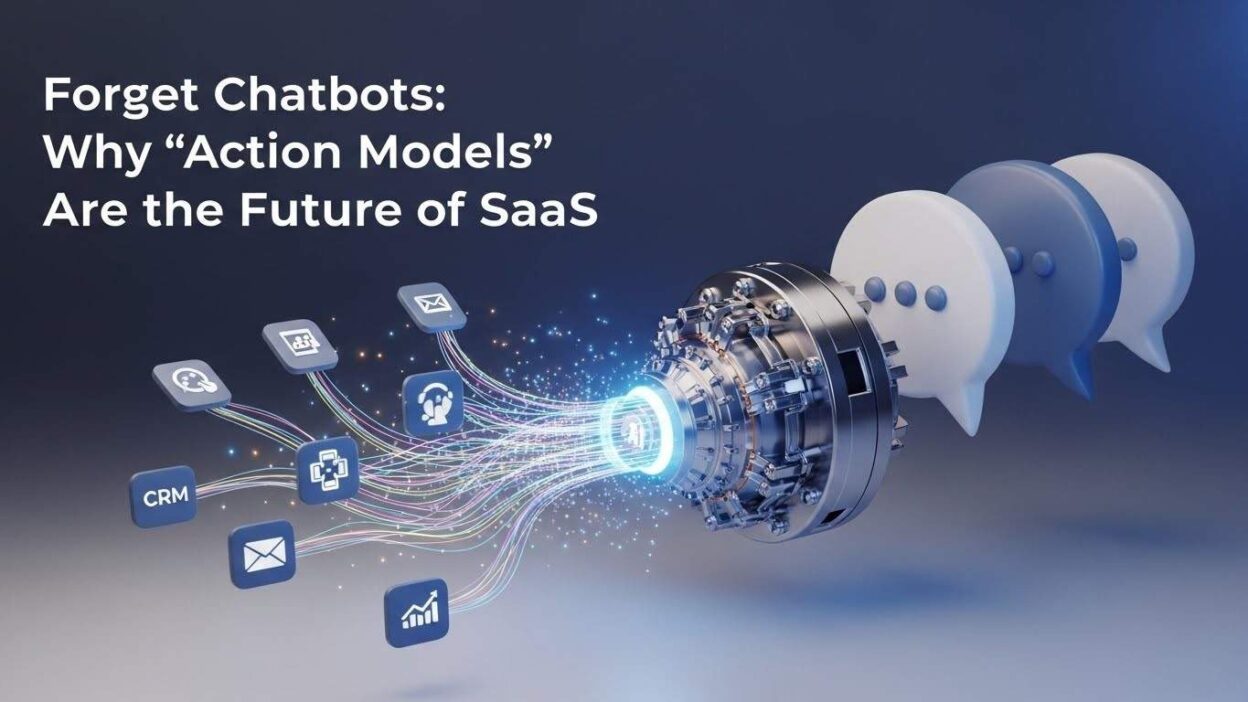
Traditional chatbots answer questions and provide information. Action models actually complete work on your behalf. The difference transforms how software operates fundamentally.
Your CRM doesn’t need another chat window. It needs an AI that creates contacts, sends emails, and updates pipelines automatically. Your project management tool should assign tasks and adjust schedules intelligently.
This shift represents the biggest change in software since mobile apps. SaaS companies embracing action models will dominate their markets. Those clinging to chatbots will fall behind quickly.
Real businesses already deploy action models successfully. Their results prove the concept works brilliantly. Customer satisfaction scores increase while support costs decrease.
Table of Contents
The Limitations of Traditional Chatbots in SaaS
Chatbots promised to revolutionize customer support and user experience. Reality delivered something far less impressive. Most implementations frustrate users more than help them.
The Conversation Bottleneck
Every chatbot interaction requires multiple back-and-forth exchanges. Users must explain their needs clearly. Bots ask clarifying questions repeatedly.
A simple task like scheduling a meeting takes 5-7 messages. The bot confirms dates, times, participants, and meeting rooms separately. Users could complete the task faster manually.
Context gets lost between messages frequently. Users repeat information the bot should remember. Conversations restart when errors occur.
Natural language understanding still fails regularly. Bots misinterpret intent despite training. Users must rephrase requests multiple times.
The conversational interface creates unnecessary friction. People want results, not dialogue. Chat feels like talking to an automated phone system.
Limited Execution Capabilities
Most chatbots retrieve information rather than take action. They show you data from other systems. You still perform the actual work elsewhere.
A marketing chatbot might display campaign metrics. You must open the campaign tool to make changes. The bot cannot modify budgets or pause campaigns directly.
Authentication and permissions create constant barriers. Bots redirect to login pages frequently. Security concerns limit what bots can do.
Multi-step workflows break chatbot interactions completely. Complex processes require jumping between interfaces. The bot loses context during handoffs.
Integration depth remains shallow for most chatbots. They access APIs but cannot manipulate underlying systems. Real work happens outside the chat interface.
Poor User Adoption Rates
Companies build chatbots expecting heavy usage. Reality shows different patterns emerging. Most chatbot features see minimal engagement.
Users try chatbots once or twice initially. Frustrating experiences prevent repeat usage. People revert to familiar interfaces quickly.
Training requirements discourage adoption significantly. Users must learn special commands and phrasing. The learning curve exceeds potential benefits.
Discovery problems plague chatbot features. Users don’t know what the bot can do. Capabilities remain hidden without documentation.
Mobile experiences suffer particularly. Typing detailed requests on phones proves tedious. Voice interfaces work poorly in public spaces.
What Are AI Action Models for SaaS?
AI action models for SaaS represent a fundamental paradigm shift. These systems execute tasks directly based on understanding user intent. Conversation becomes optional rather than required.
Core Characteristics
Action models observe user behavior continuously. They learn patterns from daily activities. Predictions improve with each interaction.
Intent detection happens automatically. The system recognizes what you want to accomplish. No explicit commands or prompts needed.
Autonomous execution defines action models. They complete multi-step workflows independently. Human approval becomes optional for routine tasks.
Integration depth exceeds traditional APIs. Action models manipulate data at the application layer. They operate like human users would.
Context awareness spans across entire platforms. The model understands relationships between different entities. Decisions consider complete business state.
Learning capabilities distinguish action models from static automation. They adapt to changing conditions. Performance improves without manual updates.
How They Differ from Chatbots
Chatbots require users to initiate conversations. Action models trigger proactively. They identify opportunities without prompting.
Communication happens through actions rather than words. Results appear directly in your workflow. Status updates replace lengthy explanations.
Chatbots operate within isolated conversations. Action models span entire applications. They coordinate across multiple tools seamlessly.
User interface changes become unnecessary. Action models work behind existing screens. The familiar interface remains unchanged.
Intelligence focuses on execution rather than comprehension. Understanding language matters less than accomplishing goals. Outcomes define success metrics.
Technical Architecture Overview
Action models build on large language model foundations. GPT-4 and Claude provide reasoning capabilities. Specialized training adapts them to specific domains.
Tool-calling mechanisms enable direct system manipulation. Models invoke functions with appropriate parameters. APIs execute requested operations immediately.
State management tracks workflow progress continuously. The model maintains context across multiple actions. Interruptions don’t require restarting processes.
Permission frameworks govern action boundaries. Models respect user roles and access levels. Security remains paramount throughout execution.
Feedback loops incorporate results into future decisions. Success and failure inform subsequent actions. The system learns from every outcome.
Monitoring systems track model behavior constantly. Anomaly detection prevents unintended consequences. Human oversight remains available always.
Real-World Applications Transforming SaaS
Practical implementations demonstrate the power of AI action models for SaaS. These examples show actual deployments delivering measurable results. The use cases span diverse industries and functions.
Customer Relationship Management
Sales CRMs benefit enormously from action models. Lead qualification happens automatically when contacts enter the system. The model scores leads based on complete profile analysis.
Emails get drafted and sent without human writing. The action model composes personalized messages matching your style. Follow-ups schedule themselves based on engagement patterns.
Meeting notes transform into actionable tasks automatically. The model creates follow-up items and assigns them appropriately. Calendar events populate with relevant context.
Deal stages update based on activity signals. The model recognizes progression indicators. Forecasts adjust in real-time as situations change.
Contact enrichment happens continuously in the background. The model finds missing information from various sources. Profiles stay current without manual research.
Pipeline management becomes genuinely predictive. Action models identify deals needing attention. They suggest specific actions to advance opportunities.
Project Management Platforms
Task creation happens from natural work descriptions. You discuss project needs in your usual channels. The action model generates structured task lists automatically.
Resource allocation adjusts dynamically as priorities shift. The model balances workloads across team members. Bottlenecks get identified and resolved proactively.
Deadline forecasting considers actual progress rates. The model detects delays before they become critical. Schedule adjustments happen automatically when needed.
Dependency tracking prevents blocking situations. The model ensures prerequisite tasks complete first. Critical path calculations update continuously.
Status reports compile themselves each week. The model synthesizes activity across all projects. Stakeholders receive summaries without manual compilation.
Risk identification surfaces potential issues early. The model recognizes patterns indicating trouble. Mitigation suggestions appear with problems.
Marketing Automation Suites
Campaign optimization runs continuously without oversight. The action model adjusts targeting and bidding automatically. Performance improves through constant experimentation.
Content creation scales to personalization extremes. The model generates variations for different segments. Every recipient sees optimized messaging.
A/B testing happens automatically across all elements. The model identifies winning combinations quickly. Statistical significance determines rollout timing.
Lead scoring evolves with market dynamics. The model updates criteria based on conversion patterns. Sales receives better-qualified opportunities.
Budget allocation shifts toward performing channels. The model moves spend automatically. ROI optimization happens in real-time.
Audience segmentation refines itself continuously. The model discovers new patterns in customer data. Targeting precision increases over time.
Financial Management Software
Expense categorization happens instantly on upload. The model recognizes transaction types accurately. Categorization errors decrease dramatically.
Anomaly detection flags unusual transactions immediately. The model learns normal spending patterns. Suspicious activity gets escalated automatically.
Cash flow forecasting incorporates multiple data sources. The model predicts future positions accurately. Planning improves with reliable projections.
Invoice processing becomes completely automated. The model extracts data and routes for approval. Payment scheduling happens without manual intervention.
Budget variance analysis identifies concerning trends. The model highlights categories needing attention. Explanations generate from underlying transaction data.
Tax preparation gets substantially simplified. The model organizes transactions by tax requirements. Documentation assembles automatically for accountants.
The Business Impact of AI Action Models for SaaS
Organizations deploying action models see transformative results. Metrics improve across every dimension of operation. The competitive advantages compound over time.
Productivity Gains and Efficiency
Knowledge workers save 8-12 hours weekly on average. Routine tasks disappear from to-do lists. Focus shifts to strategic high-value activities.
Task completion velocity increases 40-60% typically. Work flows through systems faster. Bottlenecks clear as action models intervene.
Error rates decrease by 65-75% on average. Consistent execution eliminates human mistakes. Quality improves while speed increases.
Context switching costs evaporate. Action models handle coordination between systems. Attention stays focused on single priorities.
Meeting times reduce by 30-40% in many teams. Status updates happen automatically. Discussions focus on decisions rather than information sharing.
Onboarding time decreases for new employees. Action models guide them through processes. Productivity ramps faster with assistance.
Customer Experience Improvements
Response times drop from hours to seconds. Action models address requests immediately. Customers notice the dramatic difference.
Personalization depth reaches unprecedented levels. Every interaction considers complete customer history. Experiences feel genuinely tailored.
Proactive service replaces reactive support. Models identify and resolve issues before customers notice. Satisfaction scores increase substantially.
Consistency improves across all touchpoints. Action models ensure uniform treatment. Brand experience stays coherent everywhere.
Self-service success rates climb dramatically. Customers accomplish goals without human help. Support ticket volumes decrease accordingly.
Recommendation quality exceeds human capabilities. Models analyze patterns humans miss. Customers discover valuable features faster.
Cost Reduction and ROI
Support staffing needs decrease 25-35%. Action models handle routine inquiries completely. Teams focus on complex situations only.
Software license costs consolidate. Action models integrate tools reducing redundancy. Fewer platforms deliver the same capabilities.
Training expenses decrease significantly. Intuitive action models require minimal explanation. New users become productive immediately.
Error remediation costs plummet. Fewer mistakes mean less rework. Quality assurance becomes less intensive.
Operational overhead shrinks across departments. Administrative tasks automate comprehensively. Headcount growth slows relative to revenue.
Time-to-value accelerates for implementations. Action models work immediately. Long configuration periods disappear.
Competitive Advantages
Market differentiation becomes obvious to customers. Products with action models feel magical. Word-of-mouth marketing increases naturally.
Customer retention improves substantially. Users depend on action model capabilities. Switching costs increase significantly.
Feature velocity accelerates development cycles. Action models enable rapid experimentation. Innovation happens faster than competitors.
Data network effects compound over time. Each customer interaction trains models. Quality advantages grow continuously.
Pricing power increases with unique capabilities. Premium positioning becomes justified. Margins expand relative to competitors.
Market share gains accelerate progressively. Superior products win customer preference. Growth compounds quarter over quarter.
Building vs. Buying AI Action Models for SaaS
SaaS companies face critical build-or-buy decisions. Each approach carries distinct advantages and challenges. Your specific situation determines the optimal path.
Off-the-Shelf Action Model Platforms
Several vendors offer pre-built action model frameworks. These platforms provide ready-made capabilities. Integration happens faster than custom development.
Anthropic’s Claude offers tool-calling features. Developers can build action models quickly. Documentation and examples accelerate implementation.
OpenAI’s GPT models support function calling natively. Developers define available actions declaratively. The model decides when to invoke them.
Microsoft’s Semantic Kernel provides an orchestration layer. It connects AI models to application logic. Enterprise integration becomes more manageable.
LangChain offers open-source tooling. Developers compose custom action chains. Community contributions provide example patterns.
Zapier and Make.com enable action automation visually. Non-technical teams can build workflows. The platforms handle execution infrastructure.
Implementation timelines range from weeks to months. Off-the-shelf solutions accelerate initial deployment. Customization requires additional effort.
Custom Development Considerations
Building proprietary action models offers maximum control. You define capabilities precisely for your needs. Differentiation potential reaches its peak.
Development costs range from $250,000 to $2,000,000 initially. Team requirements span ML engineers and domain experts. Ongoing maintenance adds recurring expenses.
Training data collection presents the first challenge. You need examples of desired behaviors. Quality and quantity both matter substantially.
Model fine-tuning adapts base models to your domain. This process requires specialized expertise. Iterative refinement takes several months typically.
Infrastructure requirements include GPU compute. Training and inference need substantial resources. Cloud costs accumulate quickly at scale.
Integration complexity increases with custom models. You build connections to all relevant systems. Testing requirements multiply accordingly.
Competitive advantages justify investment for some. Proprietary models create defensible moats. Larger companies pursue this approach.
Hybrid Approaches
Many organizations start with existing platforms. Early success justifies custom investment later. The hybrid path minimizes risk effectively.
Use pre-built models for generic capabilities. Customer support and scheduling work well. Standard functions don’t require customization.
Develop custom models for core differentiators. Industry-specific workflows deserve investment. Competitive advantages emerge from specialization.
Maintain flexibility to switch approaches. Avoid deep dependencies on single vendors. Architecture should accommodate evolution.
Partner with specialized AI companies. They bring expertise you lack internally. Collaboration accelerates development substantially.
Pilot projects validate approaches before commitments. Small implementations test feasibility. Lessons inform larger investments.
Implementation Roadmap for SaaS Companies
Successful action model deployments follow systematic approaches. These steps guide you from concept to production. Skipping phases increases failure risk dramatically.
Opportunity Identification
Audit current user workflows comprehensively. Identify repetitive manual tasks. Quantify time spent on each activity.
Survey customers about pain points. Ask what tasks they wish automated. Prioritize based on frequency and impact.
Analyze support ticket patterns. Common requests reveal automation opportunities. Resolution complexity indicates feasibility.
Review product analytics data. User behavior shows workflow inefficiencies. Bottlenecks highlight intervention points.
Assess competitive landscape thoroughly. Understand what others build. Identify white space opportunities.
Calculate potential ROI for each opportunity. Estimate development costs carefully. Prioritize highest-return options first.
Proof of Concept
Select one high-value use case initially. Focus efforts on clear success demonstration. Avoid scope creep during development.
Assemble a small dedicated team. Include engineers, designers, and domain experts. Clear ownership accelerates progress.
Choose appropriate technology stack. Evaluate platforms against requirements. Decide build versus buy early.
Develop minimum viable action model. Focus on core functionality only. Polish comes in later phases.
Test with friendly beta users. Gather detailed feedback systematically. Iterate rapidly on insights.
Measure success metrics rigorously. Compare against baseline performance. Document improvements clearly.
Production Rollout
Expand user base gradually. Start with enthusiastic early adopters. Monitor performance and feedback closely.
Build comprehensive monitoring systems. Track model decisions and outcomes. Anomaly detection prevents disasters.
Create fallback mechanisms for failures. Human oversight remains available. Graceful degradation protects users.
Develop clear user documentation. Explain capabilities and limitations. Set realistic expectations upfront.
Train support teams thoroughly. They need to understand model behavior. Troubleshooting skills become essential.
Establish feedback collection processes. Users should report issues easily. Continuous improvement depends on input.
Optimization and Scaling
Analyze usage patterns systematically. Identify underutilized capabilities. Understand adoption barriers honestly.
Improve model performance continuously. Retrain on new data regularly. Accuracy should increase over time.
Expand to additional use cases. Leverage learnings from initial deployment. Development velocity accelerates.
Integrate deeper into existing workflows. Reduce friction at every touchpoint. Seamless operation drives adoption.
Build network effects into capabilities. Each user interaction trains models. Quality compounds across customers.
Scale infrastructure to meet demand. Performance must remain consistent. Invest ahead of growth curves.
Common Challenges and Solutions
Every action model implementation encounters obstacles. Understanding common issues helps you prepare. These solutions come from real deployments.
Trust and Adoption Barriers
Users fear AI making mistakes on their behalf. Transparency builds confidence gradually. Show what the model does and why.
Start with low-risk actions initially. Let users verify results before expanding. Confidence grows through positive experiences.
Provide clear audit trails always. Users should see every action taken. Accountability remains crystal clear.
Offer easy undo mechanisms. Mistakes should reverse instantly. Fear diminishes when recovery is simple.
Communicate limitations honestly upfront. Don’t overpromise capabilities. Delivered value exceeds expectations this way.
Celebrate successes publicly. Share time savings and improvements. Social proof accelerates adoption.
Technical Reliability Issues
Action models sometimes make unexpected choices. Extensive testing catches most problems. Edge cases require ongoing attention.
Implement confidence scoring for decisions. Low-confidence actions seek approval. High-confidence actions execute automatically.
Build comprehensive testing frameworks. Simulate diverse scenarios systematically. Automated tests catch regressions.
Monitor model drift carefully. Performance degrades without retraining. Regular updates maintain accuracy.
Create circuit breakers for anomalies. Unusual patterns trigger safety stops. Human review prevents cascading failures.
Maintain fallback to traditional interfaces. Users should always have manual control. Safety nets reduce risk.
Data Privacy and Security
Action models access sensitive information. Security requirements become more stringent. Compliance demands careful attention.
Implement robust authentication mechanisms. Models inherit user permissions exactly. Unauthorized actions become impossible.
Encrypt all data in transit and at rest. Industry-standard protocols apply. Regular security audits verify protection.
Log all actions comprehensively. Audit trails support compliance requirements. Forensic investigation becomes possible.
Allow users to opt out of action models. Respect privacy preferences completely. Trust builds through respect.
Follow data residency regulations strictly. Some jurisdictions mandate local storage. Architecture must accommodate requirements.
Cost Management at Scale
API costs accumulate quickly at high usage. Token consumption needs careful monitoring. Optimization becomes essential.
Cache results where possible. Repeated queries waste resources. Intelligent caching reduces expenses.
Choose appropriate models for each task. Expensive models handle complex situations. Simpler models suffice for routine work.
Batch operations when feasible. Group related actions together. Efficiency improves at scale.
Implement usage quotas per customer. Prevent runaway consumption. Limits protect both parties.
Monitor ROI continuously. Ensure value exceeds costs. Adjust strategies based on data.
The Future of AI Action Models for SaaS
The action model category is still emerging. Current implementations merely scratch the surface. The next five years will bring revolutionary changes.
Autonomous Agents and Multi-Step Workflows
Future action models will chain complex sequences. They’ll coordinate across multiple systems. Entire business processes will automate end-to-end.
Strategic planning capabilities will emerge. Models will suggest long-term initiatives. Execution and planning merge together.
Collaborative agents will work together. Different models will specialize in domains. Teamwork happens between AI systems.
Learning from outcomes will improve dramatically. Models will understand cause and effect. Decisions will optimize for business results.
Predictive execution will become standard. Models will act before problems arise. Proactive operation replaces reactive responses.
Natural Multimodal Interactions
Voice, vision, and text will blend seamlessly. Users will interact however feels natural. The model adapts to preferred modalities.
Screen understanding will enable richer context. Models will see what users see. Instructions become simpler and clearer.
Gesture recognition will control action models. Physical movements trigger operations. Interfaces become more intuitive.
Ambient computing will integrate action models. They’ll operate across all devices. Seamless continuity spans contexts.
Emotional intelligence will inform decisions. Models will recognize user sentiment. Responses will adapt to emotional state.
Industry-Specific Specializations
Vertical action models will dominate niches. Healthcare, legal, and finance will see specialized solutions. Domain expertise will differentiate products.
Regulatory compliance will embed directly. Models will understand industry rules. Compliant operation happens automatically.
Professional workflows will get complete support. Industry-specific tasks will automate. Expertise augmentation reaches new levels.
Integration depth will increase substantially. Models will manipulate specialized systems. Native operation replaces API limitations.
Certification and validation will become standard. Regulated industries will verify model behavior. Trust mechanisms will formalize.
Frequently Asked Questions
How do AI action models for SaaS differ from robotic process automation?
RPA follows rigid rules and scripts. Action models understand context and adapt dynamically. RPA breaks when interfaces change. Action models adjust to variations automatically. RPA requires detailed workflow mapping. Action models infer processes from examples. RPA operates on repetitive tasks only. Action models handle novel situations through reasoning. The flexibility difference proves substantial in practice.
What level of accuracy can we expect from action models?
Current action models achieve 85-95% accuracy on well-defined tasks. Complex decisions require more sophisticated models. Accuracy improves continuously through training and feedback. Critical operations should include human verification. Low-risk actions can execute fully automatically. Domain-specific training increases accuracy substantially. Your data quality affects outcomes significantly. Realistic expectations prevent disappointment with early implementations.
Do action models replace human workers?
Action models augment rather than replace people. They handle routine tasks freeing humans for complex work. Job roles evolve toward higher-value activities. Workers focus on strategy and creativity. Some positions shift toward model oversight. Overall productivity increases dramatically. Companies typically redeploy rather than reduce staff. The technology creates new job categories. Demand for human expertise remains strong.
How much does implementing action models cost?
Platform-based implementations start around $25,000-$100,000. Custom development ranges from $250,000 to $2,000,000. Ongoing operational costs include API usage. Monthly expenses vary from hundreds to thousands. Team size and complexity affect budgets. ROI typically appears within 6-12 months. Smaller pilot projects test viability affordably. Costs decrease as technology matures. Early adopters pay premium prices currently.
What industries benefit most from action models?
Professional services see dramatic productivity gains. Financial services automate complex compliance work. Healthcare streamlines administrative burdens significantly. E-commerce personalizes customer experiences comprehensively. SaaS companies improve their own products. Marketing agencies scale operations efficiently. Any industry with repetitive workflows benefits. The technology applies broadly across sectors. Early adoption creates competitive advantages.
How do we measure success of action model implementations?
Time savings per user provides direct metrics. Task completion rates show adoption levels. Error rate reduction demonstrates quality improvements. Customer satisfaction scores reflect experience changes. Support ticket volume indicates self-service success. Revenue per employee shows productivity gains. Feature utilization reveals engagement patterns. ROI calculations combine all factors. Track metrics before and after implementation.
Can action models integrate with our existing software stack?
Modern action models integrate through standard APIs. They work with most business applications. Custom integrations handle proprietary systems. Middleware solutions bridge legacy software. The integration effort varies by complexity. Popular platforms offer pre-built connectors. Development teams build custom connections. Compatibility improves as platforms mature. Most existing stacks work with adaptations.
What happens when action models make mistakes?
Mistakes require immediate identification and correction. Comprehensive logging enables quick detection. Undo mechanisms reverse problematic actions. Users receive notifications of corrections. Root cause analysis prevents repeat errors. Model retraining addresses systematic issues. Human review processes catch patterns. Graceful degradation limits damage. Transparent communication maintains trust. Continuous improvement reduces mistake frequency.
Read More:-How AI Automation Can Cut Operational Costs by 60-80% for Mid-Size SaaS Businesses
Conclusion

Chatbots served their purpose during AI’s early evolution. They introduced users to conversational interfaces. The limitations have become increasingly obvious.
AI action models for SaaS represent the natural next step. They execute tasks directly instead of just answering questions. The user experience improves dramatically.
Real-world implementations prove the concept works. Companies deploying action models see measurable benefits. Productivity gains range from 40-60% consistently.
Customer satisfaction increases when software anticipates needs. Proactive assistance beats reactive support every time. Users feel the product truly understands them.
The competitive landscape will shift rapidly. SaaS companies with action models will win customers. Traditional chatbot-based products will seem antiquated.
Technical implementation remains achievable for most teams. Off-the-shelf platforms accelerate development significantly. Custom models offer differentiation for strategic use cases.
Start with clear opportunity identification. Choose high-value repetitive tasks for initial focus. Proof of concept validates feasibility quickly.
Gradual rollout minimizes risk effectively. Beta users provide essential feedback early. Production deployment happens with confidence.
Common challenges have proven solutions. Trust builds through transparency and reliability. Technical issues resolve with proper monitoring.
The future promises even more sophisticated capabilities. Autonomous agents will coordinate complex workflows. Multi-step processes will automate completely.
Industry specialization will drive vertical solutions. Healthcare, legal, and financial models will emerge. Domain expertise will embed directly.
Your customers expect intelligent software today. Static interfaces feel outdated already. Action models set new experience standards.
The development investment pays returns quickly. Time savings justify costs within months. Competitive advantages compound over years.
Begin planning your action model strategy now. Research available platforms and vendors. Identify initial use cases carefully.
Assemble a dedicated team for the initiative. Include technical and business stakeholders. Clear ownership ensures successful execution.
Pilot projects prove value before major commitments. Small wins build organizational support. Success stories drive wider adoption.
The chatbot era is ending rapidly. Action models define the next decade. Your SaaS company must evolve or risk irrelevance.
Customers will choose products that work for them. Manual task completion feels like ancient history. Intelligent autonomous action becomes the baseline expectation.
Start your action model journey today. The technology is ready and proven. Your competitors likely already have initiatives underway.
Transform your SaaS product into an intelligent assistant. Replace conversational interfaces with direct execution. Watch adoption and satisfaction soar dramatically.
The future of SaaS belongs to action models. Early movers will capture market leadership. Your opportunity window is open now.