Introduction
TL;DR Software has always followed instructions. You click a button. Something happens. You fill out a form. Data gets saved. The relationship between human and software has always been one-directional. Humans command. Software obeys.
That model is breaking down fast.
A new paradigm has entered the technology landscape. It does not wait for commands. It sets goals, makes decisions, and takes action on its own. It learns from context. It adapts to changing conditions. It completes multi-step tasks without a human guiding every move.
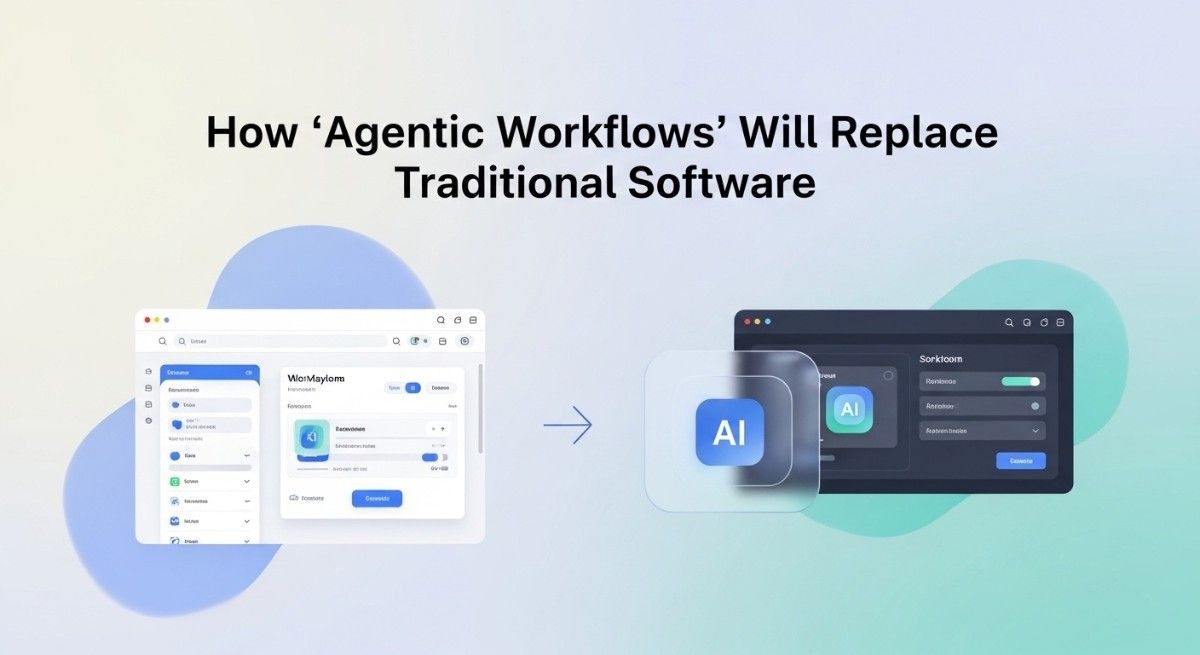
This is the age of agentic workflows replacing traditional software. The shift is not subtle. It is fundamental. It changes what software is, what it does, and what role humans play in the process.
Businesses that understand this shift will gain serious competitive advantages. They will automate complex processes that once required human judgment. They will build systems that improve over time without manual retraining. They will free their teams from repetitive decision-making.
Businesses that ignore this shift will fall behind. Their rigid, rule-based software will slow them down. Their competitors will move faster with smarter systems.
This blog breaks down what agentic workflows are, how they differ from traditional software, where they are already winning, and what the future looks like for companies ready to make the leap. If you want to understand why agentic workflows replacing traditional software is the defining tech story of this decade, keep reading.
Table of Contents
What Are Agentic Workflows?
An agentic workflow is a system where an AI agent pursues a goal autonomously. It does not just respond to a single input. It takes a series of actions, evaluates results, adjusts its approach, and continues until the goal is complete.
Think of a traditional software system. You ask it to send an email. It sends the email. Done. It does not check whether the email was appropriate for the context. It does not follow up if there is no reply. It does not adjust the tone based on the recipient’s previous responses.
An agentic system does all of that. It reads the context. It drafts the email. It sends it. It monitors the inbox. If no reply comes, it sends a follow-up. If the reply shows confusion, it clarifies. It keeps moving toward the goal without waiting for human instruction at each step.
The core building blocks of agentic workflows include planning, memory, tool use, and reflection. The agent plans a sequence of actions to reach a goal. It stores relevant information in memory. It uses external tools like APIs, databases, and search engines. It reflects on outcomes and adjusts.
This architecture is fundamentally different from traditional rule-based software. Traditional software follows a fixed script. Agentic systems write their own script based on the situation.
The rise of large language models made this possible. These models understand natural language, reason about complex situations, and generate coherent multi-step plans. When connected to external tools, they become capable agents rather than passive responders.
Agentic workflows replacing traditional software is not a distant forecast. Companies are deploying these systems right now across sales, operations, customer support, finance, and engineering.
How Traditional Software Works and Why It Falls Short
Traditional software is deterministic. It follows explicit rules. If this happens, do that. If that condition is met, execute this function. Every outcome is pre-programmed by a developer.
That model worked well for decades. Tasks were simple and repetitive. Conditions were predictable. Data was structured. Rules could cover most scenarios.
The business world has grown more complex. Data volumes exploded. Customer expectations shifted. Decision points multiplied. Rule-based systems began to crack under the weight of complexity.
Consider a customer service chatbot built on traditional software. It handles common queries well. Someone asks about their order status. The chatbot retrieves the data and responds. That works.
Now someone asks a nuanced question. They want to know whether a product will work with their existing setup, based on a complicated technical configuration. The traditional chatbot hits a wall. It was not programmed for that scenario. It either gives a wrong answer or escalates to a human.
An agentic system handles that query differently. It reads the customer’s message. It searches the product documentation. It checks compatibility databases. It drafts a clear, accurate answer. No human involvement required.
This gap is exactly why agentic workflows replacing traditional software is accelerating. Traditional software cannot handle ambiguity. It cannot reason. It cannot improvise. It fails whenever reality does not match the script.
There are other limitations too. Traditional software requires constant maintenance. Every new business rule needs a developer to code it. Every exception requires a patch. Every edge case demands a workaround. The backlog never ends.
Agentic systems adapt. They handle new scenarios without explicit reprogramming. A well-designed agent understands intent. It figures out how to act on that intent even in situations it has not seen before.
Scalability is another issue. Traditional software scales horizontally. You add more servers. You handle more requests. But you still need humans to handle the exceptions, edge cases, and complex decisions.
Agentic systems scale vertically. They take on more complexity without additional human oversight. That is a fundamentally different value proposition.
Key Industries Where Agentic Workflows Are Already Winning
Sales and Revenue Operations
Sales teams spend enormous amounts of time on non-selling activities. Researching prospects, drafting outreach emails, updating CRM records, scheduling follow-ups. These tasks consume hours every week.
Agentic systems handle all of it. They research prospects using web data and internal records. They draft personalized outreach. They send messages at optimal times. They log all activity automatically. Sales reps focus on conversations and closes.
Companies using agentic sales systems report higher outreach volume, better personalization, and shorter sales cycles. The agent does not get tired. It does not forget to follow up. It does not miss a prospect in the queue.
Agentic workflows replacing traditional software in sales is already delivering measurable ROI. This is not theoretical. Revenue teams at mid-market and enterprise companies are seeing real results.
Software Engineering and Development
Writing code is one of the most structured knowledge tasks. It follows logic, uses defined syntax, and produces testable outputs. That structure makes it ideal for agentic automation.
Agentic coding systems do more than autocomplete. They read a requirement, plan an implementation, write the code, run tests, fix errors, and submit a pull request. The human engineer reviews the output rather than doing the work from scratch.
This dramatically accelerates development cycles. Junior engineers become more productive. Senior engineers spend time on architecture and review rather than boilerplate code. Teams ship faster.
Finance and Accounting
Finance teams deal with high-volume, rule-heavy work. Invoice processing, expense categorization, reconciliation, reporting. Traditional software automates some of it. But exceptions still require human handling.
Agentic systems handle exceptions intelligently. They read an unusual invoice, cross-reference vendor contracts, flag discrepancies, and route for approval with a clear explanation. They do not just reject the invoice. They reason about it.
Agentic workflows replacing traditional software in finance reduces error rates and speeds up monthly close cycles. CFOs gain better visibility with less manual effort.
Customer Support and Success
Support teams face constant volume pressure. Tickets pile up. Resolution times stretch. Customer satisfaction drops.
Agentic support systems triage tickets intelligently. They resolve simple issues automatically. They gather context for complex issues before routing to a human. They follow up with customers after resolution. They identify churn signals and alert customer success managers.
This is a fundamentally different capability than a rule-based helpdesk system. The agent reasons about the customer’s situation. It acts accordingly.
Healthcare and Clinical Operations
Healthcare deals with enormous complexity and high stakes. Patient intake, record management, prior authorization, clinical decision support. Traditional software handles fragments of these workflows.
Agentic systems handle entire workflows end-to-end. They read patient records, check clinical guidelines, draft recommendations for physician review, and submit insurance paperwork. They reduce administrative burden on clinicians substantially.
The Technical Architecture Behind Agentic Workflows
The Role of Large Language Models
Large language models are the reasoning core of most agentic systems. They process natural language input, generate plans, evaluate options, and produce outputs. Without LLMs, true agentic behavior is not possible.
The quality of the LLM matters. Stronger models reason better. They handle ambiguity more effectively. They generate more coherent multi-step plans. Model selection is one of the most important decisions in building agentic systems.
Memory Systems and Context Management
Agents need memory. Short-term memory holds the context of a current task. Long-term memory stores information across sessions. Without memory, an agent cannot learn from past interactions or maintain context over time.
Memory architecture is still an active area of development. Vector databases enable semantic search over stored information. This lets agents retrieve relevant memories efficiently rather than scanning everything.
Tool Use and External Integrations
An agent without tools is limited to generating text. Real agentic power comes from connecting to external systems. Web search, APIs, databases, code interpreters, calendars, email, CRM platforms.
Tool use turns reasoning into action. The agent does not just think about what to do. It does it. That is the essential distinction between a chatbot and an agent.
Reflection and Self-Correction
Sophisticated agentic systems include reflection loops. After taking an action, the agent evaluates the result. Did it achieve the intended goal? If not, what went wrong? What should happen differently?
This self-correction capability is what separates mature agentic systems from simple automation. It is also what makes agentic workflows replacing traditional software such a compelling proposition. The system improves through use.
Challenges and Risks of Agentic Workflows
No technology shift is without risk. Agentic workflows introduce new challenges that companies must take seriously.
Reliability is the biggest concern. Agents can hallucinate. They can take incorrect actions based on flawed reasoning. In low-stakes environments, that is manageable. In high-stakes environments like finance or healthcare, it demands careful guardrails.
Companies building agentic systems need robust validation layers. Human review checkpoints matter for critical decisions. Monitoring systems need to flag anomalies quickly. Testing must cover edge cases aggressively.
Security is another challenge. Agentic systems have access to tools and data. A compromised agent can cause significant damage. Prompt injection attacks are a known vulnerability. Malicious input can hijack an agent’s actions.
Security teams must treat agents as privileged users. Access controls, audit logs, and sandboxing are essential. The attack surface of an agentic system is larger than traditional software.
Governance and accountability raise important questions. If an agent makes a bad decision, who is responsible? Organizations need clear policies. They need to know which decisions agents can make autonomously and which require human approval.
Explainability matters too. Traditional software decisions are traceable. Agentic decisions are harder to audit. Building transparency into agentic systems is not optional. It is a regulatory and ethical requirement in many domains.
Despite these challenges, the direction is clear. Agentic workflows replacing traditional software will continue. The risks are manageable. The benefits are transformative.
How Businesses Can Prepare for the Agentic Shift
Preparation starts with mindset. Leaders must stop thinking about software as a collection of tools. They must start thinking about intelligent systems that pursue business goals.
That shift changes how technology decisions get made. Instead of asking “what features does this software have,” the question becomes “what goals can this system pursue and how well does it pursue them.”
Practical preparation involves a few key steps.
Start with workflow mapping. Identify processes in your organization that involve repetitive decision-making. Look for tasks where a human reads information, applies judgment, and takes action. Those are prime candidates for agentic automation.
Invest in data infrastructure. Agentic systems depend on quality data. Clean, accessible, well-structured data makes agents more effective. Messy data limits what agents can do.
Build internal AI literacy. Your team needs to understand what agentic systems can and cannot do. They need to know how to work alongside agents. Training programs and hands-on experimentation build that literacy faster than lectures.
Choose the right use cases first. Not every workflow is ready for agentic automation. Start with contained, well-defined processes. Prove value. Build confidence. Expand from there.
Work with experienced partners. Building agentic systems requires specialized expertise. Partner with teams who have done it before. Leverage their experience to avoid common mistakes.
Agentic workflows replacing traditional software is happening with or without your company’s participation. The question is whether you lead that change or react to it.
What the Future Looks Like for Agentic Software
The trajectory is steep. Agentic systems are improving rapidly. Models get smarter. Tool ecosystems expand. Memory architectures mature. Multi-agent collaboration frameworks emerge.
In the near term, most companies will deploy agentic systems in isolated workflows. A sales agent here. A support agent there. An engineering assistant for a specific team. These point solutions will deliver clear value and build institutional confidence.
In the medium term, agents will begin to coordinate with each other. A sales agent will pass qualified leads to a customer success agent. An engineering agent will request resources from a procurement agent. Workflows will span departments without human handoffs.
In the long term, organizations will look fundamentally different. The ratio of human workers to automated agents will shift dramatically. Humans will focus on judgment, creativity, relationships, and oversight. Agents will handle execution, coordination, and repetitive decision-making.
This is not a dystopian scenario. It is a productivity revolution. Every significant technology shift has changed the nature of work. The industrial revolution. The personal computer. The internet. Each wave displaced some tasks and created new ones.
Agentic workflows replacing traditional software is the next wave. Companies and workers who adapt will thrive. Those who cling to old models will struggle.
The software industry itself will transform. Developers will build fewer traditional applications. They will design agentic architectures, define agent goals, build evaluation frameworks, and maintain orchestration layers.
FAQs: Agentic Workflows Replacing Traditional Software
What is the main difference between agentic workflows and traditional automation?
Traditional automation executes fixed rules. It does not reason. It does not adapt. Agentic workflows involve AI agents that plan, decide, and act autonomously. They handle ambiguity. They pursue goals rather than follow scripts.
Are agentic systems reliable enough for business use today?
Yes, with appropriate guardrails. Many companies already use agentic systems in production. The key is matching the agent’s autonomy level to the stakes of the task. Low-stakes workflows can run fully autonomously. High-stakes decisions benefit from human review checkpoints.
How long does it take to implement an agentic workflow?
Simple workflows can be operational in weeks. Complex, multi-system integrations may take several months. Timelines depend on data readiness, integration complexity, and the maturity of your internal AI capabilities.
Will agentic workflows eliminate jobs?
They will change jobs more than eliminate them. Routine, rule-based work will decrease. Tasks requiring judgment, creativity, and human relationships will grow in importance. Companies that use agentic systems effectively will create new roles around managing, evaluating, and improving those systems.
What industries are most impacted by agentic workflows replacing traditional software?
Sales, finance, customer support, software engineering, and healthcare are seeing the most immediate impact. Any industry with high-volume decision-making and structured data is a strong candidate for agentic transformation.
How do I know if my company is ready for agentic systems?
Look at your current workflows. If you have processes where humans make repetitive judgment-based decisions using structured data, you are ready to explore agentic automation. Starting with a pilot is the most practical path to understanding readiness.
Read More:-The Security Risks of Auto-GPT and How to Mitigate Them
Conclusion

Software is no longer just a tool. It is becoming a thinking, acting system that pursues goals on your behalf. That shift changes everything about how businesses operate, compete, and scale.
Agentic workflows replacing traditional software is not a trend to watch from a distance. It is a transformation already underway. Sales teams are moving faster. Engineering teams are shipping more. Finance teams are closing books quicker. Customer support teams are resolving issues at scale. All of this is happening because agentic systems can do what traditional software never could — reason, adapt, and act.
The companies pulling ahead are not waiting for the technology to mature further. They are learning by doing. They are identifying workflows, building pilots, measuring results, and scaling what works.
The risks are real. Reliability, security, and governance need serious attention. But those challenges are solvable. The organizations that solve them will unlock productivity gains that compound over time.
Traditional software will not disappear overnight. Rule-based systems will continue to serve narrow, well-defined tasks. But the center of gravity is shifting. Intelligence is becoming the baseline expectation, not the premium feature.
Agentic workflows replacing traditional software marks a new era in technology. The question for every business leader is not whether this shift will happen. It already is. The question is whether your organization will shape it or be shaped by it.
Choose to lead. Build the capability. Earn the advantage.