Introduction
TL;DR Lead qualification drains sales teams. Reps spend hours reviewing form submissions, scoring leads manually, and deciding who deserves a follow-up call. Most of that work does not require human judgment. It requires speed, consistency, and the ability to process large volumes of data fast.
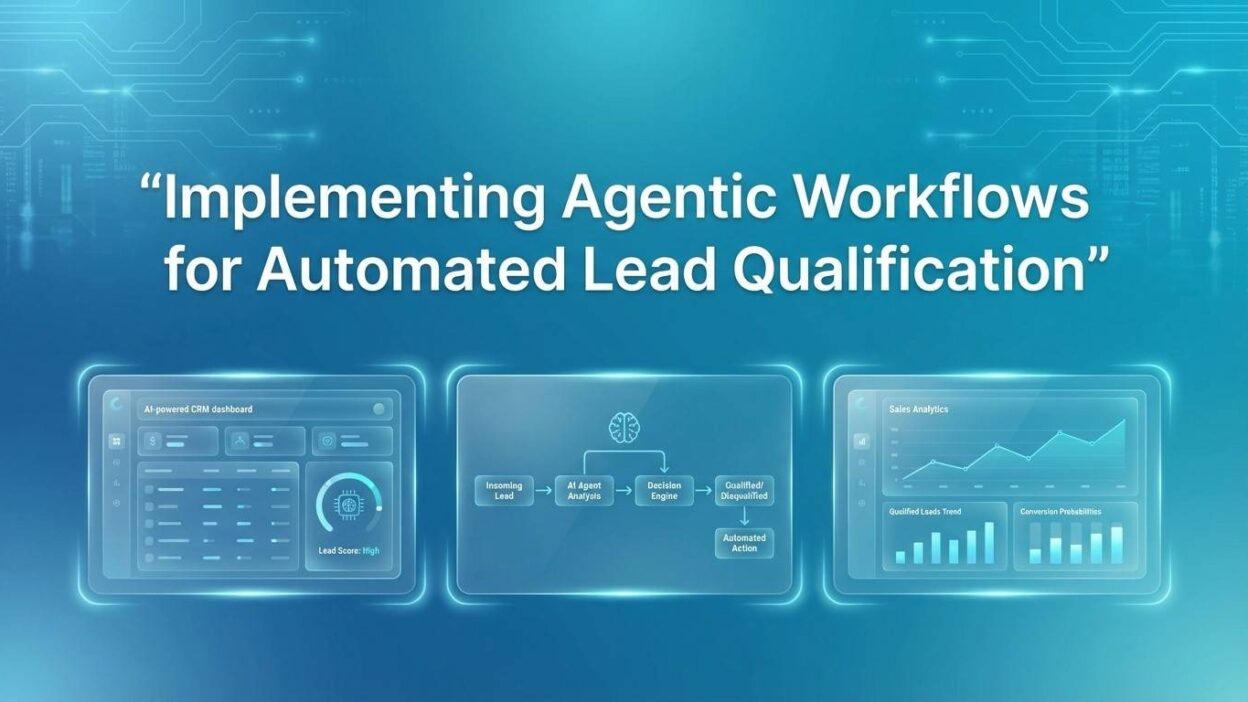
Agentic workflows for automated lead qualification solve this problem directly. An agentic workflow does not just follow a fixed script. It reasons, makes decisions, gathers information from multiple sources, and acts based on what it learns. Applied to lead qualification, it becomes a tireless system that evaluates every inbound lead the moment it arrives.
Sales teams that implement these workflows stop losing deals to slow follow-up. They stop wasting SDR time on leads that never convert. They route high-intent prospects to the right rep at the right moment — automatically, every time.
This blog covers the complete picture. You will learn what agentic workflows are, why they outperform traditional qualification methods, and exactly how to build one for your sales process. Every section delivers concrete, actionable detail rather than vague strategy.
Whether you manage a team of five reps or fifty, agentic workflows for automated lead qualification give you a compounding advantage. The system improves with every lead it processes. Let us walk through the full implementation from start to finish.
Table of Contents
What Are Agentic Workflows?
Agentic workflows represent a significant shift from traditional automation. Standard automation follows a fixed set of rules. If X happens, do Y. These rule-based systems break when conditions fall outside the predefined logic. They require constant manual updates as business conditions change.
An agentic workflow operates differently. An AI agent at the center of the workflow reasons about its task. It decides which actions to take, which tools to call, and in what order. It can loop back when it needs more information. It adapts its behavior based on what it finds during execution.
Think of an agentic workflow as the difference between a checklist and a skilled analyst. A checklist runs the same steps every time regardless of context. A skilled analyst reads the situation and applies judgment. Agentic workflows bring that analytical capability to automated systems.
For lead qualification specifically, this distinction matters enormously. Every lead is different. Job titles vary. Company contexts change. Intent signals appear in different places. A rule-based qualification system misses nuance. Agentic workflows for automated lead qualification catch that nuance by reasoning about each lead individually.
The core components of an agentic workflow are an LLM-powered reasoning engine, a set of tools the agent can call, a memory layer for context, and an orchestration layer that manages execution flow. These components work together to create a system that thinks, acts, and delivers results without human supervision.
Agentic workflows first gained serious traction in enterprise software development and customer support. Their application to lead qualification is newer but growing rapidly as sales teams discover the results they produce.
Why Traditional Lead Qualification Falls Short
Traditional lead qualification methods have clear, well-documented weaknesses. Understanding those weaknesses helps you appreciate what agentic workflows for automated lead qualification fix.
The Speed Problem
Speed-to-lead is one of the most studied metrics in sales research. Leads contacted within five minutes of submission convert at dramatically higher rates than leads contacted after an hour. Human SDRs rarely hit that five-minute window consistently. They are in calls, attending meetings, or simply off the clock.
Every hour of delay reduces lead conversion probability significantly. Inbound leads that wait 24 hours before contact convert at a fraction of the rate of leads contacted within minutes. Traditional qualification processes built around human review cannot solve this speed problem structurally.
The Consistency Problem
Human lead scoring is inconsistent. Two SDRs looking at the same lead often reach different conclusions. One focuses on job title. Another weighs company size more heavily. Moods, biases, and varying interpretations of qualification criteria create noise in the pipeline.
Noisy qualification means the pipeline data becomes unreliable. Sales managers cannot trust lead scores when they vary based on who scored them. Forecasting becomes guesswork. Resource allocation suffers.
The Volume Problem
High-growth companies generate more inbound leads than their SDR teams can process properly. Teams triage — they skim through leads quickly, making rough judgments under time pressure. Quality suffers when volume exceeds capacity.
Hiring more SDRs to match volume growth is expensive and slow. Training takes months. Turnover is high in SDR roles. Scaling human qualification linearly with lead volume is not a sustainable model.
The Data Completeness Problem
Form submissions rarely contain all the information needed for accurate qualification. A prospect submits their name, email, and company. Everything else requires research. SDRs either skip the research or spend 10–15 minutes per lead gathering context before making a qualification decision.
Agentic workflows for automated lead qualification pull that research automatically from multiple data sources. The agent enriches the lead profile before scoring it. Every qualification decision uses complete data — not just what the prospect typed into a form.
Core Components of an Agentic Lead Qualification System
Building agentic workflows for automated lead qualification requires assembling several technical components into one connected system. Each component plays a specific role.
The Reasoning Engine
The reasoning engine is the LLM at the center of the workflow. GPT-4o, Claude Sonnet, or a fine-tuned model reads the available lead data and decides what actions to take. The reasoning engine follows a system prompt that defines your ideal customer profile, qualification criteria, and scoring framework.
The quality of your system prompt directly determines the quality of qualification decisions. A vague prompt produces vague scores. A precise prompt that defines exactly what makes a lead qualified — company size range, decision-maker titles, specific pain indicators, technology signals — produces reliable, consistent scores that match your actual sales process.
The Data Enrichment Layer
Raw form data is never enough for accurate qualification. The enrichment layer pulls additional context about each lead from external sources. Company firmographics come from Clearbit or Apollo. LinkedIn profile data adds seniority and career history context. Recent company news comes from web search. Technology stack data comes from BuiltWith or Wiza.
The agent calls these enrichment tools automatically for every lead. It builds a complete prospect profile before making any qualification judgment. This enrichment step is one of the most valuable parts of agentic workflows for automated lead qualification because it removes the research burden from human SDRs entirely.
The Scoring and Decision Engine
After enrichment, the agent evaluates the lead against your qualification framework. It assigns scores across multiple dimensions — fit score, intent score, timing score, and authority score. It combines these into a composite qualification score.
The agent also makes a binary routing decision. Qualified leads get routed to the appropriate sales rep based on territory, vertical, or deal size. Unqualified leads enter a nurture sequence. Borderline leads get flagged for human review. This decision logic runs automatically for every lead without exception.
The Action Layer
Qualification alone is not enough. The agent must act on its decision. The action layer connects the reasoning engine to your CRM, your email platform, your calendar scheduling tool, and your Slack or communication system.
A qualified lead triggers automatic CRM record creation with enriched data pre-populated. It sends a personalized outreach email immediately. It notifies the assigned rep in Slack with the qualification summary. For very high-intent leads, it can trigger a direct calendar booking sequence. Every action happens within seconds of the lead arriving.
The Memory and Context Layer
Some lead qualification scenarios require multi-touch context. A prospect who visited your pricing page three times, downloaded two whitepapers, and then submitted a contact form needs a different treatment than someone who submitted a form with no prior engagement.
The memory layer stores interaction history and enriches the agent’s context during qualification. The agent reads behavioral signals alongside firmographic data. It weighs recent high-intent behavior as a strong qualification indicator. This context-aware scoring is something rule-based systems fundamentally cannot replicate.
Step-by-Step Implementation Guide
Implementing agentic workflows for automated lead qualification follows a structured sequence. Skipping steps creates gaps that show up as errors in production. Follow this sequence for a reliable, production-ready build.
Define Your Ideal Customer Profile in Detail
The agent needs explicit qualification criteria. Start by documenting your ICP with precision. Define the exact company size ranges that qualify. List specific job titles that indicate decision-making authority. Identify industries where your product delivers the most value. Note technology stack indicators that signal fit.
Also define disqualifying characteristics. Company sizes too small to afford your product. Industries with regulatory barriers. Geographic regions outside your service area. The agent uses both sides of this definition — positive qualifiers and negative disqualifiers — to make accurate decisions.
Write this ICP definition as a structured document, not as a loose description. The agent’s system prompt will reference these criteria directly. Precision in the ICP document translates directly to precision in qualification decisions.
Set Up Your Data Enrichment Pipeline
Choose your enrichment data sources based on your ICP characteristics. B2B companies typically need company firmographics, contact seniority data, and technology stack information. Specific verticals may need additional sources — real estate companies need location data, e-commerce companies need platform data.
Connect these sources through their APIs or through an aggregation platform like Clay. Clay’s waterfall enrichment model tries multiple data sources in sequence and returns the first successful result. This approach maximizes data completeness while minimizing cost.
Test your enrichment pipeline with 20–30 sample leads before connecting it to your agent. Verify that the data returned matches what your qualification criteria actually need. Fix data gaps before building the rest of the workflow.
Build the Agent Reasoning Logic
Write your system prompt with the precision your ICP document provides. Structure the prompt to define the agent’s role, the qualification framework it follows, the scoring scale it uses, and the output format it must return.
Use a structured output format. JSON works well here. Define fields for fit score, intent score, authority score, composite score, qualification decision, routing assignment, and a brief qualification rationale. The rationale field is important — it gives sales reps context about why a lead was scored the way it was.
Test the agent reasoning logic with real historical leads. Compare the agent’s qualification decisions against decisions your best SDRs made on the same leads. Tune the system prompt until alignment exceeds 85%. Gaps between agent and human decisions usually point to missing context in the enrichment pipeline or ambiguity in the ICP definition.
Connect Your CRM and Outreach Tools
Use a workflow automation platform — Make.com, n8n, or Zapier — to connect the agent to your CRM and outreach tools. When the agent returns a qualification decision, the workflow reads the decision and triggers the appropriate actions.
For qualified leads, the workflow creates or updates the CRM record with enriched data, assigns the lead to the correct rep, sends the initial outreach email, and posts a notification to the rep’s Slack channel. For unqualified leads, the workflow adds the contact to a nurture sequence. For borderline leads, the workflow creates a CRM task flagging the lead for manual review.
Map every possible qualification outcome to a specific set of actions before you build the workflow. Ambiguous routing logic causes leads to fall through cracks.
Implement Monitoring and Quality Control
Agentic workflows for automated lead qualification require ongoing monitoring. Set up a dashboard that tracks qualification volume, decision distribution (qualified vs unqualified vs borderline), enrichment success rates, and routing accuracy.
Review a sample of agent decisions weekly during the first month. Compare agent decisions to what your best SDRs would have decided. Capture disagreements in a review log. Patterns in those disagreements point to specific improvements in the system prompt or enrichment pipeline.
Tools and Technology Stack
The right technology stack makes implementation faster and the system more reliable.
Orchestration and Workflow Tools
n8n is the strongest choice for teams that want full control and self-hosted deployment. Its visual workflow editor makes complex logic readable. It supports custom code nodes for agent integration. Make.com offers faster setup with a large library of pre-built integrations. Both platforms handle the trigger-action logic that connects your agent to external systems.
For the agent reasoning layer, frameworks like PydanticAI or LangGraph handle LLM interactions with structured outputs. PydanticAI ensures the agent always returns data in your defined schema. This output reliability is critical in production qualification workflows.
Data Enrichment Platforms
Clay handles enrichment from dozens of sources through a single interface. Its waterfall enrichment model maximizes data completeness automatically. Apollo.io provides strong firmographic and contact data for B2B qualification. Clearbit offers real-time enrichment via API for instant lead processing.
CRM and Sales Engagement Platforms
HubSpot, Salesforce, and Pipedrive all offer APIs for programmatic record creation and updating. Choose the platform your sales team already uses. Your agentic workflow should write to that system, not force a migration.
For outreach execution, Instantly and Smartlead handle email sending with proper deliverability infrastructure. These platforms accept API-triggered sends, making them easy to connect to your qualification workflow.
LLM Providers
GPT-4o offers the best balance of reasoning capability and speed for qualification tasks. Claude Sonnet 3.5 handles nuanced reasoning well and produces reliable structured outputs. For high-volume qualification at lower cost, GPT-4o-mini handles straightforward qualification decisions accurately at a fraction of the full model cost.
Common Implementation Mistakes
Most teams make predictable mistakes when building agentic workflows for automated lead qualification. Knowing these mistakes early saves weeks of rework.
Vague ICP Definitions
The most common mistake is starting with an ICP definition that is too loose. “Mid-market B2B companies with sales teams” is not precise enough for reliable agent scoring. “Companies with 50–500 employees, SaaS or tech-enabled services, with dedicated SDR teams, using Salesforce or HubSpot” gives the agent concrete criteria to evaluate.
Every ambiguity in your ICP becomes variability in your qualification decisions. Spend time tightening your ICP definition before writing a single line of code.
Skipping Enrichment Validation
Teams sometimes build the agent reasoning layer before properly testing the enrichment pipeline. The agent then makes decisions based on incomplete data. Enrichment gaps produce poor qualification accuracy. Always validate enrichment coverage before testing agent logic.
No Human Review Loop
Fully automated routing sounds ideal. But every qualification system has edge cases. A human review loop for borderline scores (typically the middle 20% of your scoring range) catches leads that the agent handles inconsistently. This review loop also generates training data for improving the system prompt over time.
Ignoring Feedback From Sales Reps
Sales reps know quickly whether the leads they receive are truly qualified. Build a simple feedback mechanism — a Slack reaction, a CRM field, or a quick form — that lets reps mark leads as accurately or inaccurately qualified. That feedback is your most valuable signal for improving agentic workflows for automated lead qualification over time.
Measuring the Impact of Your Agentic Qualification System
Measurement validates whether the investment delivers real results. Track these specific metrics to evaluate your system’s impact.
Qualification Accuracy Rate
Compare agent qualification decisions against ground truth outcomes. A lead the agent marked qualified that converted to a customer counts as a true positive. A lead the agent marked qualified that never responded counts as a false positive. Track qualification accuracy as true positives divided by total qualified leads. Aim for 75% or higher accuracy before scaling.
Speed-to-Lead Improvement
Measure the average time between lead submission and first meaningful outreach before and after implementing agentic workflows for automated lead qualification. Most teams see this metric drop from hours to minutes. Document this improvement in concrete numbers — it justifies the build investment clearly.
SDR Time Reallocation
Track how many hours per week SDRs previously spent on manual qualification research and outreach prep. After implementation, those hours should shift to actual sales conversations, discovery calls, and deal advancement. This reallocation is often the most compelling metric for sales leadership.
Pipeline Quality Improvement
Measure deal velocity, average deal size, and win rate for leads that came through the agentic qualification system versus leads that came through your previous process. Improved pipeline quality manifests as higher win rates and faster sales cycles. These are the metrics that earn executive support for expanding the system.
Advanced Capabilities to Add Over Time
A baseline agentic workflows for automated lead qualification system delivers immediate value. These advanced capabilities increase that value further as the system matures.
Intent Signal Monitoring
Connect your qualification agent to intent data platforms like Bombora or G2. These platforms track when companies research topics related to your product category across the web. When a target account shows high intent signals, the agent triggers proactive outreach before a form submission even occurs. This outbound intent-based qualification adds a powerful top-of-funnel layer.
Conversational Qualification via AI Chat
Deploy an AI chat agent on your website that qualifies visitors in real time through natural conversation. The conversational agent asks qualification questions, gathers context, and scores the lead during the chat session. High-scoring conversations trigger immediate routing to a live rep or a direct calendar booking. This capability shortens the qualification cycle to real time for website visitors.
Multi-Touch Lead Scoring
Enhance the base qualification score with behavioral signals over time. Each touchpoint — email open, link click, page visit, content download — updates the lead score dynamically. The agent re-evaluates leads periodically as new behavioral data accumulates. Leads that initially did not qualify get re-evaluated when their behavioral score crosses a threshold. This dynamic scoring recovers leads that static qualification systems permanently discard.
Frequently Asked Questions
What are agentic workflows for automated lead qualification?
They are AI-powered systems that use reasoning agents to evaluate, score, and route inbound leads without human involvement. The agent gathers data from multiple sources, applies your qualification criteria, assigns a lead score, makes a routing decision, and triggers downstream actions in your CRM and outreach tools — all automatically and within seconds of a lead arriving.
How accurate are agentic systems at qualifying leads?
Well-built systems reach 75–85% qualification accuracy compared to experienced human SDRs on the same leads. Accuracy depends heavily on the quality of your ICP definition and the completeness of your enrichment data. Teams that invest time in precise ICP documentation and thorough enrichment pipeline testing consistently achieve higher accuracy rates.
How long does it take to build and deploy an agentic qualification workflow?
A basic version takes two to four weeks to build and test. That includes ICP documentation, enrichment pipeline setup, agent prompt engineering, CRM integration, and initial accuracy testing. Full production deployment with monitoring and quality control typically takes four to six weeks total. Ongoing tuning continues for the first 60–90 days as the system encounters the full diversity of real leads.
Does implementing agentic workflows replace my SDR team?
Agentic workflows for automated lead qualification replace the research and scoring tasks that SDRs perform — not the relationship and conversation work. SDRs freed from qualification research spend more time on discovery calls, relationship building, and deal advancement. Most teams see SDR productivity increase significantly after implementation rather than headcount decrease.
What CRM systems work with agentic qualification workflows?
Salesforce, HubSpot, Pipedrive, and most modern CRMs expose API endpoints that workflow automation tools connect to directly. The agentic system writes qualified lead data to whichever CRM your team uses. CRM choice does not limit your ability to implement an agentic qualification workflow.
How do you handle data privacy in an agentic qualification system?
Use data enrichment providers that comply with GDPR and CCPA. Store enriched lead data only in systems that your privacy policy covers. Build opt-out handling into the workflow so that leads who request data removal get processed immediately. Consult your legal team before deploying enrichment pipelines that process European or California resident data.
Read More:-Why Enterprises Are Moving Away from ChatGPT to Specialized LLMs
Conclusion
Agentic workflows for automated lead qualification represent a genuine step change in how sales teams manage their pipeline. The old model — humans manually reviewing, researching, and scoring leads — cannot keep pace with inbound volume, cannot maintain scoring consistency, and cannot respond at the speed modern buyers expect.
The agentic model fixes each of these weaknesses systematically. Every lead gets evaluated immediately. Every evaluation uses complete, enriched data. Every qualification decision follows a consistent framework. Every qualified lead gets routed to the right rep with full context pre-populated.
The build process requires upfront investment. A precise ICP definition, a tested enrichment pipeline, a well-crafted agent prompt, and reliable CRM integrations all need careful attention. That investment pays back quickly when qualified meetings start filling rep calendars without manual effort from your team.
Start with a narrow scope. Build the qualification agent for one lead source — your primary inbound form. Get it working reliably with strong accuracy metrics before expanding to other lead sources. Scale what works.
The sales teams that adopt agentic workflows for automated lead qualification today build a compounding advantage. Their system processes more leads with each passing month. Their qualification accuracy improves with each iteration. Their SDRs focus on selling rather than sorting.
That is the ultimate value of agentic qualification. It does not just save time. It fundamentally reallocates your team’s energy toward the work that actually closes deals.